


16th Century
Ranjha, a hero of lovers and rebels, emerges as a symbol of resistance against materialism and false values during a period of popular awakening.
Book Podcast
Book Profile
پاکستان؛ بیثباتی نهادی و توسعهنیافتگی
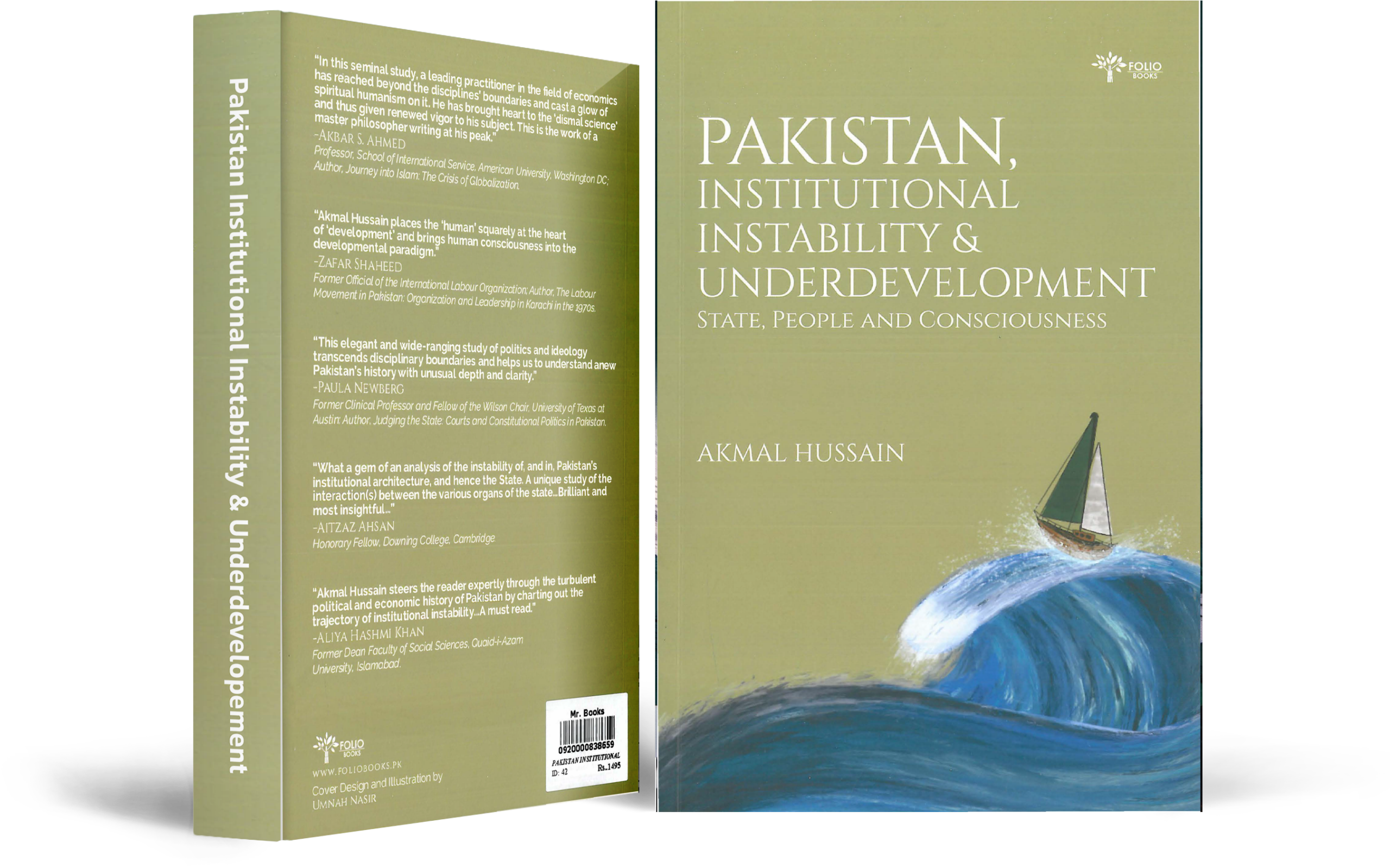
Compiler & Author: Akmal Hussain
This book offers an in-depth analysis of the roots of institutional instability and underdevelopment in Pakistan. Akmal Hussain examines how weak political and economic institutions, a disconnect between state and society, and entrenched historical power structures have undermined sustainable development. By linking politics, economics, and social consciousness, the author argues that development is not merely technical or economic but requires institutional reform, changes in values, and inclusive governance. The book highlights the role of people, human capital, and institutional transformation as pathways out of chronic instability.
Ranjha, a hero of lovers and rebels, emerges as a symbol of resistance against materialism and false values during a period of popular awakening.
Sultan Bahu, a Sufi poet, highlights the role of the 'call of the heart' in social transformation and self-realization.
Peasant uprisings in Punjab overthrow Mughal aristocracy, leading to the rise of new agricultural elites from the upper peasant classes.
1858: New landed elites assist the British in suppressing the armed rebellion of 1857-58, strengthening political alliances with the British Raj.
The development of the canal irrigation system by the British government and agricultural colonization leads to unprecedented rent generation for new agricultural elites.
Supportive laws for landowners, such as the Land Allocation Act, are enacted.
Allama Muhammad Iqbal, in his presidential address at the 25th session of the All-India Muslim League, presents his vision of Islam as a state based on a moral contract.
The Lahore Resolution of the All-India Muslim League, endorsed by Muhammad Ali Jinnah, emphasizes the principles of freedom, equality, and social justice as the foundations of an independent state.
Muhammad Ali Jinnah, at the 30th session of the All-India Muslim League, emphasizes the importance of combating exploitation and inequality.
1946: Pre-independence elections: Bengalis overwhelmingly vote for the Muslim League (95% of Muslim seats in East Bengal, 85% in Punjab).
Muhammad Ali Jinnah, in his presidential address to Pakistan's first Constituent Assembly, emphasizes legislative sovereignty and the principles of freedom and justice.
Independence of Pakistan. The leadership faces three challenges: fostering nationalism, drafting a constitution based on unity and freedom, and replacing the colonial economy with new structures.
Muhammad Ali Jinnah, in a radio address to the people of the United States, emphasizes the principles of democracy, equality, and social justice rooted in Islam.
Muhammad Ali Jinnah reaffirms the principles of social justice, equality, and fraternity as the foundations of Pakistan at a public gathering in Chittagong.
Muhammad Ali Jinnah, at the inauguration of the State Bank of Pakistan, emphasizes the need for an economic system based on Islamic equality and social justice, criticizing the adoption of Western economic theories.
After his death, coalition elites (bureaucratic-military-landlord) dominate the power structure, ignoring Jinnah's vision.
The beginning of the 'Language Movement' in East Bengal, leading to increased political and cultural tensions between East and West Pakistan.
Khawaja Nazimuddin from East Bengal presents constitutional proposals in the Basic Principles Committee report, facing opposition from the Finance and Interior Ministers from Punjab.
In the East Bengal elections, the Muslim League secures only 3% of the seats, while the Bengali nationalist United Front coalition wins 72% of the seats.
The Governor-General issues an order merging the four provinces of West Pakistan into a single unit (One Unit). This move centralizes power in the central government and establishes governance based on the principle of 'parity' between the two wings.
The Sindh High Court rules that the Governor-General does not have the authority to dissolve the Constituent Assembly (Maulvi Tamizuddin case).
The Supreme Court overturns the Sindh High Court's ruling, arguing that the Sindh Court lacked jurisdiction over the case. This sets a precedent for justifying future military interventions.
The 1956 Constitution is enacted, but due to conflicts between provincial politicians and the center, it lasts only two years. The constitution was designed based on 'parity' of seats between East and West Pakistan, rather than population-based representation.
General Ayub Khan, the Commander-in-Chief of the Pakistan Army, seizes power through a coup and abolishes the 1956 Constitution.
The 1962 Constitution is promulgated by Ayub Khan's military regime.
A significant decline in foreign capital inflow after the 1965 war.
A widespread popular movement against Ayub Khan's government begins. The killing of protesting students in Rawalpindi by police sparks this movement.
The 1962 constitution of Ayub Khan is overthrown by a widespread popular movement in 1968.
1970: Severe poverty in rural areas (59.7% below the poverty line) and urban areas (58.7% below the poverty line).
General Yahya Khan holds general elections. The Awami League led by Sheikh Mujibur Rahman wins decisively in East Bengal, and the Pakistan People's Party led by Mr. Bhutto wins in West Pakistan.
The Awami League plans to confront the military.
General Yahya Khan orders General Tikka Khan, commander of East Pakistan, to prepare for military action.
Bangladesh flags are widely displayed in Dhaka, indicating the declaration of independence by the people of East Bengal.
Operation Searchlight is launched by the Pakistan Army, leading to widespread military suppression across East Bengal and the start of the civil war.
Civil war in East Bengal (East Pakistan).
Bhutto's government releases leftist activists and announces new labor policy, but worker protests continue.
Adoption of the 1973 Constitution, the first unanimously passed by the elected parliament, incorporating principles of federal parliamentary democracy.
1975: Increase in defense and public spending to 6.7% and 1.8% of GDP, respectively.
Nationalization of small and medium-sized food industries, causing discontent among the middle classes.
Allegations of election fraud by opposition parties against Bhutto's government lead to widespread street protests.
General Zia-ul-Haq overthrows Zulfiqar Ali Bhutto's government in a coup and suspends the 1973 Constitution.
The Supreme Court justifies Zia-ul-Haq's coup under the "doctrine of necessity."
General Zia-ul-Haq introduces Sharia laws (Hudood), including amputation and stoning.
Pakistan acts as a frontline state in the Afghan war against Soviet forces.
Osama bin Laden and Abdullah Azzam arrive in Pakistan to recruit Middle Eastern youth for 'jihad'.
Soviet forces withdraw from Afghanistan, marking a historic victory for militants supported by Pakistan and the United States.
General Zia-ul-Haq dismisses Prime Minister Junejo's government citing Article 58(2)(b) of the Constitution.
1990: Benazir Bhutto's government. Tensions with President Ishaq Khan and Army Chief General Aslam Beg over authority.
President Ishaq Khan dismisses Benazir Bhutto's government citing Article 58(2)(b) of the Constitution.
President Ishaq Khan and the military conspire to financially support the IJI coalition against Benazir Bhutto.
1993: Nawaz Sharif's government. Tensions with President Ishaq Khan over powers.
President Ishaq Khan dismisses Nawaz Sharif's government, but the Supreme Court overturns the decision and reinstates Nawaz Sharif.
Benazir Bhutto becomes Prime Minister for the second time.
President Farooq Leghari dismisses Benazir Bhutto's government due to corruption and undermining the judiciary's independence.
Chief Justice Sajjad Ali Shah suspends the 14th Amendment, restoring the President's power to dissolve the National Assembly.
Nawaz Sharif, after winning a decisive majority in elections, passes the 13th Amendment, removing the President's power to dissolve the Assembly.
Historic visit of Indian Prime Minister Atal Bihari Vajpayee to Lahore for peace talks with Nawaz Sharif's government.
Nawaz Sharif orders the withdrawal of Pakistani forces after escalating conflicts in Kargil and fears of nuclear war.
General Pervez Musharraf overthrows the elected government of Prime Minister Nawaz Sharif in a coup, suspending the constitution. He declares himself as 'Chief Executive'.
The Supreme Court declares Pervez Musharraf's coup legal, citing the 'doctrine of necessity' and the principle 'Salus populi suprema lex' (the welfare of the people is the supreme law).
The Supreme Court legitimizes the coup under the 'doctrine of necessity' and grants Musharraf extensive legislative powers.
The September 11 terrorist attacks in the United States.
Supporting certain militant groups in Afghanistan while cooperating with the US against others.
General Pervez Musharraf holds a "dubious" referendum claiming 98% of the vote.
General Musharraf issues the "Legal Framework Order" (LFO), restoring Article 58(2)(b) of the Constitution, granting the President powers to dissolve the National Assembly.
Pervez Musharraf identifies the Taliban as the main threat to Pakistan's security.
Revival of the Constitution (with Musharraf's amendments).
By 2011: Terrorism results in the death of 35,000 Pakistani citizens and economic damage of $68 billion.
Taliban suicide attack on Bari Imam shrine in Islamabad.
Pervez Musharraf suspends Chief Justice Iftikhar Muhammad Chaudhry.
Police attack protesting lawyers at Lahore High Court.
Violent clash between supporters and opponents of the Chief Justice in Karachi, resulting in 39 deaths.
Bomb explosion outside Islamabad district court coinciding with a scheduled speech by Iftikhar Muhammad Chaudhry.
The Supreme Court rules that the suspension of Iftikhar Muhammad Chaudhry by the President was illegal and reinstates him. This is seen as a major victory for the 'Lawyers' Movement'.
Pervez Musharraf declares a state of emergency, suspends the constitution, and dismisses Iftikhar Muhammad Chaudhry and other judges. This leads to a 'coup within a coup' and a new phase of the 'Lawyers' Movement'.
Benazir Bhutto, former Prime Minister of Pakistan, is assassinated in a terrorist attack after returning to the country.
Explosion at the Naval War College in Lahore and a suicide attack on the Federal Investigation Agency (FIA) building in Lahore.
General Kayani, the Army Chief, issues a joint statement with Prime Minister Yousaf Raza Gillani emphasizing the importance of judicial independence. This leads to the reinstatement of Iftikhar Muhammad Chaudhry as Chief Justice.
Terrorist attack on the General Headquarters (GHQ) in Rawalpindi.
Adoption of the 18th Constitutional Amendment restoring the powers of the Prime Minister and reducing the powers of the President.
Memogate: Mansoor Ijaz, a Pakistani-American businessman, reveals a secret memo from a Pakistani official to Admiral Mike Mullen, Chairman of the US Joint Chiefs of Staff, proposing a restructuring of Pakistan's security framework in favor of the US.
Militants launch a major attack on the Mehran naval base in Karachi.
All Parties Conference (APC) led by Nawaz Sharif passes a resolution to start negotiations with militant groups (Taliban).
Militants launch a coordinated attack on Karachi's international airport.
The army launches Operation Zarb-e-Azb in North Waziristan, the largest counter-insurgency operation in Pakistan's history.
Brutal massacre of students and teachers at an army-run school in Peshawar by TTP militants.
Approval of the Constitution (21st Amendment) and the Pakistan Army Act 2015, establishing military courts to try civilians accused of terrorism.
Taliban attack on a Shia mosque in Peshawar.
Asif Ali Zardari, co-chairman of the Pakistan People's Party, threatens to expose "many abuses by generals" in the army.
Militant attack on the Minhas Pakistan Air Force base in Kamra.
Dawn Leaks: The Dawn newspaper publishes a report on a secret security meeting between Nawaz Sharif's government and military officials, highlighting the government's concerns about Pakistan's diplomatic isolation due to support for militant groups.
Increase in public external debt from $14.19 billion in 1989 to $75.36 billion.

AI Assistant
Fast and reliable answers