


1921
The Council on Foreign Relations (CFR) was established.
Book Podcast
Book Profile
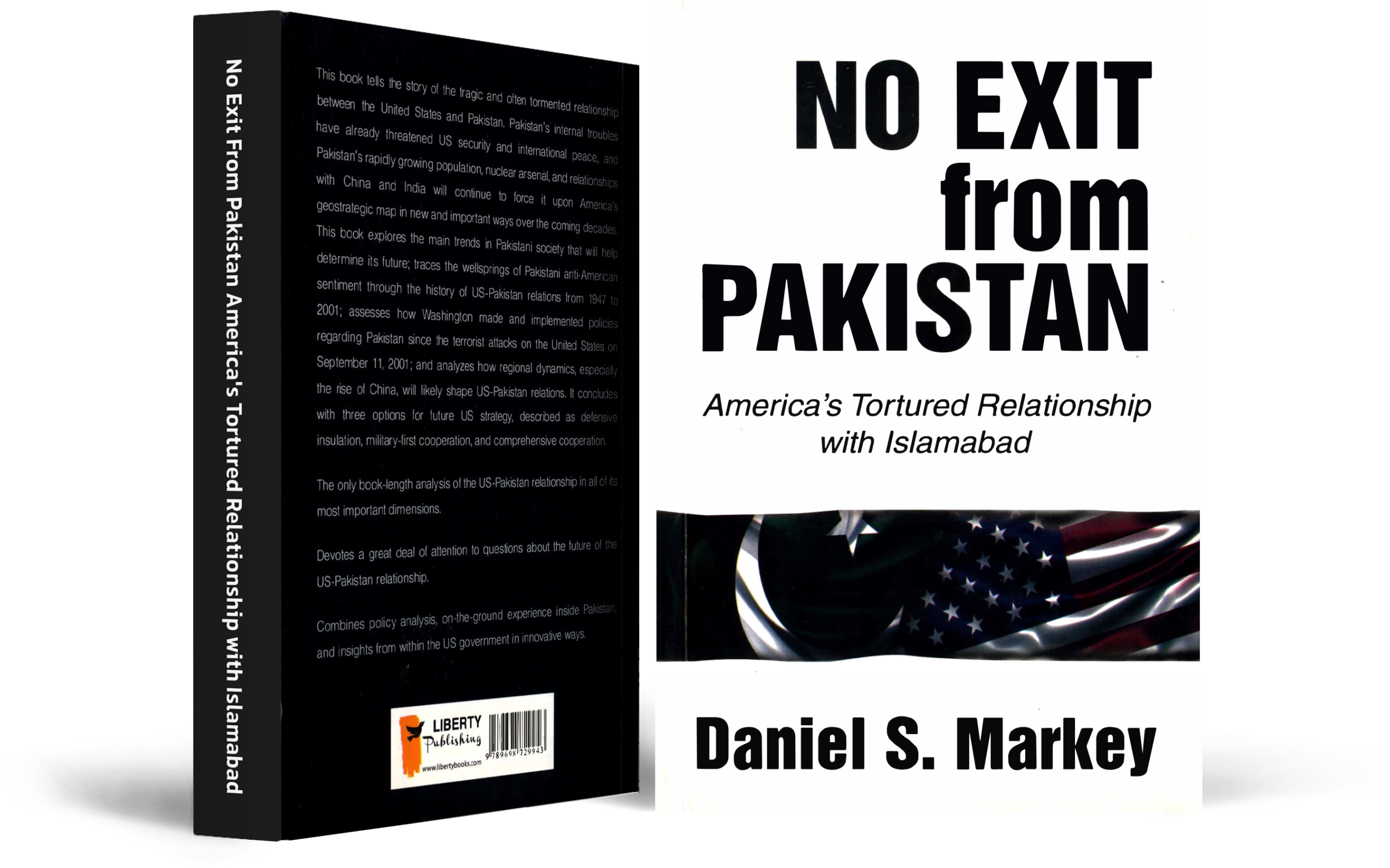
راه خروجی از پاکستان نیست: رابطه پرتنش آمریکا با اسلامآباد
Compiler & Author: Daniel S. Markey
The book examines the complex and often turbulent relationship between the United States and Pakistan, beginning in 1947 and continuing through the aftermath of the September 11, 2001 attacks. The author emphasizes that Pakistan’s internal challenges, its expanding nuclear arsenal, and its relations with regional powers such as China and India make it a vital geostrategic actor for U.S. security and global peace. The book analyzes major trends in Pakistani society, traces the roots of anti-American sentiment throughout the history of U.S.–Pakistan relations, evaluates Washington’s policymaking toward Pakistan after 9/11, and examines regional dynamics, particularly the rise of China, in shaping these relations. In conclusion, it presents three strategic options for the future of U.S. policy toward Pakistan: defensive isolation, military-first cooperation, and comprehensive engagement. The book aims to show how Washington can prepare for the worst-case scenario, strive for the best outcome, and avoid past mistakes.
The Council on Foreign Relations (CFR) was established.
General Zia-ul-Haq was born.
Sartre's "No Exit" premiered in Paris.
The United States supported its allies against the Soviet Union without deploying its own military forces.
Richard Armitage was born.
Muhammad Ali Jinnah emphasized the rights of all citizens regardless of religion in his speech to Pakistan's Constituent Assembly.
Pakistan separated from India.
Average wages in Pakistan increased fivefold.
Pakistan produced enough wheat, rice, sugar, and milk for its population.
Pakistan joined the US global effort to contain the Soviet Union.
Hafiz Muhammad Saeed was born.
As a young officer in Pakistan, General Mirza Aslam Beg joined the newly formed Pakistan Special Services Group and trained in guerrilla warfare with American forces.
A.Q. Khan moved to Pakistan.
A.Q. Khan began stealing designs and equipment for Pakistan's nascent nuclear program.
Secretary of State Dulles highlighted the need for collective security in his Foreign Affairs article.
The United States and Pakistan officially signed a mutual assistance agreement.
John Foster Dulles was named "Man of the Year" by Time.
The United States announced a new South Asia strategy.
The Eisenhower administration agreed to equip five and a half divisions of the Pakistani army with over $500 million.
Ms. Hashmi was born in Pakistan.
The Acumen Fund was established.
General Ayub Khan became Pakistan's first military dictator.
The Karakoram railway was inaugurated.
The Tarbela Dam project was constructed with substantial US financial aid.
Nikita Khrushchev delivered a secret speech on "small wars of liberation."
Kennedy asked the Pentagon to "reassess its entire defense strategy."
Kennedy requested $500 million in economic aid for India.
The Cuban Missile Crisis occurred.
The Sino-Indian border war began.
The Johnson administration seriously considered collaborating with Moscow to counter China.
The Indo-Pakistani War began.
Ayub Khan severed ties with Bhutto.
A B-52 bomber crashed off the coast of Spain with four hydrogen bombs.
Ayub Khan was ousted by a protest movement that called him an 'American puppet'.
The Pakistan People's Party (PPP) was founded from scratch by Bhutto.
Kissinger's secret mission to China was facilitated by Pakistan's assistance.
The war between East and West Pakistan led to Bangladesh's independence.
A.Q. Khan worked at a facility dedicated to uranium enrichment.
A.Q. Khan fled from the Netherlands to Pakistan, and Bhutto put him in charge of Pakistan's nuclear program.
India conducted its first "peaceful nuclear explosion."
Richard Armitage led a convoy of ships that transported over 20,000 South Vietnamese to the Philippines.
Zia-ul-Haq removed Bhutto from power.
The US Embassy in Islamabad was attacked and set on fire by radical protesters.
Bhutto was executed.
The Iranian Revolution took place.
A.Q. Khan criticized US hypocrisy on nuclear programs in a letter to a German magazine editor.
The Soviet Union invaded Afghanistan.
Beg served as the commander of the XI Corps in Peshawar.
The US Congress passed a law requiring the President to certify annually that Pakistan did not possess a nuclear device.
Saeed and sixteen others founded an organization to promote the Ahl-e-Hadith ideology and jihad.
The infant mortality rate in northern areas and Chitral communities with active Rural Support Programs (RSP) decreased from 162 per 1000 to 33 per 1000.
Beg was promoted to Deputy Chief of Army Staff.
Hamid Gul was the head of ISI.
Zia-ul-Haq died in a suspicious air crash.
Beg immediately took on the most powerful job in the country.
The Berlin Wall fell.
Lashkar-e-Taiba (LeT) was officially established.
The United States imposed sanctions on Pakistan for developing a nuclear bomb.
India experienced an average annual real economic growth of 6.6%.
India and Pakistan engaged in 'composite dialogue' between foreign ministries and a secret channel between Tariq Aziz and Indian envoys.
India removed some internal barriers to economic success.
The United States refused to sell F-16 aircraft to Pakistan.
Per capita real income in RSP communities grew by an average of 84%.
Imran Khan became the captain of Pakistan's national team in the Cricket World Cup.
India finalized a civilian nuclear project with the United States.
Powell published his memoirs.
Roshaneh Zafar founded Kashf, Pakistan's first microfinance bank.
Pakistan and India conducted their nuclear weapons tests.
The Pakistani Navy and PRAM participated in joint exercises.
John Schmidt served as the U.S. political advisor in Islamabad.
Pervez Musharraf overthrew Prime Minister Nawaz Sharif in a military coup.
The Kargil War between India and Pakistan began.
The U.S. missile strike on Bin Laden's training camp in Afghanistan failed.
China began establishing databases in Pakistan.
A US EP-3 reconnaissance plane violated Chinese airspace and crashed.
US forces negotiated with the Taliban in Kandahar.
Terrorist attacks occurred in the United States.
Pakistan became a "frontline ally" of the US in the "Global War on Terrorism."
ISI expanded its counter-terrorism cooperation with the CIA and FBI.
The US resumed military and civilian aid programs to Pakistan.
The US asked Mahmood to choose between the US and the terrorists.
Pakistan closed the Afghan border and allowed US forces to enter its territory.
A terrorist attack occurred at the Indian Parliament building in New Delhi.
The US failed to close the Afghan border and trap Al-Qaeda in Tora Bora.
The US forgave $1.6 billion of Pakistan's debt.
Lashkar-e-Taiba was officially banned by Islamabad.
A terrorist attack occurred in India in the Kashmir region (Twin Peaks Crisis).
A.Q. Khan made a forced confession and received official pardon.
The Pakistan Army launched its first major military operation in the tribal areas of FATA.
The US spent nearly $700 billion on homeland security and anti-terrorism programs.
Atal Bihari Vajpayee, the Prime Minister of India, extended a 'hand of friendship' to Pakistan.
Pervez Musharraf 'in principle' accepted the US request for peacekeepers' participation in Iraq's stabilization force.
Bush proposed $3 billion in aid to Pakistan over five years.
The first armed drones flew over Pakistan's tribal areas.
The Pakistan Army signed its first major peace agreement (Shakai Agreement).
Pervez Musharraf survived an assassination attempt.
Benazir Bhutto spoke in Washington, urging the US to abandon support for Pervez Musharraf's dictatorship.
Pervez Musharraf pardoned A.Q. Khan.
Pervez Musharraf sent the army to Pakistan's tribal areas.
Pervez Musharraf announced in a televised speech that he would retain both the presidency and the army chief position.
A 7.6 magnitude earthquake shook Pakistan-controlled Kashmir.
The Bush administration announced the resumption of F-16 aircraft sales to Pakistan.
Condoleezza Rice delivered a speech at the American University in Cairo, emphasizing the Bush administration's "freedom agenda."
Ronald Neumann served as the U.S. ambassador in Kabul.
Pakistan signed another peace agreement in FATA, fueling the Taliban insurgency in Afghanistan.
Neumann requested additional resources from Rice.
A drone killed 80 people at a religious school in Bajaur.
The first suicide bombing occurred in Peshawar.
Indus Hospital opened in Karachi.
A US Air Force B-52 lost two nuclear warheads.
Salman Taseer was assassinated in Islamabad.
Red Mosque uprising in Islamabad.
US National Intelligence Estimate warned of Al-Qaeda's safe haven in FATA.
Benazir Bhutto met with American officials in Washington D.C.
Pakistan's cable networks were shut down.
Benazir Bhutto returned to Pakistan.
Nawaz Sharif returned to Pakistan.
Pakistan's 'military economy' grew.
Pervez Musharraf resigned as army chief and held elections.
Richard Holbrooke reported from Pakistan that hopes for political change were high.
Prime Minister Gilani spoke at the Council on Foreign Relations.
The US changed its policy on cross-border attacks into Pakistan.
Haqqani network terrorists, supported by Pakistan, rammed a suicide bomb into the Indian embassy in Kabul.
A truck bomb turned the Islamabad Marriott Hotel into a burning crater.
U.S. Special Forces attacked the Angoor Ada compound in South Waziristan.
The U.S. Senate voted 86-13 for a historic agreement to open civilian nuclear trade with India.
Lashkar-e-Taiba terrorist attacks in Mumbai.
The United States conducted its first strategic review of 'Af-Pak'.
The United States had 7,000 drones.
The Pakistani Taliban expanded its control over areas near Islamabad.
John Kerry publicly criticized the House version of the Pakistan aid bill (KLB).
A Hellfire missile from a drone killed Baitullah Mehsud, the leader of the Pakistani Taliban.
The US Congress passed the Enhanced Partnership with Pakistan Act (KLB).
The statement identifying Matthew Rosenberg and Daniel Brühl as CIA spies was released.
Obama announced the deployment of 30,000 additional troops to Afghanistan.
Pakistan experienced 400 terrorist attacks, killing 866 civilians.
Pakistan treated over 100,000 patients in the Indus Hospital emergency department.
Pakistani forces expelled the Pakistani Taliban from the Khar area in Bajaur.
The US consulate in Peshawar was attacked.
US Defense Secretary Robert Gates stated that India's patience against terrorist attacks is limited.
Shahzad confessed in court.
An ISI officer in Islamabad stated that the ISI's 'political wing' has been closed.
Meeting with Imran Khan.
Obama traveled to India.
A Sentinel drone flew over Bin Laden's compound in Pakistan.
Pakistan granted "Most Favored Nation" status to India.
General Kayani sent a 14-page memo to Obama questioning U.S. goals in Pakistan and Afghanistan.
Richard Holbrooke passed away.
Pakistan signed an agreement supporting a $831 million civilian program.
China released an annual report to the US Congress stating its military budget exceeded $160 billion.
ISI lost seventy officers in the fight against the Pakistani Taliban.
A.Q. Khan wrote in an article that Pakistan "remains a slave of America."
India supported Libya and Syria at the United Nations.
Naveed Butt wrote an 'Open Letter to the Armed Forces of Pakistan'.
Raymond Davis killed two Pakistanis in Lahore.

AI Assistant
Fast and reliable answers