


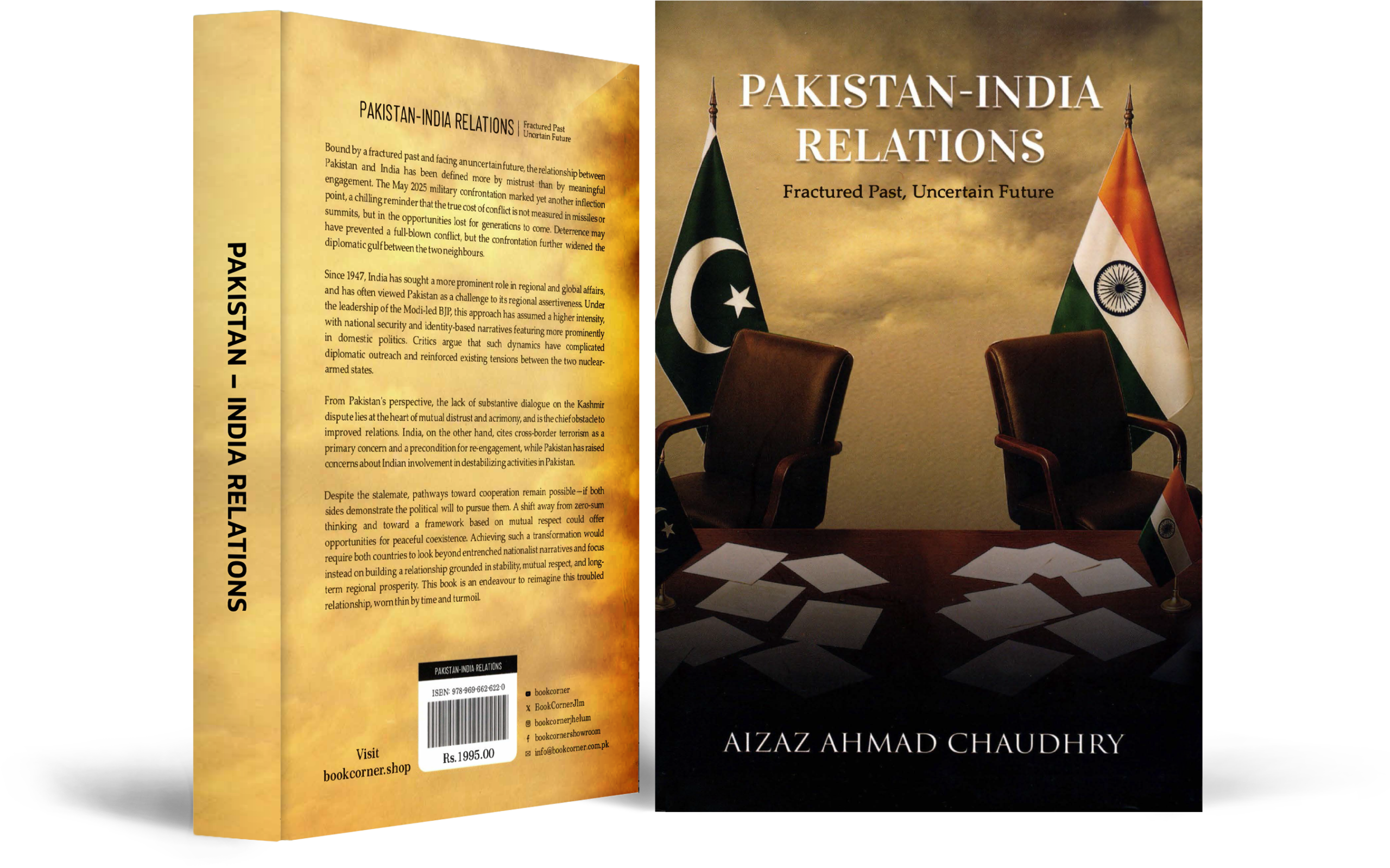
Pakistan-India Relations: Fractured Past, Uncertain Future

Book Podcast

Book Profile

Pakistan-India Relations: Fractured Past, Uncertain Future

روابط پاکستان و هند: گذشته‌ای گسسته، آینده‌ای نامطمئن

Compiler & Author: Aizaz Ahmad Chaudhry

This book examines the complex and often tense relationship between Pakistan and India since their independence. Drawing on his diplomatic experience, Aizaz Ahmad Chaudhry analyzes the historical roots of conflict, particularly the Kashmir dispute. He reviews wars, negotiations, and peace initiatives over the decades. The book presents a realistic assessment of the uncertain future of bilateral relations.

Pages 327
Timeline Stops 27
Book Timeline

Book Timeline

1857 Rebellion

Revolt against the East India Company (First War of Independence). Impact: Britain viewed Muslims as their 'main rivals' after suppressing the revolt, as their rule was overthrown. This led to structural discrimination and a sense of political disenfranchisement among Muslims.

Late 19th Century

Strategic efforts by Sir Syed Ahmad Khan for political awakening. Impact: Recognizing the need to adapt to the new environment, he emphasized educational reform and the national awakening of Muslims as a distinct political entity.

Early 20th Century

Transformation of Muhammad Ali Jinnah from 'Ambassador of Unity' to a leader for Muslim rights. Impact: Realizing that Muslim rights would not be secured in a united India's parliamentary structure, Jinnah shifted from a strategy of preservation to advocating for an independent state.

August 1947

Partition of British India and the creation of Pakistan. Impact: Independence began with a heavy burden of bitterness, organized violence, and mass displacement, laying the foundation for systemic mistrust.

October 1947

Jinnah's interview with Reuters about partition massacres. Outcome: Jinnah described these events as a conspiracy designed to 'cripple' the newborn Pakistan, aligning with early Indian leaders' efforts to economically stifle Pakistan.

1948-1997 - Era of Wars and Fragile Treaties

This period witnessed the futility of diplomatic efforts amidst fundamental territorial disputes and Delhi's regional dominance ambitions.

1948

First war over Kashmir. Outcome: Kashmir became the focal point of Pakistan's strategic anxiety as the 'unfinished business of partition'.

1960

Signing of the Indus Waters Treaty (IWT). Impact: Established a technical mechanism for water resource sharing that remained the only link for 65 years.

1965

Second war between the two countries. Outcome: Deepened military stalemate and distrust in international mediation.

1971

East Pakistan crisis and direct Indian military intervention. Impact: Partition of Pakistan and formation of Bangladesh led to a fundamental shift in Pakistan's defense psychology.

1972

Simla Agreement. Outcome: An attempt at bilateralism that ultimately failed to create lasting peace due to conflicting interpretations.

1992

Demolition of Babri Masjid. Impact: This event was a turning point in the 'Hinduisation' of India, removing the mask of secularism and replacing it with aggressive religious nationalism.

Nuclear Balance and Diplomatic Deadlocks

The 1998 nuclear tests altered the security paradigm, but India sought to shift the balance of power in its favor by leveraging global developments.

1998

Mutual nuclear tests. Outcome: Stabilization of the deterrence regime and South Asia becoming a critical point in international security.

1999

Lahore Declaration and Kargil Conflict. Impact: Highlighted the fragility of peace processes in the presence of non-state actors and deep territorial disputes.

2001

Agra Summit between Musharraf and Vajpayee. Outcome: Talks failed due to India's refusal to accept the Kashmir issue as the core of the conflict.

September 11, 2001

Terrorist attacks in the USA. Impact: India strategically used the global atmosphere to portray Kashmir's freedom struggles as terrorism and diplomatically isolate Pakistan.

2004

2008: The 'Comprehensive Dialogue' process. Outcome: Confidence-building measures were established but quickly suspended by Delhi with any border tension.

2015

Agreement to resume talks during Nawaz Sharif and Modi's tenure. Impact: Symbolic contacts were established but quickly reached a deadlock due to lack of political will in Modi's government.

Freefall of Relations and Confrontation 2025 (2016)

From 2016, relations entered a phase of 'absolute blockade' due to Modi government's active isolation strategy against Pakistan.

2016

Complete cessation of diplomatic interactions by India. Impact: End of diplomacy era and start of cold confrontation.

February 2019

Indian airstrike on Balakot. Consequence: Crossing traditional red lines and entering direct aerial military confrontation.

August 5, 2019

Revocation of Article 370 of the Indian Constitution. Impact: Initiation of 'demographic and electoral engineering' in Kashmir to alter the Muslim majority structure; an action that blatantly violated UN Security Council resolutions.

June 2023

Installation of the 'Greater India' (Akhand Bharat) map in the new parliament. Consequence: Formalization of Delhi's hegemonic and territorial ambitions threatening neighbors' survival.

April 2025

Publication of an article by an Indian MP (from the Congress Party) advocating for the 'permanent extinction' of Pakistan and unilateral suspension of the Indus Waters Treaty (IWT). Impact: Demonstrated that the desire to destroy Pakistan extended beyond the BJP and encompassed the entire Indian political class. Suspension of the water treaty led to

May 2025

Widespread military confrontation following the 'Pahalgam' incident. Outcome: Intense missile and drone exchanges halted in a strategic stalemate mediated by the United States.

July 2025

Foreword of the book written by Aizaz Ahmad Chaudhry. Impact: Emphasized the need to 'rehumanize' relations and move out of the heavy shadow of extreme nationalism.