

February 1978 (Author's Account)
The rise of Islamic revolutionary idealism in Iran's foreign policy after the Islamic Revolution.
Book Podcast
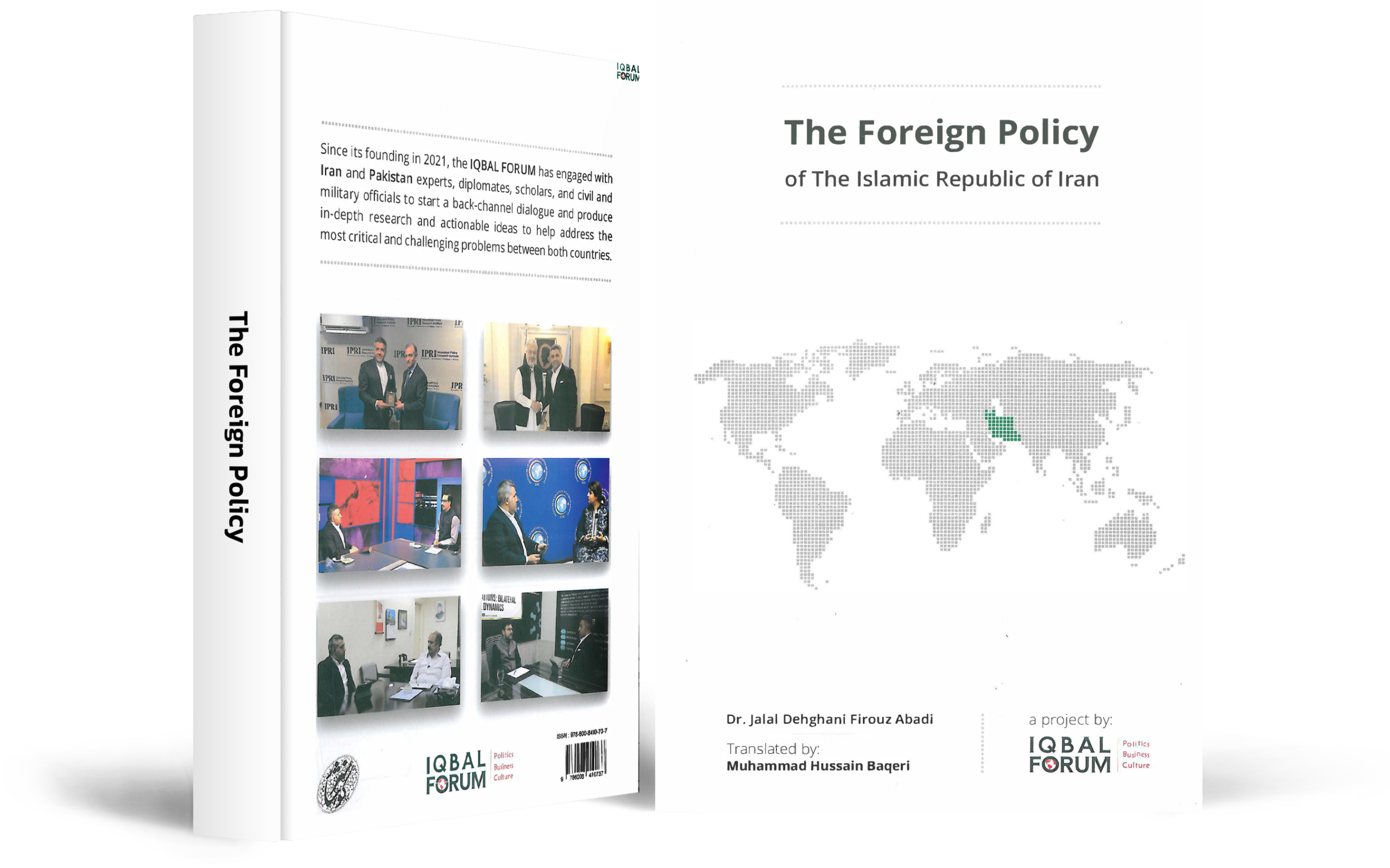
Book Profile
سیاست خارجی جمهوری اسلامی ایران
Compiler & Author: Dr. Jalal Dehghani Firooz Abadi
Translator: Muhammad Hussain Baqeri
This book analyzes the theoretical foundations and practical dimensions of the foreign policy of the Islamic Republic of Iran. Dr. Jalal Dehghani Firooz Abadi examines ideological, security, and geopolitical principles shaping Iran’s external relations. He discusses Iran’s role in the Middle East and its interactions with global powers and international institutions. The book provides a structured understanding of Iran’s diplomatic strategies and challenges.
The rise of Islamic revolutionary idealism in Iran's foreign policy after the Islamic Revolution.
Separatist activities in Iran's border regions, especially Kurdistan, with foreign support after the revolution.
The separatist crisis in Kurdistan and its management by the interim government with a peaceful approach.
The Assembly of Experts began drafting and approving the Constitution of the Islamic Republic of Iran.
Meeting of Mehdi Bazargan and Ebrahim Yazdi with Brzezinski (Carter's National Security Advisor) in Algeria, marking the peak of the interim government's 'Westward Look' policy.
The U.S. Embassy in Tehran was seized by 'Students of the Imam's Line', marking the start of the hostage crisis. This event became known as the 'Second Revolution'.
The interim government resigned one day after the U.S. Embassy seizure.
The Revolutionary Council approved the abolition of the 1921 Iran-Soviet Treaty.
Iran stopped its oil exports to the United States.
President Carter issued Executive Order 12170, freezing all assets and interests of the Iranian government, affiliated institutions, and the Central Bank of Iran in the U.S.
Iran closed its air and sea borders to American planes and ships.
The new constitution of the Islamic Republic of Iran was approved in a referendum.
Sadegh Ghotbzadeh, then Iran's Foreign Minister, called the Soviet military intervention in Afghanistan a "hostile act" against "all Muslims worldwide."
Iran severed its relations with Jordan and Morocco due to their anti-Iran policies and support for Iraq.
The then Prime Minister, Mohammad Ali Rajai, attended the Non-Aligned Movement conference in India.
The Islamic Republic of Iran withdrew from the CENTO pact.
Abolhassan Banisadr was elected as the first President of Iran.
President Carter ordered the complete severance of diplomatic relations with Iran.
The first UN Security Council statement on Iraq's invasion of Iran was issued.
Saddam Hussein, President of Iraq, unilaterally annulled the 1975 Algiers Agreement.
The official start of the Ba'athist Iraq regime's invasion of Iran with the bombing of Iranian airports, marking the beginning of the 'Sacred Defense' era.
The Iranian parliament passed a resolution approving four conditions for resolving the hostage crisis.
This date contradicts earlier years and seems to be a typographical error. Based on the text, it likely means January 1981: Iran and the USA agreed on a statement prepared by Algeria and signed it separately.
Ramadan, Iraq's Deputy Prime Minister, declared that the main goal of the war was to overthrow the Islamic Republic of Iran.
Abolhassan Banisadr was removed from the presidency.
Mohammad Ali Rajai became the president.
The Islamic Republic of Iran successfully conducted Operation Fath ol-Mobin.
The Islamic Republic of Iran successfully conducted Operation Beit ol-Moqaddas.
Operation Beit ol-Moqaddas led to the liberation of Khorramshahr.
The Non-Aligned Movement decided to hold its seventh foreign ministers' meeting in Baghdad (later moved to Havana).
Iran arrested Tudeh Party leaders and expelled 18 Soviet diplomats.
The Islamic Republic of Iran adopted an 'open doors' policy to develop relations with Third World countries.
Diplomatic relations between the United States and Iraq were established.
Imam Khomeini emphasized the need to strengthen foreign relations, and Ayatollah Khamenei designed and announced the 'open doors' policy.
The President of Iran emphasized the need to establish relations with African countries.
UN Security Council Resolution 598 was adopted, calling for an immediate ceasefire and return to international borders.
Iran's Foreign Minister outlined Iran's position on Resolution 598 in a letter to the UN Secretary-General.
Massacre of Iranian pilgrims in Mecca.
The United States destroyed the Iranian Navy in the Persian Gulf.
Saudi Arabia cut diplomatic ties with Iran.
Imam Khomeini accepted UN Security Council Resolution 598.
Hashemi Rafsanjani adopted a conciliatory stance on Iran-GCC relations.
The Iranian people approved the revised 1979 Constitution in a referendum (beginning of the Reconstruction Era and the "Second Republic").
Hashemi Rafsanjani became President (beginning of the Reconstruction Era).
Hashemi Rafsanjani emphasized the need to expand relations with the Gulf Cooperation Council countries.
The British Foreign Secretary expressed the UK's desire to improve relations with Iran for the second time.
The Director-General of the French Foreign Ministry arrived in Tehran at the head of a delegation for talks with Iranian officials.
Saddam Hussein accepted the 1975 Algiers Agreement in a letter to the President of Iran.
Iraq's invasion and occupation of Kuwait (beginning of the Kuwait crisis).
Hashemi Rafsanjani announced that the main issues in relations with Western European countries have been resolved.
Iran's Foreign Minister (Ali Akbar Velayati) met and discussed with the foreign ministers of the European Community on the sidelines of the 45th UN General Assembly session.
The Irish Foreign Minister visited Iran, leading to the lifting of European Economic Community sanctions against the Islamic Republic.
The Damascus Declaration on establishing 2+6 security arrangements was issued, excluding the Islamic Republic of Iran from regional security management.
Establishment of the permanent mission of the Islamic Republic of Iran at the Organization of Islamic Cooperation headquarters in Jeddah.
The first specialized meeting of the Islamic Human Rights Committee was held in Tehran.
The end of the bipolar system with the dissolution of the Soviet Union.
Democrat Bill Clinton elected as President of the United States (Note: Hillary Clinton never became President; this refers to Bill Clinton's election).
Hashemi Rafsanjani sent a message in response to European leaders' statement, expressing Iran's readiness for serious and frank dialogue with the European community and its members.
The Prime Minister of Denmark (EU President at the time) emphasized the importance of constructive, comprehensive, and open dialogue with the Islamic Republic of Iran.
Ratification of the Maastricht Treaty and the formation of the European Union.
Iran and the United Arab Emirates entered negotiations to develop and strengthen relations and good neighborliness.
Iran attempted to bring Central Asian and Caucasus countries into ECO membership.
The "Dual Containment" policy against Iran was announced and implemented by the United States.
Hashemi Rafsanjani stated in an interview with Time magazine that he does not trust political negotiations with the US due to its lack of goodwill.
Clinton banned any assistance or involvement of American citizens in Iranian oil operations.
The Iran and Libya Sanctions Act (ILSA) was passed in the US Congress, known as the D'Amato Act.
Hashemi Rafsanjani attended the 6th OIC Summit in Dakar, Senegal.
Hashemi Rafsanjani traveled to Riyadh and met with King Fahd and Crown Prince Abdullah.
Seyyed Mohammad Khatami was elected President (beginning of the Reform Era).
Seyyed Mohammad Khatami proposed the "Dialogue Among Civilizations" at the 8th Islamic Summit in Tehran.
Seyyed Mohammad Khatami conveyed his message to the American people via CNN.
Bill Clinton responded to Khatami's initiative, calling Iran an "important country with an ancient and rich cultural heritage."
The 8th Islamic Summit Conference was held in Tehran, and Seyyed Mohammad Khatami was elected as the President of the Organization of Islamic Cooperation for three years.
Seyyed Mohammad Khatami attended the 53rd UN General Assembly and proposed the Dialogue of Civilizations, suggesting the year 2001 be named after it.
The UN General Assembly unanimously adopted Resolution 53/22, naming the year 2001 as the Year of Dialogue among Civilizations.
The Saudi Arabian Foreign Minister (Saud Al-Faisal) visited Iran and emphasized the need for stronger cooperation between Iran and Saudi Arabia.
President Khatami's visit to Saudi Arabia and Qatar.
Bill Clinton stated in an unprecedented position that Iran had few violations.
President Khatami attended the annual UNESCO meeting and outlined his views on the essential prerequisites for the realization of dialogue among cultures and civilizations.
Dr. Jalal Dehghani Firouzabadi presented a scholarly lecture on the foreign policy discourses of the Islamic Republic of Iran at the Faculty of Law and Political Science, Allameh Tabataba'i University, for the first time.
President Khatami attended the UN Millennium Summit and emphasized the importance of dialogue among civilizations.
The Supreme Leader of Iran (Ayatollah Khamenei) strongly criticized negotiations with the United States.
The foreign ministers of Iran and the United States met for the first time in 20 years at the 6+2 meeting on the Afghanistan crisis in New York.
Terrorist attacks in the United States, leading to the Afghanistan and Iraq crises.
President Khatami's visit to Kabul as the first foreign leader signified Iran's approval and support for Afghanistan's transitional government.
President George W. Bush labeled Iran, along with North Korea and Iraq, as part of the "Axis of Evil" in his State of the Union address.
US military attack on Iraq.
Madrid meeting of European leaders on Iran ended without a final document.
Luxembourg meeting of European leaders agreed to pursue cooperation with Iran through two separate economic-trade documents and one political cooperation document.
Iran's peaceful nuclear activities were revealed and gradually turned into a foreign policy crisis.
The European Union issued a statement making its negotiations with the Islamic Republic conditional.
The tenth round of comprehensive Iran-Europe talks was held in Athens.
Iran's Secretary of the Supreme National Security Council invited three European countries (Britain, Germany, and France) to visit Tehran.
Signing of the Tehran Declaration (or Saadabad Declaration) in Tehran between Iran and three European countries.
Signing of the Additional Protocol 93+2 to the Nuclear Non-Proliferation Treaty (NPT) by Iran's representative at the International Atomic Energy Agency (not yet ratified by the parliament).
The Herat-Dogharoon road project in Afghanistan was inaugurated.
Announcement of general policies for the Fourth Development Plan in foreign policy.
Start of the first round of negotiations for implementing the Paris Agreement in Brussels.
It was decided to start negotiations on the trade and cooperation agreement between Iran and Europe.
Political and security negotiations began in Geneva.
Beginning of the "Era of Principlism" in the foreign policy of the Islamic Republic of Iran with the advent of the ninth government.
The second steering committee meeting was held in Paris where Iran presented its four-step plan.
The third steering committee meeting in London reached a deadlock.
Hassan Rouhani, Javier Solana, Jack Straw, Michel Barnier, and Joschka Fischer met to find a solution to the nuclear negotiation deadlock.
Iran rejected the EU's request to suspend enrichment.
The IAEA Board of Governors issued a resolution urging Iran to resume negotiations and halt enrichment.
Mahmoud Ahmadinejad emphasized the constructive role of the Non-Aligned Movement at its 14th summit.
Ahmadinejad's visit to Syria and discussions with journalists about forming a "global anti-imperialist and anti-hegemonic front."
The Permanent Secretariat of the Conference in Support of the Palestinian Intifada, affiliated with the Islamic Consultative Assembly, was established.
Iran broke the seals at the Natanz facility in the presence of IAEA inspectors to resume uranium enrichment.
The IAEA Board of Governors referred Iran's nuclear dossier to the United Nations Security Council.
Ali Larijani, in a letter to ElBaradei, announced Iran's readiness to negotiate with the agency to resolve the nuclear issue.
Sharm el-Sheikh Conference attended by Manouchehr Mottaki (Iran's Foreign Minister) and Condoleezza Rice (US Secretary of State).
The UN Security Council issued Resolution 1747, intensifying and expanding sanctions against the Islamic Republic.
Ahmadinejad's attendance at the 62nd session of the United Nations General Assembly.
Iranian representatives and the agency reached an agreement on the framework and method to resolve remaining issues after three rounds of intensive negotiations.
The second summit of the five Caspian Sea littoral states was held in Tehran.
Trade volume between Iran and China reached 15 billion dollars.
Reference to negotiations with P5+1 in Baghdad.
Establishment of Iqbal Think Tank by Mohammad Hossein Bagheri.

AI Assistant
Fast and reliable answers