

7th and Early 8th Century
Arrival of Muslim traders, missionaries, and armies in South Asia.
Book Podcast
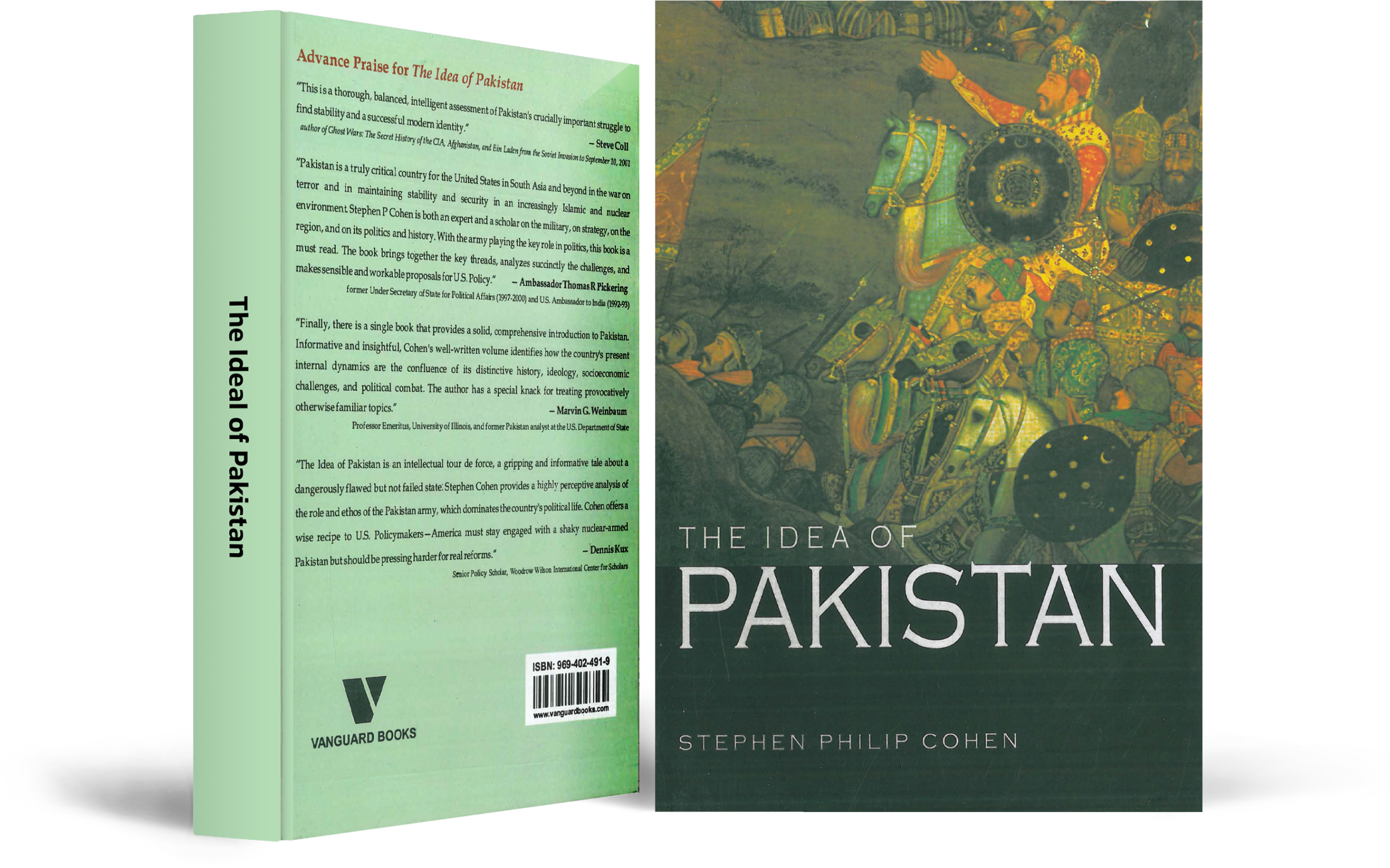
Book Profile
ایدهٔ پاکستان
Compiler & Author: Stephen Philip Cohen
This book explores the evolution of Pakistan’s national idea and identity since independence. Stephen Philip Cohen analyzes the country’s political structure, the role of the military, political parties, and religious institutions. He examines Pakistan’s internal challenges and its regional and international relationships. The book provides an analytical perspective on Pakistan’s possible future trajectory.
Arrival of Muslim traders, missionaries, and armies in South Asia.
Caliph Umar sends the first Arab expedition to Sindh.
Muhammad bin Qasim conquers Sindh, initiating the spread of Islam.
Muslim invaders enter northwestern India, followed by the Mongols in the 13th century.
Mahmud of Ghazni plunders Somnath, destroying temples and attacking the Hindu social system (as per Al-Biruni's writings).
Several Hindu-Muslim states are established in northern and northwestern India.
Almost all of India comes under the rule of independent Muslim rulers.
The Mughal Empire is established.
1707 CE: The Mughal Empire reaches its peak power.
Control of India is transferred from the East India Company to Whitehall (British government).
The princely state of Awadh is annexed to British India.
A major uprising occurs in India, leading to the end of Company rule and Mughal authority.
Britain formally dissolves the Mughal Empire and begins direct rule over India (British Raj).
Aligarh Muslim University is established.
The Ahmadiyya movement is founded in Qadian, Punjab.
Muhammad Ali Jinnah joins the Indian National Congress.
The Muslim League is established.
Muslims and Hindus become more involved in 'myth-making', and Muslim missionary groups like Tablighi Jama'at are formed.
The Indian National Congress demands an independent India.
Muhammad Iqbal, a Punjabi poet-politician, proposes the idea of a separate Muslim state. Muhammad Ali Jinnah withdraws from active politics and moves to London.
A group of Indian students in Cambridge propose that the separate Muslim state be named 'Pakistan'.
Muhammad Ali Jinnah returns to India to revive the Muslim League.
Maududi, after traveling with a prominent Hindu politician, becomes convinced that Hindus and Muslims cannot live together.
Muhammad Ali Jinnah and the Muslim League, at the Lahore session, declare support for the idea of Pakistan, and the Lahore Resolution is passed.
Maulana Maududi establishes Jama'at-i-Islami.
Jama'at-i-Islami does not participate in local elections.
Negotiations between Britain, the Indian National Congress, and the Muslim League lead to the decision to partition India.
The student wing of Jamaat-e-Islami, Islami Jami'at Tulabah, is officially formed.
Britain's plan to partition the Indian subcontinent into two territories - India and Pakistan - is announced.
The country of Pakistan is established. Bengal and Punjab are divided, leading to mass population migration.
The Pakistani army begins its first military engagement in Kashmir.
The first 'small wars' occur between the Baloch and Pakistani forces (lasting several months).
Gandhi goes on a hunger strike to protest India's seizure of Pakistani assets and Hindu and Sikh attacks on Muslims in India.
Muhammad Ali Jinnah dies of tuberculosis.
The first war between India and Pakistan over Jammu and Kashmir begins.
The United Nations enforces a ceasefire in Kashmir, leaving about three-quarters of the state under Indian control.
The Objectives Resolution is passed by the Constituent Assembly.
The Rawalpindi Conspiracy occurs, an unsuccessful coup attempt by junior officers.
Liaquat Ali Khan, the first Prime Minister of Pakistan, is assassinated at a political rally in Rawalpindi.
31 scholars present an Islamization plan to the Pakistani government (becomes the manifesto of Jamaat-e-Islami).
Language riots occur in East Bengal.
The Muslim League declines. Four provinces of West Pakistan merge under the 'One-Unit' scheme.
Governor-General Ghulam Muhammad orders Constituent Assembly members to be barred from meeting in Karachi, seen as undermining democracy in Pakistan.
Pakistan signs a mutual defense agreement with the United States and joins the Southeast Asia Treaty Organization (SEATO).
Pakistan joins the Baghdad Pact (later known as CENTO).
The Constituent Assembly passes the first constitution, renaming the country to the "Islamic Republic of Pakistan." Iskander Mirza becomes President.
The second "minor conflict" occurs between the Baloch and Pakistani forces, lasting several months.
Iskander Mirza abrogates the constitution.
General Ayub Khan overthrows Iskander Mirza in a coup, initiating a long period of military rule in Pakistan.
The first land reforms are implemented, focusing on abolishing tax-free land ownership (jagirs).
Ayub Khan presents a nine-point plan for the 'Ideology of Islam' in a private note.
Ayub Khan becomes President after winning 80% in a referendum.
Ayub Khan signs the Indus Waters Treaty with India.
A new constitution is announced by Ayub Khan, creating a stronger presidency and a system of 'Basic Democracies'. The India-China war begins.
The third Balochistan civil war begins and continues until 1968.
A full-scale war with India over Kashmir occurs.
Maududi is imprisoned for supporting Fatima Jinnah in the presidential election.
Zulfikar Ali Bhutto establishes the Pakistan People's Party (PPP).
Economist Mahbub ul Haq announces that 22 families control 66% of the country's economy, symbolizing economic inequality.
Ayub Khan resigns and General Yahya Khan takes power.
1971: Islami Jamiat Talaba (IJT) participates in paramilitary operations in East Pakistan under the guidance of the Pakistan Army.
The first free national elections are held in Pakistan, and the Pakistan People's Party (PPP) wins in West Pakistan.
1971: The Pakistan Army uses Islamic militias to intimidate, torture, and kill Bengali intellectuals and politicians.
The Pakistan Army is defeated in the East, and over 90,000 Pakistani soldiers surrender. East Pakistan becomes the independent country of Bangladesh. Zulfikar Ali Bhutto becomes the leader of the remaining Pakistan.
The second land reform reduces the land ownership ceiling by 70%.
Bhutto signs a peace treaty with Indira Gandhi, the Prime Minister of India, in Simla, and Pakistani prisoners of war are returned.
Bhutto's government nationalizes private schools.
A coalition of the Jamiat Ulema-e-Islam (JUI) and the National Awami Party (NAP) takes power in Balochistan and the North-West Frontier Province.
A new constitution is passed by the parliament, making Bhutto the Prime Minister with full executive powers.
1975: The fourth and bloodiest Balochistan civil war occurs, initiated by Bhutto's dismissal of local administrators. The Pakistani army and paramilitary forces launch a full-scale military operation.
The Parliament of Pakistan declares Ahmadis as non-Muslims.
The War Inquiry Commission report on the 1971 defeat is submitted to the government (but is never officially published).
Zulfikar Ali Bhutto appoints Zia-ul-Haq as Chief of Army Staff.
The land ownership ceiling is further reduced in the third land reform.
The Pakistan People's Party wins an election suspected of widespread rigging. The Pakistan National Alliance (PNA) takes to the streets, demanding military intervention.
General Zia-ul-Haq stages a coup, removing Bhutto and the Pakistan People's Party from power. Bhutto is arrested.
Bhutto enforces a ban on alcohol.
A Mohajir student organization is founded.
Zulfikar Ali Bhutto is hanged in Rawalpindi after being convicted of conspiracy to murder.
The Soviet Union invades Afghanistan.
The Orangi Pilot Project is established in Karachi.
1989: Extensive efforts by the US and Pakistan to overthrow the communist regime in Kabul and force Soviet troops to withdraw from Afghanistan.
The Movement for the Restoration of Democracy is formed. The University Grants Commission issues guidelines for textbook authors based on Pakistan's ideology.
The Muttahida Qaumi Movement (MQM) is established as a political party for migrants. A small operation is conducted to support Sikh separatists in India.
Zia-ul-Haq allows non-party elections and martial law is lifted by the end of the year. The banking system moves towards profit and loss sharing (PLS). Mahbub ul Haq is appointed as Finance Minister and begins economic reforms.
Mahbub ul Haq is removed from the Ministry of Finance.
Benazir Bhutto returns to Pakistan to take leadership of the Pakistan People's Party (PPP).
The number of religious schools (madrasas) in Pakistan increases to 3,000.
A series of crises between India and Pakistan begins.
Zia-ul-Haq dismisses his Prime Minister, Muhammad Khan Junejo.
Mahbub ul Haq returns as Finance Minister in the interim government and initiates revenue system reforms.
Zia-ul-Haq dies in an unexplained air crash.
Benazir Bhutto comes to power for the first time.
A major uprising begins in Indian-controlled Kashmir. Al-Qaeda is founded in Afghanistan.
Pakistan likely produces a deployable nuclear bomb. Benazir Bhutto is removed from the prime ministership.
1993: Asif Nawaz Janjua, the army chief, gradually pushes back political Islam in the military.
Abdul Qadeer Khan's role in Pakistan's nuclear program is revealed, and a 'cult of personality' forms around him.
The demolition of the Babri Mosque in India leads to sectarian riots and attacks on Hindu temples and Christian churches in the subcontinent.
Muhammad Khan Junejo passed away.
The interim government of Moeen Qureshi implements IMF revenue-boosting policies. Benazir Bhutto returns to power for the second time.
Summer workshops on South Asian security issues are held.
A failed coup by an Islamist general and several junior officers.
The Citizens Foundation (TCF) is established as an educational NGO.
Prime Ministerial power is restored by Nawaz Sharif.
Nawaz Sharif comes to power for the second time.
Pakistan's economic growth falls to 2.6%.
Pakistan conducts nuclear tests.
Nawaz Sharif meets Indian Prime Minister Atal Bihari Vajpayee in Lahore.
Nawaz Sharif meets Bill Clinton and orders withdrawal from Kargil on his advice.
General Pervez Musharraf, the army chief, dismisses Nawaz Sharif's civilian government and becomes 'Chief Executive'. Shaukat Aziz is appointed as Musharraf's finance advisor.
Pakistan's economic growth returns to 4.3%.
The military exiles Nawaz Sharif and his family to Saudi Arabia.
Terrorist attacks on the Pentagon and World Trade Center transform US-Pakistan relations.
The United Nations suggests Pakistan review its tourism policy.
In a televised speech, Musharraf declares Pakistan's goal to become a moderate Islamic state.
Musharraf holds a national referendum on military rule and wins with 98% of the vote.
National and provincial elections are held. The Muttahida Majlis-e-Amal (MMA), a coalition of six Islamic parties, wins 62 seats in the National Assembly (17% of the vote). The Tablighi Jamaat publicly supports the MMA.
The report of the 1971 War Inquiry Commission is officially released. Foreign direct investment increases to $795 million.
2003: The MMA government in the NWFP initiates Islamist programs. Pakistan's education budget increases by nearly 80%.
Qazi Hussain Ahmed delivers a speech at a conference at the Brookings Institution.
Shaukat Aziz is introduced as Prime Minister.
Several Pakistani soldiers are accidentally killed by American forces at the Afghanistan-Pakistan border.
A Pakistani suspected of Taliban/Al-Qaeda membership is released from Guantanamo.
Musharraf pledges to step down from the military by the end of 2004.
Musharraf announces that UN resolutions on Kashmir may be set aside if progress is made in resolving the issue. A US task force recommends appointing a high-level official to assist in India-Pakistan dialogue on Kashmir.
Shahbaz Sharif (Nawaz's brother) is deported from Pakistan while flying to Lahore.

AI Assistant
Fast and reliable answers