


The Scorpion’s Tail

Book Podcast

Book Profile

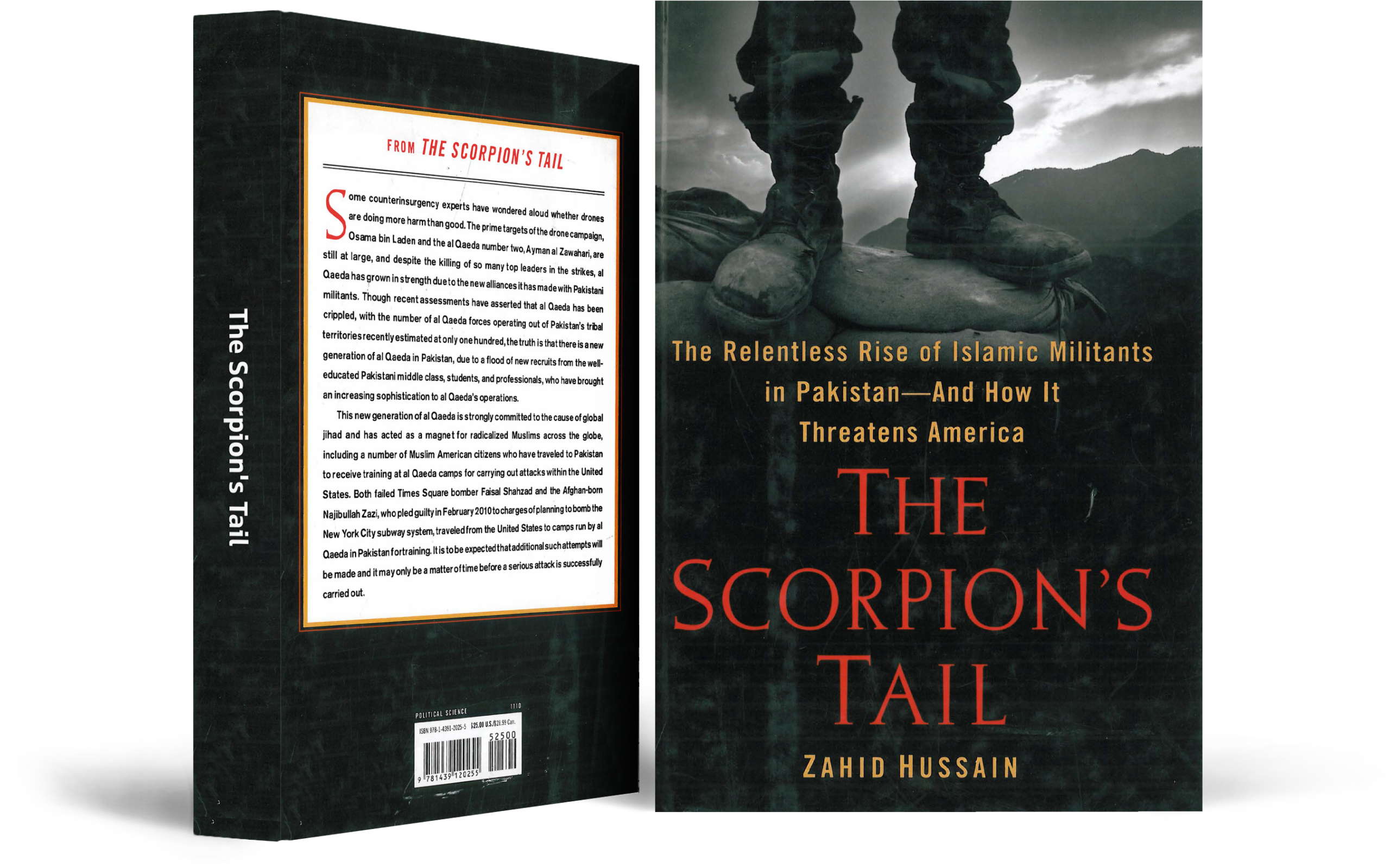
The Scorpion's Tail

دمِ عقرب: اوج بی‌امان شبه‌نظامیان اسلامی در پاکستان و تهدید آن برای آمریکا

Compiler & Author: Zahid Hussain

This book investigates the rise of Islamic militant groups in Pakistan and the roots of extremism. Zahid Hussain analyzes the impact of the Afghan war, regional politics, and security institutions in fostering militancy. He explains how these groups evolved into both domestic and international threats. The book serves as a warning about the security implications for Pakistan and the wider world.

Pages 262
Timeline Stops 51
Book Timeline

Book Timeline

August 1947

Pakistan was established as an independent country, and immediately a struggle began between moderates and Islamists to define national identity. This event marked the beginning of a long search for identity for a country oscillating between modern democracy and a religious state.

1949

The Constituent Assembly passed a resolution effectively declaring Pakistan an Islamic state. This was the first major concession to Islamist groups and set the country's future path towards further Islamization.

1953

Widespread riots against the Ahmadiyya minority community occurred in Punjab. This event solidified the clergy's power in defining Islamic orthodoxy and demonstrated that religious groups could use violence to impose their views.

1956

Pakistan's first constitution was adopted, and the country was officially named the "Islamic Republic." This action institutionalized the Islamic identity of the state in the country's foundational laws.

1958

General Muhammad Ayub Khan seized power in a bloodless coup and declared martial law. His regime, with a modernization agenda, was a temporary setback for Islamist forces but solidified the military's power in politics.

1969

Ayub Khan resigned following widespread protests and handed over power to General Yahya Khan, the army chief.

1970

The first free elections were held in the country, leading to a decisive victory for the Awami League in East Pakistan (now Bangladesh). This result triggered a political crisis that eventually led to a civil war and the separation of Bangladesh.

July 4, 1977

General Muhammad Zia-ul-Haq, the army chief, seized power by overthrowing the government of Zulfikar Ali Bhutto. His coup was a pivotal moment that initiated widespread Islamization of the army and Pakistani society, changing the army's motto to 'Faith, Piety, Jihad in the way of Allah'.

April 4, 1979

Zulfikar Ali Bhutto, the deposed populist Prime Minister, was executed by Zia-ul-Haq's military regime. His removal created a deep political vacuum and paved the way for Zia-supported Islamists to dominate the country's political landscape.

1979 - Soviet Invasion of Afghanistan

The Soviet Union invaded Afghanistan by sending over 30,000 troops. This event catalyzed the largest covert operation in CIA history, organized with Pakistan's ISI, to wage a global jihad against the Soviets.

1986 - US Supplies Stinger Missiles

The United States provided advanced Stinger anti-aircraft missiles to the Mujahideen. This shifted the balance of power on the battlefield in favor of the Mujahideen and pushed the war towards Soviet defeat.

1988 - Death of General Zia-ul-Haq

General Zia-ul-Haq was killed in a suspicious air crash.

1989 - Soviet Withdrawal from Afghanistan

The last Soviet soldier left Afghanistan. Instead of ending the war, this led to a bloody civil war among rival Mujahideen groups, devastating Kabul.

1989 - Kashmir Insurgency Begins

An uprising and armed struggle began in Indian-controlled Kashmir. This event shifted the focus of jihadist networks, experienced from the Afghan war, from Afghanistan to Kashmir, with ISI using them as proxies against India.

April 1992

The communist government in Kabul fell, and Afghanistan entered a bloodier phase of civil war among warlords.

Mid 1993

The Taliban Islamic Movement was formed near Kandahar by Mullah Mohammad Omar. This movement emerged as a reaction to the chaos and crimes of the warlords. Reportedly, Mullah Omar's anger was sparked when a local commander "killed a young boy after assaulting him.

1996

The Taliban captured Kabul, and Osama bin Laden, after being expelled from Sudan, settled in Afghanistan. This event was not the start of a strategic alliance; relations were initially tense. Mullah Omar openly scorned bin Laden, calling him a "donkey" and complained about his presence.

1998

The United States, in response to the bombings of its embassies in Africa, launched cruise missiles at an al-Qaeda training camp in Khost, Afghanistan. Among the dead were several Pakistani militants, providing the first documented evidence of their close ties.

February 1999

General Pervez Musharraf, then the head of Pakistan's army, initiated a covert operation in the Kargil mountains of Kashmir without the approval of Nawaz Sharif's government. This incursion brought India and Pakistan to the brink of full-scale war.

October 1999

General Pervez Musharraf ousted Nawaz Sharif in a military coup and seized power. He intensified the policy of supporting the Taliban in Afghanistan and militants in Kashmir.

September 11, 2001

The al-Qaeda terrorist attacks on the United States shocked the world. Musharraf made a sudden shift, cutting support for the Taliban and becoming a key ally of the US in the "War on Terror." This decision brought Pakistan out of international isolation but put him at odds with many.

December 2001

Following US military operations in the Tora Bora mountains, thousands of Al-Qaeda and Taliban fighters fled to North and South Waziristan in Pakistan, creating safe havens by paying tribal leaders.

January 12, 2002

Musharraf banned five Islamic militant groups. However, the ban was not effectively enforced, and these groups continued their activities under new names.

June 25, 2002

Clashes between the Pakistani army and Arab fighters in the village of Kaza Punga in South Waziristan revealed for the first time the extensive presence and local support for Al-Qaeda in these areas.

2002 Elections

The coalition of Islamist parties, Muttahida Majlis-e-Amal (MMA), won the provincial elections. This victory strengthened extremism in border areas and brought Taliban and Al-Qaeda supporters to power.

December 14 and 25, 2003

Two failed assassination attempts on Pervez Musharraf took place in Rawalpindi. Investigations revealed that these attacks were planned with the collaboration of Al-Qaeda and local extremists, including members of the Pakistan Air Force.

March 16, 2004

The Pakistan Army launched its first major military operation in South Waziristan. Heavy fighting in areas like Kalusha and Shin Warsak faced fierce resistance from foreign fighters and local tribes, resulting in significant casualties for the army.

April 24, 2004

The army signed the 'Shakai Agreement' with militant leader Nek Muhammad. This agreement was a strategic surrender that legitimized the militants, allowing them to keep their weapons and gain time to regroup.

June 17, 2004

Nek Muhammad was killed in the first recorded CIA drone strike in Pakistan. This attack marked the beginning of a new and controversial strategy in the war on terror.

February 7, 2005

The Pakistani government signed a new peace agreement with Baitullah Mehsud, an emerging militant leader. This agreement was another surrender that effectively handed control of the region to the militants, undermining the government's administrative authority in those areas.

January 13, 2006

A U.S. drone strike on the village of Damadola in the Bajaur region resulted in civilian casualties, including women and children. This attack sparked widespread public outrage and intensified anti-American sentiments.

September 5, 2006

The government signed the 'Waziristan Accord' with North Waziristan militants. This agreement, which was a complete surrender, led to a halt in military operations, while cross-border militant attacks on NATO forces in Afghanistan increased by 300%, allowing them to gain strength.

April 2007

The assassination attempt on Aftab Ahmad Khan Sherpao, the Interior Minister, highlighted the growing power and audacity of the Taliban in targeting senior government officials.

3

July 10, 2007: The siege and military assault on the 'Lal Masjid' in Islamabad, which had become a stronghold for radical militants, resulted in dozens of deaths. This event was a turning point that led militants to formally declare jihad against the Pakistani government.

August 30, 2007

Baitullah Mehsud's forces captured 260 Pakistani soldiers in South Waziristan. This event was a major humiliation for the Pakistani army and showcased its inability to counter the insurgents.

October 18, 2007

Benazir Bhutto returned to Pakistan after years of exile, but her convoy in Karachi was targeted by a deadly suicide attack that left over 140 dead.

November 3, 2007

Facing an escalating political crisis, Pervez Musharraf declared a state of emergency and dismissed Supreme Court judges.

2007 - Formation of TTP

Around forty militant commanders from various regions formally established the "Tehrik-i-Taliban Pakistan" (TTP) and chose Baitullah Mehsud as their leader. This move united different militant factions under a single command.

2007 - Assassination of Benazir Bhutto

Benazir Bhutto was assassinated in a suicide attack in Rawalpindi. Her death plunged Pakistan into deep political instability and sparked public outrage against the Musharraf government.

2008 - Resignation of Pervez Musharraf

Pervez Musharraf resigned from the presidency under pressure from political parties.

2009 - Swat Valley Peace Deal

The Pakistani government signed a peace deal with the Taliban in the Swat Valley, allowing them to enforce Sharia law in the region. This agreement was a disastrous strategic concession that weakened government authority and emboldened militants.

2009 - Taliban Advance to Buner

Taliban forces advanced into the Buner region, coming within less than a hundred kilometers of Islamabad. This move sounded alarm bells for Pakistan and the international community, indicating that the Taliban threat was nearing the capital.

May 2009

The Pakistani army, under intense domestic and international pressure, launched a major military operation to reclaim the Swat Valley from the Taliban.

August 5, 2009

Baitullah Mehsud, leader of the TTP, was killed in a CIA drone strike in South Waziristan. This was a major tactical victory for the US, but had limited impact on the Taliban's operational capability as they quickly appointed his successor.

October 2009

Militants launched a daring attack on the General Headquarters (GHQ) in Rawalpindi, taking dozens hostage. This attack demonstrated the Taliban's ability to regroup even after their leader's death.

October 17, 2009

The Pakistan Army launched a major operation, "Zalzala," against TTP strongholds in South Waziristan.

December 2009

President Obama announced a strategy to deploy an additional 30,000 troops to Afghanistan to seize the initiative from the Taliban.

December 30, 2009

A suicide bomber attacked a CIA base in Khost, Afghanistan, killing seven CIA officers. The attack, planned with TTP and Al-Qaeda collaboration, indicated closer cooperation between the two groups.

February 2010

NATO launched a major operation 'Moshtarak' in Marjah, Afghanistan. The disappointing results of this operation, which General McChrystal called a 'bleeding ulcer', symbolized the significant challenges of the US counterinsurgency strategy.

May 2010

Faisal Shahzad, a Pakistani-American citizen, attempted to bomb Times Square in New York. This event, supported by the TTP, revealed the global threat of the group and its ability to recruit from the educated middle class.

June 2010

The Afghanistan war officially became the longest war in United States history.