


1955 - Birth of Asif Ali Zardari
Significance: This date marks the beginning of the life of a man who would later become one of Pakistan's most influential and resilient political figures.
Book Podcast
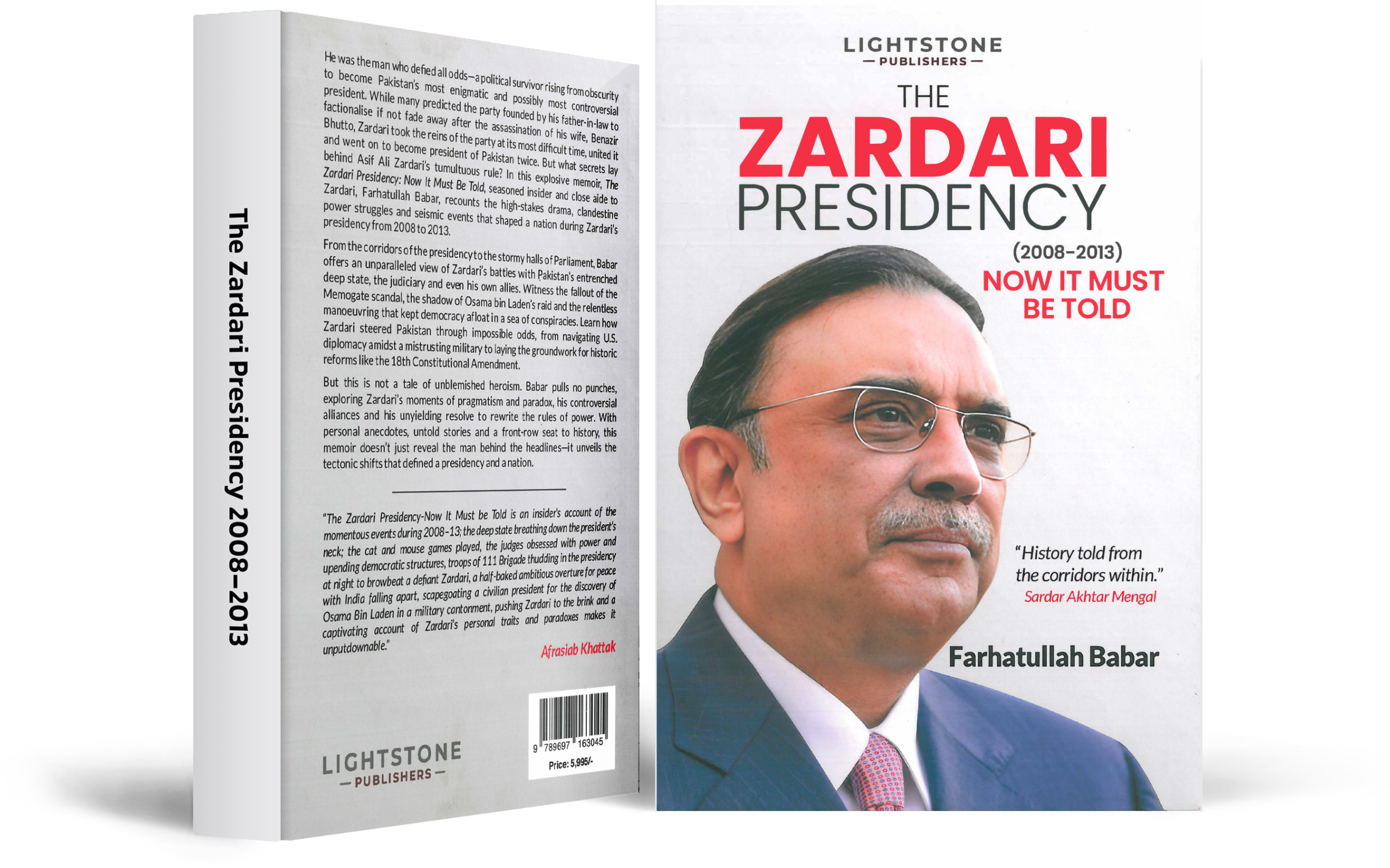
Book Profile
ریاستجمهوری زرداری (۲۰۰۸–۲۰۱۳): اکنون باید گفته شود
Compiler & Author: Farhatullah Babar
This book provides an insider account of Asif Ali Zardari’s presidency from 2008 to 2013. Farhatullah Babar, who closely worked with the administration, discusses political developments, security challenges, and civil–military relations during that period. He highlights democratic restoration, constitutional reforms, and counter-extremism efforts. The book offers a behind-the-scenes perspective on a significant phase in Pakistan’s contemporary politics.
Significance: This date marks the beginning of the life of a man who would later become one of Pakistan's most influential and resilient political figures.
Significance: This marriage forever changed Zardari's identity, transforming him from a businessman and landowner to the spouse of one of the most powerful political figures in the Islamic world, placing him in the national spotlight.
Significance: This was the first instance of a recurring pattern of political persecution, where he faced unproven charges of corruption and crime, experiencing alternating periods of imprisonment and power.
Significance: This arrest led to 11 years of imprisonment without conviction, a period that showcased his resilience against adversity. This imprisonment had a profound impact on his personal life, as Benazir Bhutto mourned.
Significance: This tragic event unexpectedly propelled Zardari to the leadership of the Pakistan People's Party, altering the course of Pakistan's history forever.
Zardari's return from Dubai and the slogan 'Pakistan First'. [Significance: This slogan played a crucial role in quelling ethnic riots in Sindh and preventing the country's disintegration. Its historical importance was later acknowledged by President Arif Alvi.
Victory of the coalition led by the Pakistan People's Party in the general elections. [Significance: This victory restored democracy to Pakistan and paved the way for Zardari's presidency and his inevitable confrontation with the remnants of dictatorship.]
Finalization of plans for Musharraf's peaceful removal. [Significance: This move showcased Zardari's shrewd strategy. He asked his trusted members to pass resolutions in provincial assemblies and form a committee to draft charges, creating media buzz.]
Musharraf's resignation. [Significance: This event was a turning point in Pakistan's civil-military relations, showing that a civilian leader could remove a military dictator without a coup, paving the way for Zardari's presidency.]
Zardari's inauguration as President of Pakistan. [Significance: This event completed the full transition to democracy. Inviting Hamid Karzai, the President of Afghanistan, to the ceremony was a symbolic move to start a new chapter in regional relations and indicated foreign policy priorities.]
Initial steps and early crises. Zardari's first year as president began with bold foreign policy initiatives aimed at regional peace. However, these hopes were quickly dashed by the Mumbai terrorist attacks, creating a tense atmosphere for his presidency.
Zardari's first UN General Assembly speech and call for Aung San Suu Kyi's release. [Significance: This positioned him as a democratic leader on the global stage and showcased his commitment to democratic values.]
Proposal of a 'No First Use' nuclear policy to India. [Significance: This was a bold and unprecedented initiative for regional peace, reflecting his different approach in foreign policy, but faced strong internal opposition.]
Mumbai terrorist attacks. [Significance: These attacks, organized from Pakistani soil, shattered all hopes for peace with India and dashed Zardari's dream of regional reconciliation, putting him on the defensive.]
Confrontation with the judiciary and reforms.
Dismissal of Shahbaz Sharif's government in Punjab and imposition of governor's rule. [Significance: This was a "major blunder" that provoked the Sharif brothers against Zardari and turned the lawyers' movement into a powerful tool to pressure his government.]
March 16, 2009: Entry of the 111 Brigade into the presidential compound at the peak of the lawyers' movement. [Significance: This action heightened military pressure on Zardari to reinstate Iftikhar Chaudhry as Chief Justice. Farhatullah Babar described the night as: "All lights dimmed
Agreement to reinstate Iftikhar Chaudhry after Justice Dogar's retirement. [Significance: Although Zardari conceded, he gained a small moral victory by resisting the illegal removal of Justice Dogar, showing readiness for future confrontations with the judiciary.]
Military prevented Zardari from announcing FATA reforms package. [Significance: This event clearly demonstrated how military establishment's security concerns took precedence over democratic reforms, showcasing the army's influence over key and vital policies.]
Constitutional achievements
Recognized as a landmark year for constitutional reforms under Zardari's leadership.
Approval of the 18th Amendment. [Significance: This amendment transferred power from the President to Parliament and renamed the North-West Frontier Province to 'Khyber Pakhtunkhwa', marking a major constitutional achievement under Zardari and a significant step towards strengthening democracy.]
Three-year service extension granted to General Kayani, Army Chief. [Significance: This unprecedented decision was a strategic concession to maintain a fragile democratic government under constant threat, but it sparked widespread criticism and was seen as a sign of Zardari's compromise with the establishment.]
2011 was the most perilous year of Zardari's presidency, marked by a series of successive crises. These began with the Raymond Davis incident, continued with the shocking discovery of Osama bin Laden in Abbottabad, and culminated in the 'Memogate' scandal.
The Raymond Davis incident in Lahore. [Significance: This event, involving a US embassy official with a private security contractor background, severely strained Pakistan-US relations and led to accusations against Zardari of conspiring for his release.]
US special forces raid on Osama bin Laden's hideout in Abbottabad. [Significance: This operation was a major humiliation for the Pakistani military and intelligence, placing Zardari in an indefensible position, accused of either complicity or sheer incompetence.]
Publication of Mansoor Ijaz's article and the start of the 'Memogate' scandal. [Significance: This scandal created a deep political and security crisis, with military and ISI commanders openly accusing their commander-in-chief (Zardari) of treason.]
Request for Husain Haqqani's resignation as ambassador to the US. [Significance: This was the first casualty of the Memogate scandal, indicating intense military pressure on the civilian government to find a scapegoat.]
Zardari's collapse due to severe stress and travel to Dubai for treatment. [Significance: This health crisis, following a two-hour monologue with stuttering and incoherent speech, culminating in a physical collapse ("his head turned to the right and he fell onto the couch"), highlighted his vulnerability.]
Zardari's return to Pakistan. [Significance: His return despite illness demonstrated his resolve to fight, ended rumors of his escape, and surprised his opponents.]
2013: The final phase of Zardari's presidency was a time of recovery and stabilization. Despite ongoing tensions, he achieved diplomatic successes, advanced domestic programs like the creation of South Punjab province, and ultimately oversaw a peaceful power transition.
Meeting with Aung San Suu Kyi in Myanmar. [Significance: This meeting and the awarding of the Benazir Bhutto Democracy Award to her showcased Zardari's commitment to democratic values on an international level.]
Approval of a resolution in the National Assembly to create South Punjab province. [Significance: This was a crucial step towards fulfilling a key PPP promise to address regional disparities, although it ultimately failed due to military opposition.]
Oversight of general elections and peaceful power transition. [Significance: This was the first time in Pakistan's history that an elected civilian government completed its full term and transferred power to another elected government. This is considered Zardari's most important legacy.]
Foundation of the China-Pakistan Economic Corridor (CPEC). [Significance: To initiate this project, Zardari overcame three major challenges: convincing Singapore to relinquish the Gwadar port contract, persuading the Chief Justice to lift court suspensions, and convincing the Navy to support the project.]

AI Assistant
Fast and reliable answers