

1928 - Birth of Zulfikar Ali Bhutto
Zulfikar Ali Bhutto was born in Larkana, Sindh. His father, Sir Shah Nawaz Bhutto, was a prominent politician.
Book Podcast
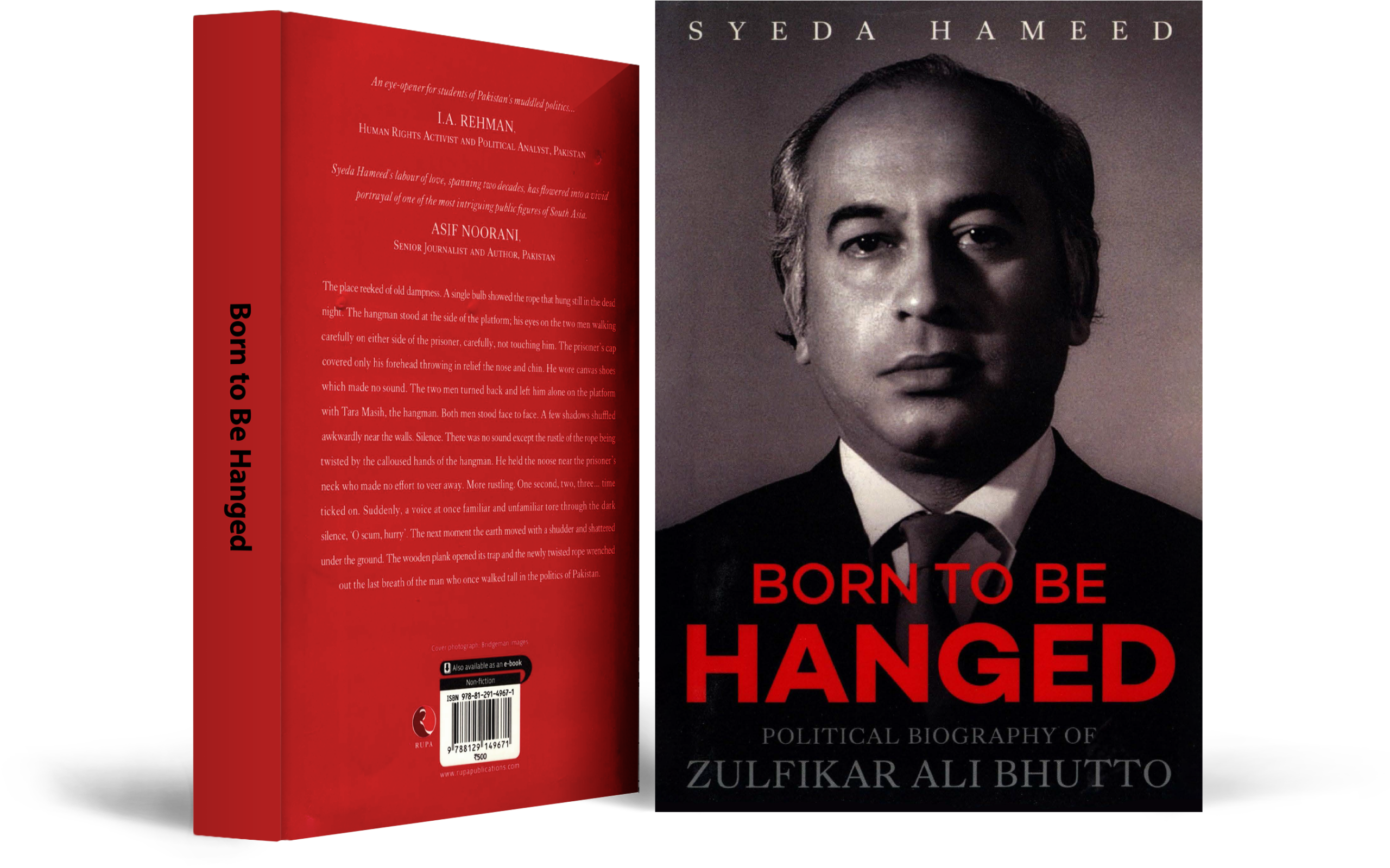
Book Profile
زادهشده برای دار زدن
Compiler & Author: Syeda Hameed
This book presents a political biography of Zulfikar Ali Bhutto, one of Pakistan’s most influential leaders. It traces his rise from an ambitious politician to Prime Minister, and ultimately to his controversial trial and execution. The author explores his impact on foreign policy, nuclear ambitions, and domestic reforms. The book offers a critical and reflective account of his dramatic ascent and tragic downfall.
Zulfikar Ali Bhutto was born in Larkana, Sindh. His father, Sir Shah Nawaz Bhutto, was a prominent politician.
Shah Nawaz Bhutto joined the Bombay State Cabinet as a representative of Sindh, and the family moved to Bombay.
At the age of 9, Zulfikar Bhutto entered the Cathedral Boys' School in Bombay.
At age 15, Zulfikar Bhutto wrote a letter to Muhammad Ali Jinnah, expressing support for the idea of Pakistan and his distrust of Hindus and Congress politics.
Muhammad Ali Jinnah replied to Zulfikar Bhutto's letter, encouraging him to study politics deeply and not to neglect his education.
Zulfikar Bhutto went to Mussoorie with his friends Piloo Mody and Jahangir Mogaseth.
Shahnawaz Bhutto moved to Junagadh, a small autonomous state, and became the Dewan of the Nawab of Junagadh.
Zulfikar Bhutto went to the University of California, Berkeley for higher education and became acquainted with Marx's works.
Zulfikar Bhutto joined the University of California, Los Angeles (UCLA) and transferred to Berkeley after a year.
Zulfikar Bhutto graduated with honors in political science from Berkeley and went to Oxford to study international law. He was also admitted to Lincoln's Inn.
Zulfikar Bhutto married Nusrat Isfahani.
Zulfikar Bhutto graduated in law from Oxford University and then taught international law at the University of Southampton.
Zulfikar Bhutto returned to Pakistan due to his father's illness, practiced law in Karachi, and taught constitutional law at Sindh Muslim Law College.
The first child of Zulfikar and Nusrat Bhutto, Benazir, was born.
Zulfikar and Nusrat Bhutto had a son named Ghulam Murtaza.
The assembly passed the 'One Unit Scheme' to merge the provinces and princely states of West Pakistan. Zulfikar Bhutto opposed the scheme.
Zulfikar Bhutto was sent as a member of the Pakistani delegation to the United Nations and at the age of 29, he spoke at the Sixth United Nations Conference on the 'Definition of Aggression'.
Zulfikar Bhutto spoke at the Sixth United Nations Conference on the 'Definition of Aggression'.
Zulfikar Bhutto delivered five speeches at the International Conference in Geneva, Switzerland.
Zulfikar Bhutto, at the age of 30, was sworn in as the youngest member of the federal cabinet in Pakistan's history under General Ayub Khan.
Zulfikar Bhutto was the first minister to lead a delegation to Moscow for negotiations on joint oil investment with the Soviet Union.
Zulfikar Bhutto signed the China-Pakistan border agreement.
Zulfikar Bhutto received the Hilal-e-Pakistan award.
Operation Gibraltar by Pakistan to infiltrate Kashmir began.
India crossed the international border, marking the start of the 1965 war.
Zulfikar Bhutto, as Pakistan's Foreign Minister, delivered a significant speech at the UN Security Council on Kashmir, calling for a thousand-year war.
Zulfikar Bhutto delivered a longer speech at the UN General Assembly on the Kashmir conflict.
Ayub Khan and Lal Bahadur Shastri signed the Tashkent Agreement. Zulfikar Bhutto strongly opposed this agreement.
Zulfikar Bhutto resigned from the federal cabinet and subsequently began a three-month tour of Europe with his wife.
Zulfikar Bhutto received a historic welcome in Lahore.
Dr. Mubashir Hassan and J.A. Rahim decided in Paris to persuade Zulfikar Bhutto to form a new party.
J.A. Rahim drafted and printed the manifesto of the Pakistan People's Party.
Ayub Khan's ministers began undermining Zulfikar Bhutto's credibility and his role as a minister.
The first assassination attempt on Zulfikar Bhutto occurred at a public meeting in Gul Bagh, Lahore.
December 1, 1967: The Pakistan People's Party (PPP) was founded at an inaugural convention in Lahore with four slogans: "Islam is our faith; democracy is our politics; socialism is our economy; all power to the people."
Zulfikar Bhutto wrote a letter to S. M. Yusuf, the Foreign Minister, criticizing the ministry's stance on the PPP's statement regarding Assam's special status.
Zulfikar Bhutto delivered speeches across the country discussing the PPP's agenda and the incompatibility of socialism with Islam.
Zulfikar Bhutto addressed the women of the party in Lahore, assuring them of their rightful place in the country.
Zulfikar Bhutto supported students, lawyers, and workers at the Nawabshah Bar Association and criticized the government's exploitative system.
Zulfikar Bhutto wrote to Mustafa Khar expressing satisfaction with his speech in the National Assembly and emphasized his potential as a future PPP leader.
During his visit to the United States, Ayub Khan was questioned by the media for sending Zulfikar Bhutto to the United Nations.
Zulfikar Bhutto visited Pindi Gheb to express condolences to Abdul Hamid's family after hearing about a student's death in a police shooting.
Another assassination attempt on Zulfikar Bhutto occurred in Multan.
Zulfikar Bhutto was arrested in Lahore on charges of anti-national activities.
January 1969: Zulfikar Bhutto wrote numerous letters from prison to his colleagues, especially Mubashir Hassan, advising on party strategy and the country's political situation.
J.A. Rahim proposed Zulfikar Bhutto's candidacy for the presidency at the Lahore Bar Association.
Zulfikar Bhutto filed a writ petition in the West Pakistan High Court in Lahore, denying charges of inciting violence.
The West Pakistan High Court accepted Zulfikar Bhutto's writ petition and called for his release from prison and house arrest.
Ayub Khan announced the lifting of the state of emergency and the release of Zulfikar Bhutto and all political prisoners.
Zulfikar Bhutto received an unprecedented welcome on his train journey from Lahore to Larkana and delivered a speech near the Quaid-e-Azam's mausoleum.
Ayub Khan resigned and Yahya Khan took over power.
June 6, 1969: Talks were held between Yahya Khan and Zulfikar Bhutto.
President Yahya Khan announced the appointment of a chief election commissioner to prepare for general elections within the next 12 to 18 months.
Mubashir Hassan issued a press statement about the critical situation in East Pakistan and the need for its autonomy after returning from Dhaka.
During his visit to Multan and Bahawalpur, Zulfikar Bhutto was attacked by Jamaat-e-Islami thugs in Sadiqabad, injuring several party workers.
Mubashir Hassan issued a press statement condemning the Jamaat-e-Islami attacks on the Pakistan People's Party.
J.A. Rahim wrote a letter to Maulana Noorul Amin, head of PPP Dhaka, apologizing for Zulfikar Bhutto's inability to attend the peasants and workers conference hosted by Maulana Bhashani.
Mubashir Hassan replied to the district commissioner's letter, emphasizing the party's decision to hold a public gathering at Mochi Gate Lahore on March 8.
Zulfikar Bhutto held a massive public gathering at Mochi Gate Lahore, which was attended by a large crowd despite the rain.
J.A. Rahim wrote a letter to Mubashir Hassan about the importance of celebrating International Workers' Day.
The Pakistan People's Party, led by Zulfikar Bhutto, held a grand rally in Lahore to celebrate International Workers' Day.
Mubashir Hassan issued a press statement condemning the assassination attempt on Zulfikar Bhutto in Sanghar, Sindh.
Mubashir Hassan issued a press statement condemning Maulana Maududi as an agent of US imperialism and monopoly capitalism.
J.A. Rahim wrote a letter to Zulfikar Bhutto criticizing his decision to ignore the party's ideological principles and restructure it.
J.A. Rahim held a press conference addressing the internal conflicts within the PPP.
The first general elections were held in Pakistan, with the Awami League led by Sheikh Mujibur Rahman winning decisively in East Pakistan and the Pakistan People's Party led by Zulfikar Bhutto winning in West Pakistan.
Mujib Rahman called for a constitution based on his six-point formula.
Yahya Khan postponed the opening of the National Assembly.
The decision to postpone the National Assembly faced strong protests in Dhaka.
Zulfikar Bhutto announced his party's readiness to negotiate with the Awami League on the constitution.
Zulfikar Bhutto arrived in Dhaka to participate in talks between President Yahya Khan and Sheikh Mujib Rahman.
Yahya Khan suddenly left Dhaka, and the Pakistani army began military operations in East Pakistan.
The underground radio declared the People's Republic of Bangladesh independent. Yahya Khan outlawed the Awami League and arrested Sheikh Mujibur Rahman.
The civil war between the two parts of the country began.
Yahya Khan declared a state of emergency due to "foreign aggression."
Zulfikar Bhutto delivered his "farewell" speech at the UN Security Council, accusing it of "legalizing aggression."
The Pakistani army unconditionally surrendered in East Pakistan.
President Yahya Khan resigned, and Zulfikar Bhutto was sworn in as President and Chief Martial Law Administrator (CMLA) of Pakistan.
President Zulfikar Bhutto issued orders to commute all death sentences to life imprisonment, abolish flogging as punishment, and withdraw all military cases against students, workers, and peasants.
Zulfikar Bhutto nationalized control of 10 basic industrial groups.
Mujib Rahman was released from prison and returned to Bangladesh via the UK.
Zulfikar Bhutto announced that he would not immediately restore full democracy and needed martial law powers for land and industrial reforms.
Pakistan withdrew from the Commonwealth in protest against the recognition of Bangladesh by the governments of the UK, Australia, and New Zealand.
Zulfikar Bhutto made an official visit to China.
Zulfikar Bhutto announced a land reform program.
Zulfikar Bhutto dismissed army and air force chiefs Gul Hassan and Abdul Rahim Khan, appointing General Tikka Khan and Air Marshal Zafar Chaudhry as new chiefs.
Zulfikar Bhutto announced the nationalization of all life insurance companies.
The interim constitution was enacted, martial law was lifted, and Zulfikar Bhutto was sworn in as President under the new constitution.
The Simla Agreement was signed between President Zulfikar Bhutto and Prime Minister Indira Gandhi.
Zulfikar Bhutto praised Mubashir Hassan for opposing his son Murtaza Bhutto's $100 request to attend the Munich Olympics.
Pakistan withdrew from SEATO and activated its membership in CENTO.
Zulfikar Bhutto dismissed the governors of the North-West Frontier Province and Balochistan.
The new constitution was adopted.
The Senate elections were held, and the PPP won 33 out of 45 seats.
The National Assembly of Bangladesh was recognized.
Zulfikar Bhutto was elected as the Prime Minister of Pakistan.
An agreement for the exchange of Pakistani prisoners with India was signed.
The government's emergency powers were extended until March 1974.
Zulfikar Bhutto accepted the resignation of Akbar Bugti, the Governor of Balochistan.
Zulfikar Bhutto accepted the resignation of Mumtaz Bhutto, the Chief Minister of Sindh.
Foreign ministers of Islamic countries flew from Lahore to Dhaka to ensure Sheikh Mujibur Rahman's presence at the Lahore summit.
February 24, 1974: The three-day Islamic Summit Conference was held in Lahore. Zulfikar Bhutto officially recognized Bangladesh.
The state of emergency was extended by Parliament for six months.
Ghulam Mustafa Khar resigned as Chief Minister of Punjab and was replaced by Muhammad Hanif Ramay.
Aslam Khattak, Governor of the North-West Frontier Province, resigned and was succeeded by Major General Syed Ghawas.
Hayat Muhammad Khan Sherpao, Minister of the North-West Frontier Province, was killed in a bombing.
Governor's rule was imposed in the North-West Frontier Province.
The US arms embargo against India and Pakistan was lifted.
Ghulam Mustafa Khar was reappointed as the Governor of Punjab.
The tribal leadership system was abolished with immediate effect.
Lieutenant General Zia-ul-Haq was appointed as the new Chief of Army Staff.
Trial of 44 prominent members of the National Awami Party (NAP) in Hyderabad began on charges of conspiracy, waging war against Pakistan, and high treason.
Zulfikar Bhutto announced the nationalization of flour mills, rice husking, and cotton ginning factories.
Sardar Muhammad Khan Barozai was elected as the Chief Minister of Balochistan.
New land reforms were implemented.
A coalition of 9 parties (PNA) was formed to contest elections against the PPP.
General elections were held, and the Pakistan People's Party achieved a decisive victory. The opposition alleged electoral fraud.
PNA leadership announced that their successful candidates would not take their seats in the National Assembly and called for a peaceful general strike and protest demonstrations.
Provincial elections were held without incident.
Zulfikar Bhutto called for cooperation from PNA leaders.
24 PNA leaders were arrested or placed under house arrest.
Zulfikar Bhutto was sworn in as Prime Minister.
The Election Commission annulled National Assembly elections in six Punjab constituencies due to serious irregularities and called for new elections.
Several prominent PPP members resigned from the party or government positions.
Zulfikar Bhutto announced a ban on alcohol, gambling, and liquor stores.
The military staged a coup. Key government and PNA members were arrested, national and provincial assemblies were dissolved, and a military regime led by General Zia-ul-Haq was established.
Zulfikar Bhutto was arrested in Karachi on charges of conspiracy to murder and transferred to Lahore.
Zulfikar Bhutto pleaded not guilty and was released on bail the next day.
Zulfikar Bhutto was arrested again in Larkana.
Chief Justice of Pakistan, Justice Yaqub Ali Khan, who accepted Nusrat Bhutto's petition against the legality of martial law, was forced to retire.
Justice Maulvi Mushtaq Hussain, Chief Justice of the Lahore High Court, revoked Zulfikar Bhutto's bail.
The Supreme Court rejected the legal detention petition of Nusrat Bhutto.
All accused in the murder case of Nawab Muhammad Ahmad Khan were found guilty and sentenced to death.
Protests were held in Rawalpindi, Lahore, and Karachi.
Zulfikar Bhutto submitted his appeal to the Supreme Court.
The Supreme Court rejected Zulfikar Bhutto's appeal.
President Zia announced that Pakistan's legal system would be replaced with traditional Islamic code.
Zulfikar Ali Bhutto was executed in Rawalpindi prison.

AI Assistant
Fast and reliable answers