

تاریخ روزنامه‌ای پاکستان (جلد اول)

Book Podcast

Book Profile

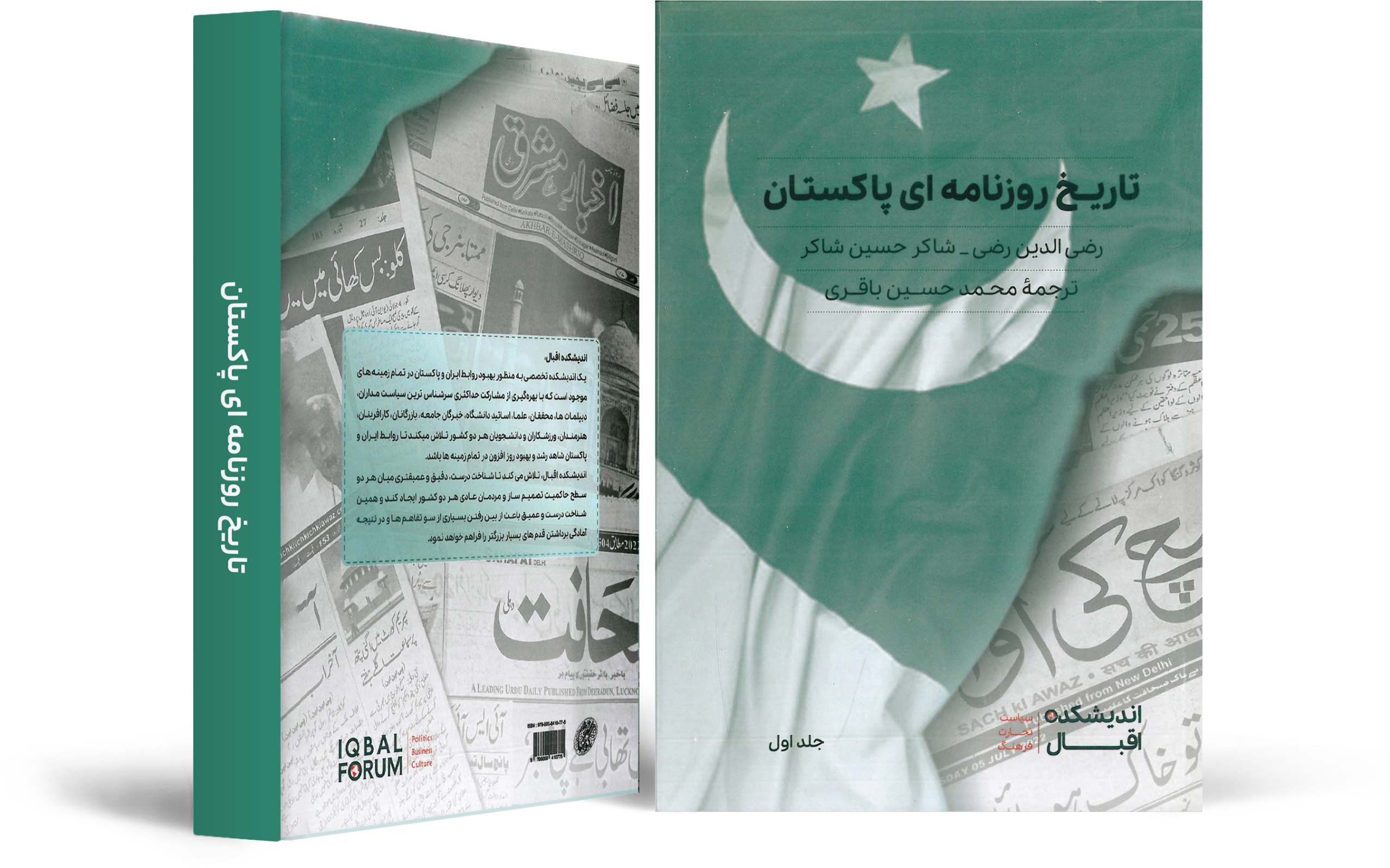
The Newspaper History of Pakistan (Volume 1)

تاریخ روزنامه‌ای پاکستان (جلد اول)

Compiler & Author: Razi-ud-Din Razi, Shakir Hussain Shakir

Translator: Muhammad Hussain Baqeri

This book presents Pakistan’s history through the lens of newspapers and media reports. The authors analyze headlines and journalistic accounts to narrate major political and social events. It highlights the role of the press in shaping public opinion and national developments. Volume One focuses on the early phases of Pakistan’s history.

Pages 638
Timeline Stops 62
Translator Muhammad Hussain Baqeri
Book Timeline

Book Timeline

August 14, 1947 - Independence of Pakistan

Pakistan was established as an independent Muslim country at midnight. Muhammad Ali Jinnah, known as Quaid-e-Azam, became the first Governor-General, and Liaquat Ali Khan was appointed as the first Prime Minister. This marked the culmination of the independence movement and the official start of Pakistan's political life.

August 15, 1947 - Oath Ceremony

Quaid-e-Azam and Liaquat Ali Khan officially took their oaths. Simultaneously, commanders of the army, air force, and navy, as well as governors of Punjab, East Bengal, Sindh, and the Frontier (now Khyber Pakhtunkhwa) were appointed, indicating the rapid establishment of the country's administrative and military structure.

Radcliffe Award Announced

The Radcliffe Award, which determined the new borders between India and Pakistan, was officially announced. This partition, based on the 1941 census, allocated Muslim-majority areas to Pakistan but was controversial and problematic.

August 18, 1947 - UN Membership Application

Pakistan applied for membership in the United Nations. This was the first diplomatic step to gain a position in the international community and recognition of the new country's sovereignty.

August 22, 1947 - Diplomatic Relations Established

Pakistan and Iran decided to establish diplomatic relations, highlighting the importance of ties with Muslim neighbors and efforts to create a regional position for the new nation.

September 4, 1947 - Attack on Poonch

The Maharaja of Kashmir, with the help of the Dogra army, attacked Muslims in the Poonch region. This event ignited the conflict in Kashmir and marked the beginning of the first Indo-Pakistani war.

September 15, 1947 - Junagadh's Accession Decision

The rulers of Junagadh decided to accede to Pakistan. Although this decision was ultimately nullified by India, it highlighted the complexities of the accession process of princely states.

September 30, 1947 - Pakistan Joins United Nations

Pakistan's membership in the United Nations was officially accepted, solidifying its sovereignty on the international stage and recognizing its status as an independent nation by the global community.

October 22, 1947 - Indian Army's Manoeuvre

The Indian army attacked the Manavadar region, arresting and exiling its Muslim governor. This military action heightened tensions in the princely states and provoked the anger of Pakistani Muslims.

October 27, 1947 - Indian Military Intervention in Kashmir

India deployed military aircraft and troops to Kashmir, declaring the state's accession to India. This direct military intervention escalated the Kashmir conflict into a full-scale war between the two countries.

December 23, 1947 - Division of All-India Muslim League

The All-India Muslim League split into two separate parties for India and Pakistan after 41 years of activity. This event marked the end of an era of Muslim politics in the subcontinent and the beginning of new political structures in the two independent countries.

December 31, 1947 - India Appeals to UN on Kashmir Issue

India formally appealed to the United Nations to resolve the Kashmir issue. This action internationalized the conflict and paved the way for UN involvement in the coming years.

1947 - Challenges Post-Independence

Despite the successful establishment of the country, unresolved Kashmir issue and deep refugee crisis posed significant challenges.

January 20, 1948 - January 20

The United Nations agreed to the proposal to form the 'Kashmir Committee'. This decision was the first practical step by the international community to mediate in the conflict.

February 21, 1948 - February 21

Yahya Kemal arrived in Karachi as the first Turkish ambassador to Pakistan. This event marked the expansion of Pakistan's diplomatic relations with influential Muslim countries.

March 24, 1948 - March 24

In his speech at Dhaka University, Quaid-e-Azam declared that Urdu would be the 'only and only' common language of the people of Pakistan. Although aimed at national unity, this stance sowed seeds of future discontent due to the neglect of the Bengali language.

March 27, 1948 - March 27

The region of Kalat was formally annexed to Pakistan. This annexation was a significant step towards completing the territorial integrity of Western Pakistan.

April 1, 1948 - April 1

New coins and banknotes of Pakistan were unveiled. This symbolic act represented the country's economic independence and monetary sovereignty.

June 15, 1948 - June 15

Khan Abdul Ghaffar Khan, a prominent Pashtun political leader, was arrested for actions against the government and sentenced to three years in prison. This arrest marked an escalation in the central government's crackdown on ethnic leaders and political opponents.

July 1, 1948 - July 1

The State Bank of Pakistan was officially inaugurated. This event marked a milestone in establishing an independent financial system and controlling the country's monetary policies.

September 11, 1948 - September 11

Muhammad Ali Jinnah, the founder of Pakistan, passed away at 10:25 PM. His death plunged the country into shock and mourning, depriving Pakistan of a leader who was a symbol of unity and independence.

September 14, 1948 - September 14

Khawaja Nazimuddin was sworn in as the second Governor-General of Pakistan. This appointment was the first step in filling the power vacuum following Jinnah's death.

December 25, 1948 - December 25

The United Nations Kashmir Commission announced that the Kashmir issue would soon be resolved. This announcement raised hopes for ending the conflict through diplomacy, although the realities on the ground were more complex.

January 1, 1949 - January 1

The United Nations Kashmir Commission announced a ceasefire in Kashmir starting at midnight. This ceasefire ended the first Indo-Pakistani war but left the final status of Kashmir unresolved.

January 24, 1949 - January 24

The government of West Punjab led by Mamdot was dissolved. This marked the beginning of central government intervention in provincial affairs and intensified internal rivalries within the Muslim League.

February 19, 1949 - February 19

The first major conference of the Muslim League after the establishment of Pakistan was held in Karachi, and Chaudhry Khaliquzzaman was elected as the first president of the party. This conference aimed to redefine the role and structure of the party in the post-independence era.

March 7, 1949 - March 7

Prime Minister Liaquat Ali Khan presented the "Objectives Resolution" in the assembly. This resolution, which established divine sovereignty and Islamic principles as the basis for the future constitution, became a foundational document in Pakistan's legal and political history.

March 12, 1949 - March 12

The "Objectives Resolution" was passed by a majority in the Pakistan parliament. This approval defined the Islamic orientation of the future state and sparked deep debates about the role of religion in politics.

June 14, 1951 - June 14

The Prime Minister declared that Pakistan would not allow Kashmiri Muslims to become "slaves of infidels." This firm stance reflected Pakistan's commitment to supporting the self-determination of Kashmiri Muslims.

July 18, 1951 - July 18

A joint military conference between India and Pakistan was held in Karachi to establish a ceasefire line. These talks resulted in the establishment of the "Line of Control," effectively dividing Kashmir into two parts.

October 14, 1951 - October 14

The border between Pakistan and China's Xinjiang province was defined. This was an important step in delineating and stabilizing the country's northern borders.

November 1, 1951 - November 1

Banknotes that had only the word "Pakistan" instead of "Government of Pakistan" were declared invalid. This move was an effort to standardize and solidify symbols of state sovereignty.

December 13, 1951 - December 13

Maulana Shabbir Ahmad Usmani, a prominent Pakistani scholar, passed away in Karachi. His death was a loss to the religious community and the Islamic state movement.

January 4, 1950 - January 4

Pakistan officially recognized the People's Republic of China. This move made Pakistan one of the first non-communist countries to recognize the new Chinese government, reflecting a pragmatic foreign policy.

February 18, 1950 - February 18

The Treaty of Friendship between Iran and Pakistan was signed. This treaty strengthened the historical and cultural ties between the two neighboring countries.

April 8, 1950 - April 8

The Liaquat-Nehru Pact was signed in Delhi. This pact, emphasizing the protection of religious minorities' rights in both countries, was a significant step towards reducing sectarian violence and building trust between the two nations.

May 3, 1950 - May 3

Liaquat Ali Khan began his official visit to the United States. This visit, aimed at garnering economic and political support, laid the foundation for Pakistan's future strategic alliance with the USA.

June 24, 1950 - June 24

The agreement for the trade of essential goods between India and Pakistan was signed. This agreement highlighted the necessity of economic cooperation despite political tensions.

September 24, 1951 - Ayub Khan Appointed

General Ayub Khan was appointed as the successor to General Gracy and the first Pakistani commander of the army. This appointment marked a turning point in the 'Pakistanization' of the armed forces and strengthening national control over military institutions.

September 28, 1951 - Constitutional Principles Report

The report of the Basic Principles Committee was presented in the assembly. This report, which proposed a federal and Islamic structure of government, sparked extensive debates among political and regional factions.

November 21, 1951 - Opposition Conference in Lahore

A conference with opposition parties, including Jamaat-e-Islami and Awami League, was held in Lahore. This was not merely a temporary event but marked the beginning of a structured and multi-party opposition front, rooted in regional and political discontent.

December 7, 1951 - Urdu Language Policy

The government ordered all official departments to send their correspondence in Urdu. This policy was another effort to promote Urdu as the national language but intensified dissatisfaction among Bengali speakers.

February 25, 1951 - February 25

A new trade agreement was signed between India and Pakistan. Despite political tensions, this agreement highlighted the economic interdependence of the two countries.

March 9, 1951 - March 9

The government announced the discovery of a plot to overthrow the regime, known as the 'Rawalpindi Conspiracy'. General Akbar Khan, Faiz Ahmed Faiz (a prominent poet), and other leftist officers and intellectuals were arrested. This event was the first serious indication of military involvement in politics.

April 5, 1951 - April 5

The Pakistan Parliament approved the establishment of the 'Iqbal Academy'. This initiative aimed to promote the thoughts and philosophy of Allama Iqbal, the national poet and philosopher, as one of the ideological foundations of the country.

June 23, 1951 - June 23

The government announced that Indian forces had been deployed near the Pakistani borders. This military movement heightened tensions once again and cast the shadow of war over the two countries.

July 15, 1951 - July 15

Liaquat Ali Khan declared in a speech that Pakistan would never succumb to India's threats and would use an 'iron fist' against them. This resolute speech reflected Pakistan's determination to defend its sovereignty.

October 16, 1951 - October 16

Liaquat Ali Khan, the Prime Minister of Pakistan, was assassinated during a speech in Rawalpindi. This event was a devastating blow to the country's political stability, depriving Pakistan of an experienced leader from the founding generation.

October 17, 1951 - October 17

Khawaja Nazimuddin was sworn in as the new Prime Minister and Ghulam Muhammad as the Governor-General. These swift leadership changes were an attempt to prevent a power vacuum but failed to curb political instability.

October 24, 1951 - October 24

Following the Prime Minister's assassination, a state of emergency was declared in the country. This move indicated the government's deep concern over the security and political implications of the crisis.

November 26, 1951 - November 26

Khawaja Shahabuddin was appointed as the Governor of the Frontier and Sardar Abdur Rab Nishtar as the Governor of Punjab. These appointments were part of the extensive power structure changes following Liaquat Ali Khan's death.

January 27, 1952 - January 27

Prime Minister Khawaja Nazimuddin reiterated in Dhaka that Urdu would be the only official language of Pakistan. This speech further ignited anger and protests among Bengali speakers.

February 21, 1952 - February 21

During student protests in Dhaka for the recognition of the Bengali language, police fired on the protesters, resulting in several deaths. This day became a symbol of cultural resistance and Bengali identity, deepening the divide between East and West Pakistan.

February 26, 1952 - February 26

Bengali students in Karachi also protested by boycotting classes, showing solidarity with the language movement. This action demonstrated that the language issue had become a national crisis.

March 12, 1952 - March 12

The Federal Court of Pakistan declared the "Public Safety Act" unconstitutional. This ruling was a victory for civil liberties and limited the government's power to suppress dissent.

March 21, 1952 - March 21

The East Bengal Assembly was suspended indefinitely due to police firing on protesters. This action indicated the paralysis of political processes in the state following the language crisis.

April 10, 1954 - April 10

The Legislative Assembly of Pakistan postponed the discussion and selection of the country's official language to future sessions. This decision was a tactical retreat by the government under pressure.

October 12, 1953 - October 12

Khawaja Nazimuddin was elected as the leader of the Muslim League party. This election was an effort to consolidate his power in the ruling party amidst political challenges.

December 22, 1952 - December 22

The Basic Principles Committee released its report, proposing equal representation for West and East Pakistan in the federal parliament. This proposal aimed to balance power between the two regions of the country.

Year 1953

Internal unrest and the first martial law

March 6, 1953 - March 6

Following widespread anti-Ahmadiyya riots in Lahore, martial law was declared in the city. This was the first time the military was used to control internal unrest in a major Pakistani city, marking a turning point in the country's civil-military relations.

April 17, 1953 - April 17

Governor-General Ghulam Muhammad, in a sudden and controversial move, dismissed the government of Khawaja Nazimuddin. This action, justified by the government's inability to manage the economic crisis, dealt a serious blow to the principles of parliamentary democracy.