


پاکستان: ۵۸ سال

Book Podcast

Book Profile

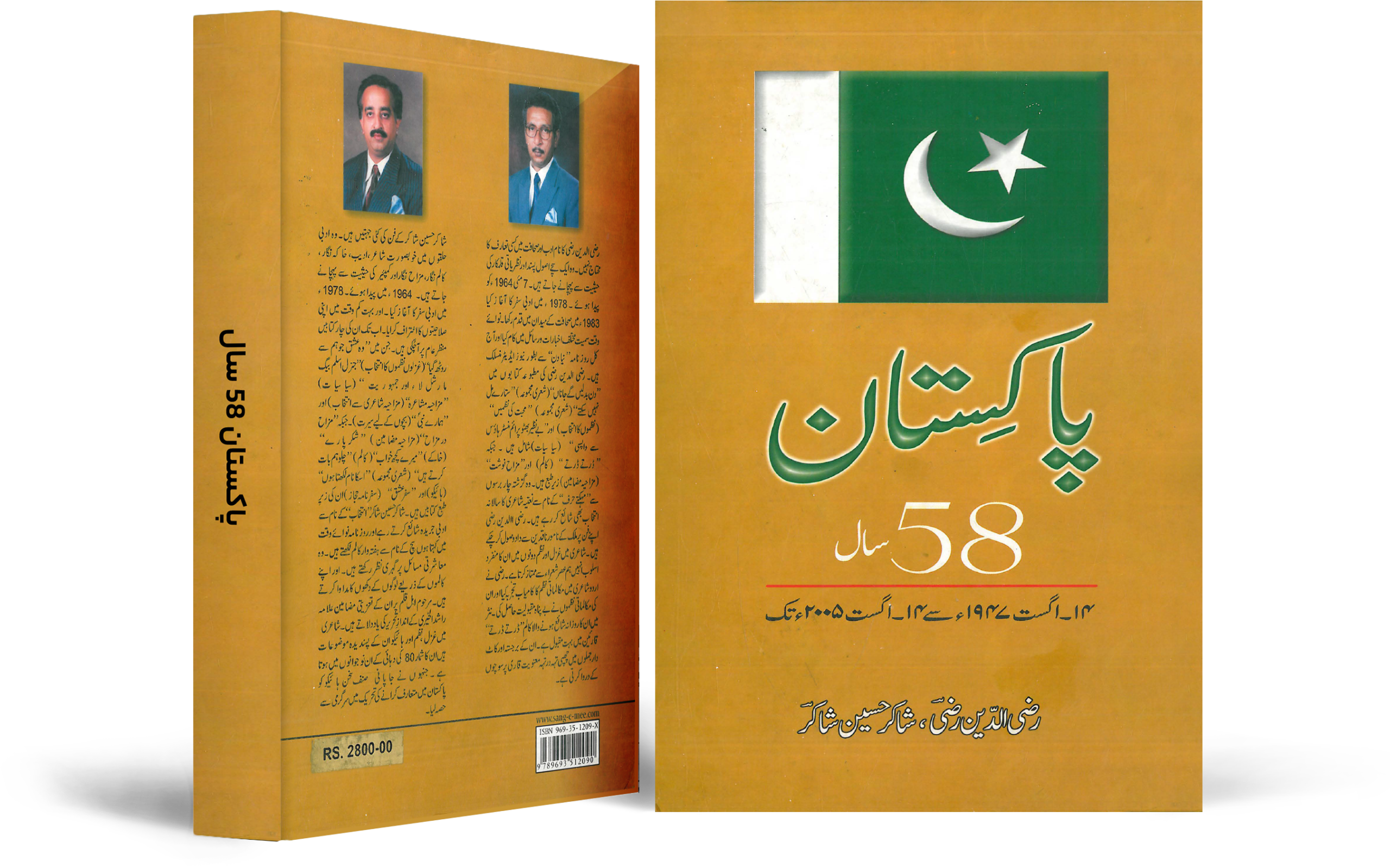
Pakistan: 58 Years

پاکستان: ۵۸ سال

Compiler & Author: Razi-ud-Din Razi, Shakir Hussain Shakir

This book provides a historical overview of Pakistan’s first 58 years, from 1947 to 2005. The authors examine major political events, regime changes, and social developments during this period. It highlights the roles of key leaders, wars, and significant reforms. The book offers a concise account of Pakistan’s historical trajectory in its early decades.

Pages 1331
Timeline Stops 17
Book Timeline

Book Timeline

October 26, 1947 - Maharaja's Request

The Maharaja of Kashmir formally requested military intervention from the Indian government amid threats. Significance: This request provided the legal basis for the Indian army's entry into Kashmir, officially starting the first Indo-Pakistani war.

October 27, 1947 - Indian Troops Land

India airlifted its troops into Kashmir and declared the state's accession to New Delhi. General Gracy, the commander of the Pakistani army, refused to execute Quaid-e-Azam Muhammad Ali Jinnah's order to mobilize forces in response.

December 3, 1947 - Mass Migration

It was announced that 4 million Muslims had migrated from East Punjab and Delhi to Pakistan. Significance: This highlighted the unprecedented scale of the refugee crisis and the immense pressure on the nascent state's economic and social infrastructure.

December 6, 1947 - Financial Settlement

The Indian government agreed to pay 750 million rupees from Pakistan's share of assets. Significance: This temporary agreement resolved a major financial dispute that had strained early relations between the two countries, providing vital funds for Pakistan.

December 8, 1947 - Joint Defense Council

The Joint Defense Council, chaired by Lord Mountbatten, met in Lahore to address the Kashmir issue. Significance: This meeting highlighted the high-level but ultimately unsuccessful efforts of post-partition joint institutions to contain the escalating conflict.

December 9, 1947 - December 9

Pakistan and India reached an agreement on the division of military assets, arms factories, and financial matters. Importance: This agreement was crucial for establishing and equipping Pakistan's independent armed forces and laying the financial foundations of the state.

December 22, 1947 - December 22

Quaid-e-Azam Muhammad Ali Jinnah took oath as the first Chief Scout of Pakistan and ordered the establishment of the Pakistan Red Cross Society. Importance: These actions were symbolic steps in creating national institutions and identities distinct from British and Indian colonial structures.

December 24, 1947 - December 24

A call was issued for a national conference of scholars to discuss national issues. Importance: This call was an early indication of efforts to involve religious leaders in shaping the identity and policies of the new state.

January 20

The United Nations passed a resolution calling for the establishment of a commission to facilitate a referendum in Kashmir. Significance: This resolution established the principle of a referendum as the international solution to the Kashmir dispute and laid the foundation for Pakistan's diplomatic stance for decades.

January 23

Afghanistan and Pakistan decided to establish diplomatic relations. Significance: Despite border disputes over the Durand Line, this was a necessary step toward normalizing relations between the two neighboring Muslim countries.

March 27

The state of Kalat officially joined Pakistan. Significance: The annexation of Kalat, the largest princely state, completed the territorial integrity of West Pakistan, although the process faced resistance that later fueled tensions in Balochistan.

March 28

Pakistan opposed Israel's membership in the United Nations. Significance: This was one of Pakistan's earliest foreign policy stances, demonstrating its commitment to solidarity with the Arab world.

April 1

India cut off water flow in the Upper Bari Doab canal, damaging Pakistani agricultural lands. Significance: This action escalated the water resources dispute to a critical point in India-Pakistan relations, showing how infrastructure issues can become highly political.

July 1, 1948 - July 1

Quaid-e-Azam Muhammad Ali Jinnah inaugurated the State Bank of Pakistan in Karachi. Significance: This was a vital symbol of Pakistan's economic independence and a crucial step towards establishing a monetary system separate from India. It was Jinnah's last major public appearance before his death.

September 11, 1948 - September 11

Quaid-e-Azam Muhammad Ali Jinnah, the founder of Pakistan, passed away after a prolonged illness. Significance: His death created a massive political and spiritual void in the country, depriving Pakistan of its charismatic leadership.

September 14, 1948 - September 14

Khawaja Nazimuddin was sworn in as the second Governor-General of Pakistan. Significance: This swift and constitutional transfer of power demonstrated the stability of the nascent system, but also marked a shift from charismatic leadership to a more traditional political style.

October 9, 1949 - October 9

Abdur Rashid was appointed as the first Chief Justice of the Federal Court of Pakistan. Significance: This appointment was a crucial step in establishing an independent judiciary and completing the structure of the three branches of government in the new state.