


Independence Celebrations
August 14, 1947: Independence of Pakistan and India is celebrated. "Agha Muhammad Yahya Khan" speaks as the senior Pakistani officer at the Quetta Club celebration.
Book Podcast
Book Profile
برداشتها از رهبری در پاکستان
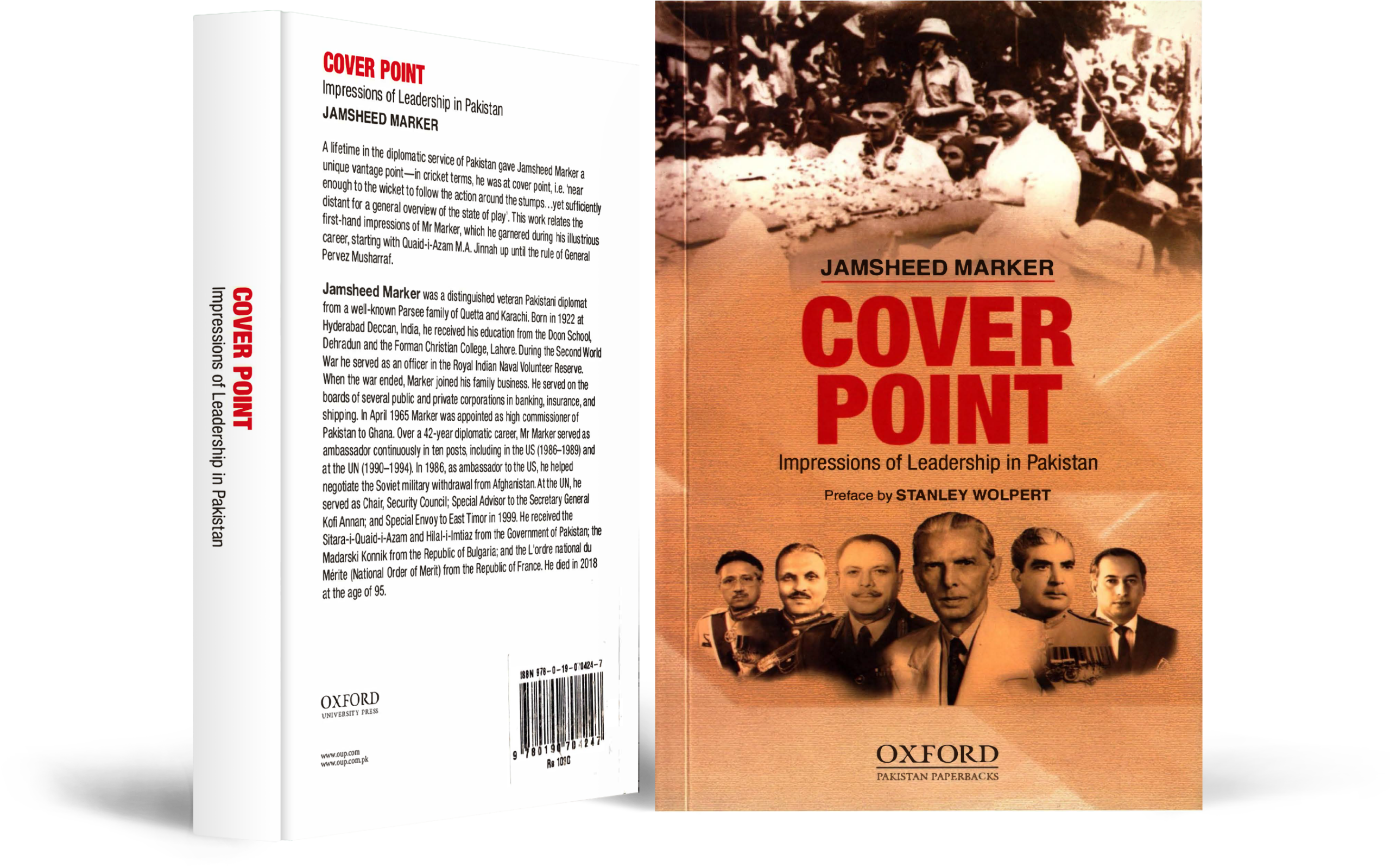
Compiler & Author: Jamsheed Marker
Cover Point by Jamsheed Marker reflects on his four decades of diplomatic service in Pakistan. Writing from the perspective of someone both close to power and analytically distanced—borrowing the cricket term “cover point”—Marker offers personal insights into the country’s most powerful leaders. He examines their policies, personalities, and the influence of courtiers, flattery, and inner circles on decision-making. The book provides reflective commentary on leadership challenges from the time of Pakistan’s founder through later political eras.
August 14, 1947: Independence of Pakistan and India is celebrated. "Agha Muhammad Yahya Khan" speaks as the senior Pakistani officer at the Quetta Club celebration.
"Muhammad Ali Jinnah", the founder of Pakistan, passes away. "Khawaja Nazimuddin" becomes Governor-General and "Liaquat Ali Khan" becomes Prime Minister.
"Liaquat Ali Khan" offers "Jamshed Marker" to join Pakistan's foreign service, but "Marker" declines due to family commitments.
"Liaquat Ali Khan" is assassinated during a public speech in Rawalpindi. "Ghulam Muhammad" becomes Governor-General and "Khawaja Nazimuddin" is appointed Prime Minister.
"Ghulam Muhammad" uses Article 10 of the interim constitution to dismiss Prime Minister "Khawaja Nazimuddin". This action is considered the first coup in Pakistan's history.
Iskander Mirza becomes the Governor-General of Pakistan.
Pakistan becomes a republic and Iskander Mirza becomes its first President.
Huseyn Shaheed Suhrawardy, after becoming Prime Minister, establishes friendly relations between Pakistan and the People's Republic of China and leads a large delegation to Beijing.
President Iskander Mirza abrogates the constitution and declares martial law. Zulfikar Ali Bhutto joins the cabinet as Minister of Commerce, and Ayub Khan is appointed as the head of martial law.
Ayub Khan, in a peaceful yet dramatic move, removes Iskander Mirza from power and exiles him to London. Ayub Khan becomes the President of Pakistan.
Jamshed Marker meets Ayub Khan and is confirmed as Pakistan's High Commissioner to Ghana.
The Indo-Pakistani War occurs.
Ayub Khan and Lal Bahadur Shastri sign the Tashkent Agreement. Zulfiqar Ali Bhutto strongly criticizes Ayub Khan after the agreement.
Zulfiqar Ali Bhutto establishes the Pakistan People's Party (PPP).
Ayub Khan suffers a heart attack and goes to Texas for treatment, leading to a decline in his confidence and power.
Ayub Khan, opposed by leaders Zulfiqar Ali Bhutto and Sheikh Mujibur Rahman, transfers his martial law authority to General Yahya Khan. Yahya Khan abolishes the constitution and declares martial law.
Yahya Khan and Nixon meet at the Governor's House in Lahore, initiating plans for US-China rapprochement.
Jamsheed Marker meets with Yahya Khan, who announces his intention to visit Moscow.
Yahya Khan visits the Soviet Union, reaching significant agreements on a steel mill and other economic issues. He declines Yuri V. Gankovsky's proposal to resume Soviet arms supply.
Yahya Khan conducts free and fair elections. The Awami League (Mujib) and Pakistan People's Party (Bhutto) achieve decisive victories, leading to a political crisis.
Pakistan loses the Indo-Pakistani War, leading to the creation of Bangladesh. Yahya Khan resigns, and Zulfikar Ali Bhutto becomes President and the first civilian Chief Martial Law Administrator.
Zulfikar Ali Bhutto meets with Pakistani nuclear scientists in a secret meeting in Multan, emphasizing the importance of acquiring nuclear capability for national security.
Zulfikar Ali Bhutto signs the Simla Agreement with India, leading to the return of occupied territories and the repatriation of prisoners of war.
Nixon visits China and signs the Shanghai Communiqué.
The new constitution of Pakistan is adopted, transferring power to the Prime Minister, with Bhutto assuming the role.
Zulfikar Ali Bhutto hosts the Lahore Islamic Summit and successfully manages the recognition of Bangladesh.
Zulfikar Ali Bhutto passes parliamentary law declaring Ahmadis/Qadianis a minority.
Ahmad Raza Kasuri files a murder complaint against Zulfikar Ali Bhutto.
The Federal Security Force (FSF) under Bhutto reaches 18,000 personnel equipped with automatic weapons, grenades, and rocket launchers.
Zulfikar Ali Bhutto holds general elections that are heavily rigged, leading to widespread public protests.
General Muhammad Zia-ul-Haq stages a coup, arresting Zulfikar Ali Bhutto and other political leaders. Zia-ul-Haq declares martial law.
The Supreme Court justifies Zia-ul-Haq's martial law citing the 'doctrine of necessity'.
The Lahore High Court declares Zulfikar Ali Bhutto the 'main culprit' and sentences him to death.
In an interview with Gavin Young of the Observer, Zia-ul-Haq states he will release Bhutto if the Supreme Court finds him innocent, or execute him if sentenced to death.
Diana Marker, wife of Jamsheed Marker, passed away due to cancer.
Zulfikar Ali Bhutto is executed in Rawalpindi Jail.
The Soviet invasion of Afghanistan occurs, transforming Pakistan's status from a "pariah state" to an international "hero."
Martial law in Pakistan is finally lifted, and Muhammad Khan Junejo is appointed as Prime Minister.
Benazir Bhutto returns to Pakistan from exile and is met with widespread public support.
India's Operation Brasstacks leads to military tensions with Pakistan, which are managed diplomatically by Zia-ul-Haq.
The Geneva Accords regarding the withdrawal of Soviet forces from Afghanistan are signed.
Zia-ul-Haq uses his political 'nuclear option' to dissolve Prime Minister Junejo and the parliament.
General elections are held in Pakistan, and Benazir Bhutto and the Pakistan People's Party win.
Benazir Bhutto is sworn in as Prime Minister of Pakistan. Ghulam Ishaq Khan becomes President.
General Zia-ul-Haq's plane crashes in the Bahawalpur desert, killing him and US Ambassador Arnold Raphel. Ghulam Ishaq Khan becomes President.
Benazir Bhutto visits Washington D.C. and addresses the US Congress.
Nawaz Sharif is appointed as the Prime Minister of Pakistan.
General Asif Nawaz replaces General Aslam Beg as the Army Chief.
Nawaz Sharif leads the Pakistani delegation at the UN Conference on Environment and Development (UNCTAD) in Rio de Janeiro.
General Asif Nawaz dies of a heart attack, and General Abdul Waheed Kakar replaces him.
Ghulam Ishaq Khan dismisses Nawaz Sharif using Article 8 powers.
General Waheed Kakar mediates an agreement leading to the resignation of both Ghulam Ishaq Khan and Nawaz Sharif. A neutral interim government is formed to conduct elections, with Moeenuddin Qureshi appointed as interim Prime Minister.
Moeen Qureshi conducts free and fair elections leading to the victory of the Pakistan People's Party.
Benazir Bhutto becomes Prime Minister for the second time.
Muhammad Khan Junejo passes away due to cancer.
General Pervez Musharraf organizes the UN Peace Conference at GHQ in Rawalpindi. Jamsheed Marker participates.
General Jahangir Karamat replaces General Abdul Waheed Kakar as the Army Chief.
Murtaza Bhutto, brother of Benazir Bhutto, passed away.
Nawaz Sharif becomes Prime Minister for the second time with a decisive majority.
Nawaz Sharif appoints General Pervez Musharraf as Army Chief.
Pakistan conducts six nuclear tests in response to India's nuclear tests.
Relations between Pakistan and India deteriorate after the Kargil conflict.
Pervez Musharraf seizes power following the hijacking of his plane and the arrest of Nawaz Sharif, forcing Nawaz Sharif into exile in Saudi Arabia.
Pervez Musharraf issues the National Reconciliation Ordinance (NRO).
Pervez Musharraf resigns.

AI Assistant
Fast and reliable answers