



1947 - Independence of Pakistan
Pakistan's independence and the beginning of efforts to gain knowledge in new scientific fields.
Book Podcast
Book Profile
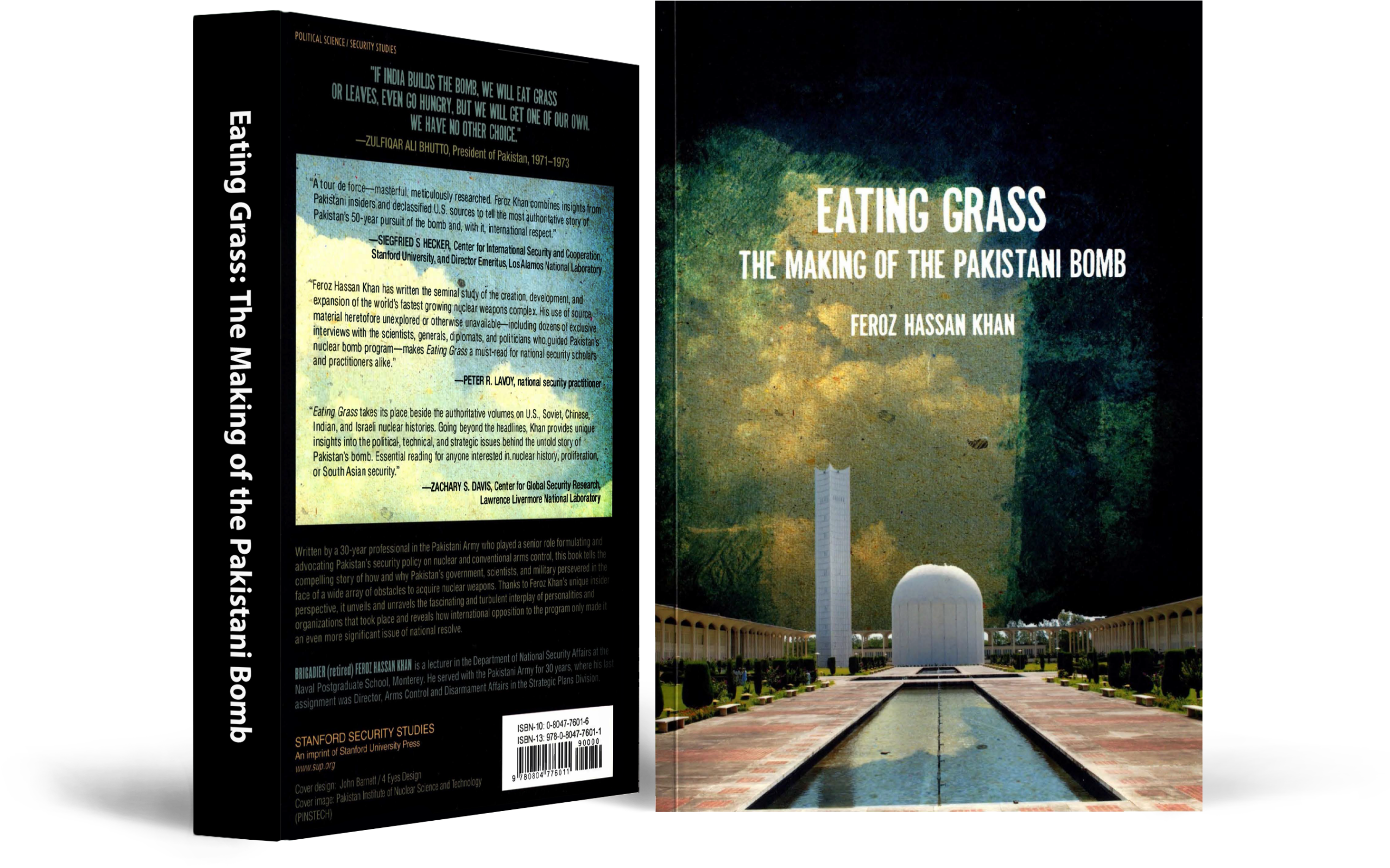
خوردن علف: شکلگیری بمب پاکستانی
Compiler & Author: Feroz Hassan Khan
This book traces the development of Pakistan’s nuclear program from the 1960s to the nuclear tests of 1998. It explains how security threats—especially after the 1971 defeat and India’s nuclear advancements—pushed Pakistani leaders toward nuclear deterrence. The author discusses the roles of key figures such as Zulfikar Ali Bhutto and Abdul Qadeer Khan, along with scientific, financial, and diplomatic challenges. The book also examines the strategic, political, and ethical implications of nuclear weapons for Pakistan and the wider region.
Pakistan's independence and the beginning of efforts to gain knowledge in new scientific fields.
The passing of Muhammad Ali Jinnah, the founder of Pakistan.
In 1950, Ayub Khan, as commander of the 14th Division in Dhaka (East Pakistan), witnessed Bengali dissatisfaction with Pakistan's policies.
Dr. Rafi Muhammad Chaudhry began building a particle accelerator at the university.
Assassination of Prime Minister Liaquat Ali Khan.
Start of the Bengali Language Movement after protesting students were killed outside Dhaka University.
Governor-General Ghulam Muhammad dismissed Prime Minister Nazimuddin and replaced him with Muhammad Ali Bogra.
President Eisenhower presented the 'Atoms for Peace' plan at the United Nations General Assembly.
The United States amended its Atomic Energy Act to allow the transfer of nuclear technology.
Nazir Ahmad led the Pakistani delegation at the International Conference on the Peaceful Uses of Atomic Energy in Geneva.
Pakistan decided to enhance its provisional nuclear activities by establishing a more formal Pakistan Atomic Energy Commission (PAEC) with Nazir Ahmad as its first chairman.
Pakistan and the United States signed an agreement to cooperate in the civilian and peaceful uses of atomic energy.
PAEC established a small laboratory in Karachi for the initial training of scientists and engineers.
Ayub Khan seized power in the 'October Revolution', marking the start of a decade of stability and growth in Pakistan.
PAEC discovered radioactivity in the Sulaiman Range in the DG Khan area.
Pakistan's Foreign Minister, Manzur Qadir, proposed a border agreement with China.
Ayub Khan appointed Ishrat Hussain Usmani as the head of PAEC. Zulfiqar Ali Bhutto also assigned one of his ministerial duties to fuel, power, and natural resources, which included PAEC.
SUPARCO (Space and Upper Atmosphere Research Commission) was initially established as the space science research branch of PAEC.
Pakistan and China officially announced their intention to begin border negotiations in October.
The war between India and China began.
Drilling began in a hundred-kilometer belt in the areas of Rakhi, Baghalchur, and Rajanpur.
Bhutto signed a border agreement with China.
The assassination of President Kennedy ended serious U.S. mediation between India and Pakistan over Kashmir.
China conducted its first nuclear test at Lop Nur, sparking nuclear debates in India and Pakistan.
The official establishment of KANUPP by the Executive Committee of the National Economic Council.
Pakistan signed an agreement to build a CANDU reactor with General Electric Canada.
Ayub Khan visited Beijing and Moscow.
Armed clashes in the Rann of Kutch region between India and Pakistan.
Pakistan's infiltration into Indian-controlled Kashmir began in Operation Gibraltar.
Operation Grand Slam was launched by the Pakistani Army in Kashmir.
The Second Kashmir War between India and Pakistan. The United States cut military aid to both countries.
Pakistan accepted the UN-backed ceasefire.
The PARR-I reactor at PINSTECH reached criticality (self-sustaining).
The PINSTECH reactor reached full power of 5 megawatts.
Bhutto traveled to Europe after being dismissed as Foreign Minister and delivered anti-India speeches.
Usmani, head of PAEC, gave a speech at the Army Headquarters (GHQ) on the role of power reactors and the nuclear fuel cycle in nuclear weapons development.
Founding of the Pakistan People's Party (PPP) by Zulfikar Ali Bhutto.
A United Nations study estimated that a complete nuclear weapons program requires a complex material and human base.
Early 1970: Mahmood began work on Yusuf, a senior member of East Pakistan's PAEC.
AEMC engineers and scientists designed and built a pilot plant with a capacity of ten thousand pounds per day for concentrating extracted uranium ore.
The Pakistani army launched an operation against Bengali insurgents in Dhaka, leading to a civil war in East Pakistan.
Yahya Khan assisted Henry Kissinger in arranging a secret visit to Beijing.
The fall of Dhaka and Pakistan's defeat in the war with India.
Zulfikar Ali Bhutto became the President of Pakistan.
PAEC scientists' conference held in Multan.
Munir Ahmad Khan officially replaced Dr. I. H. Usmani as PAEC Chairman.
Zulfikar Ali Bhutto inaugurated KANUPP.
PINSTECH initiated a local program to produce uranium oxide fuel.
Pakistan hosted the summit of thirty-eight Islamic countries representing the Organization of Islamic Conference (OIC).
India conducted its first nuclear test in Pokhran.
Munir Ahmad Khan stated that India's nuclear test opened the floodgates for nuclear weapons.
Prime Minister Bhutto convened a meeting of the Cabinet Defence Committee (DCC).
Dr. Abdul Qadeer Khan wrote to Prime Minister Bhutto, offering his expertise in gas centrifuge technology.
Dr. Khan sent another letter to Bhutto, explaining the importance of highly enriched uranium (HEU) as an alternative to plutonium.
PAEC officially launched the secret uranium enrichment plan codenamed "Project 706."
Prime Minister Bhutto allocated $350 million for several PAEC initiatives, including a centrifuge plant for uranium enrichment and a uranium mine at Baghalchur (BC-1) in the Dera Ghazi Khan valley.
Assassination of Hayat Sherpao, a close associate of Bhutto, in Peshawar.
Abdul Qadeer Khan left Europe and arrived in Pakistan.
Abdul Qadeer Khan officially joined the enrichment project.
France approved the sale of a reprocessing plant to Pakistan, and the following month an agreement was reached between Pakistan and the International Atomic Energy Agency (IAEA).
Bhutto signed a strategic agreement with China, which included military, nuclear, and other civilian agreements.
Canada cut off the supply of nuclear fuel, heavy water, spare parts, and technical support to KANUPP.
The Pakistani army took power after four months of violent protests. General Zia-ul-Haq ruled Pakistan for eleven years.
Joseph Nye Jr., a nuclear expert from the U.S. State Department, visited Islamabad and threatened to cut economic aid.
The first shipment of inverters for the enrichment project was sent from Europe to Pakistan.
A centrifuge at the Sihah plant successfully enriched uranium.
Completion of the inverter order from Europe.
Pakistan completed its first uranium enrichment.
The Soviet Union invaded Afghanistan.
Iran, Saudi Arabia, and Libya loaned Pakistan 450 million dollars.
Abdul Qadeer Khan wrote to his friend in Canada, Abdul Hafeez Khan, about a major success at ERL (Engineering Research Laboratories).
Charles Van Doren, Assistant Director of the Arms Control and Disarmament Agency (ACDA), expressed his suspicion in testimony to the General Advisory Committee on Arms Control and Disarmament that Pakistan would soon be ready to test a nuclear device.
Nuclear test sites in Balochistan needed to be prepared.
Nuclear test sites were prepared.
Establishment of the Diagnostics Directorate.
13-megaton heavy water plant in Multan completed with Belgian assistance.
Israeli planes attacked and destroyed Iraq's Osirak nuclear reactor.
An earthquake destroyed four thousand centrifuges at the Khan Research Laboratories (KRL).
Zia-ul-Haq visited ERL and renamed it to KRL.
Pakistan successfully conducted its first cold test of an operational nuclear device.
Pakistan's Northern Command Forces (FCNA) observed Indian helicopters deploying troops in the heights of the Saltoro Range in the Siachen Glacier region.
Assassination of Indira Gandhi by her Sikh bodyguards.
Abdul Qadeer Khan publicly announced that Pakistan was capable of uranium enrichment.
Pakistan and China signed a new nuclear cooperation agreement.
PAEC held the exhibition "Atoms for Development - 1986".
General Arif was informed about India's preparations for the "Brasstacks" exercise.
Abdul Qadeer Khan stirred controversy in an interview with a Pakistani journalist, highlighting Pakistan's nuclear achievements.
Work began on the 40-50 MW Khushab production reactor.
The Khushab-1 Heavy Water Production Plant (KCP-I) was initiated.
The non-attack agreement on nuclear facilities between India and Pakistan was formalized.
Brent Scowcroft, the US National Security Advisor, warned General Beg that certifying Pakistan's nuclear activities would no longer be routine.
Pakistan received 'credible information' of another preemptive strike plan by India and Israel.
China transferred M-11 or DF-11 missile technology to Pakistan.
General Beg criticized US policy in the attack on Iraq.
Representatives from KRL and Pakistani government officials visited the Sanum Dong missile development center in North Korea.
Pakistani and Iranian engineers visited North Korea to observe the first Nodong missile test launch.
General Abdul Waheed was appointed as the Chief of Army Staff (COAS).
Prime Minister Sharif criticized President Ghulam Ishaq Khan in a televised speech.
President Ghulam Ishaq Khan dismissed the government and parliament.
The Supreme Court overturned the President's decision and reinstated Sharif.
Elections brought Benazir Bhutto to power.
The Combat Development Directorate officially took over nuclear coordination responsibilities from the COAS.
Benazir Bhutto visited Pyongyang and signed a deal to purchase Nodong missiles.
NDC and AWC successfully completed cold tests for aerial delivery.
After years of cold testing with aerial launches, PAEC achieved desired results.
Arundhati Ghose, India's ambassador in Geneva, criticized the 'discriminatory and flawed nature of the CTBT' at the plenary session of the Conference on Disarmament.
The Arms Control and Disarmament Agency (ACDA) was officially established.
Nawaz Sharif, the Prime Minister of Pakistan, met with Indian Prime Minister Gujral.
The Bharatiya Janata Party (BJP) won in India, reinstating Atal Bihari Vajpayee as Prime Minister.
The Sharif government authorized the first test of the Ghauri missile.
India conducted several nuclear tests in Pokhran.
The Army Chief ordered Samar Mubarakmand to hand over two bombs to KRL for testing.
Prime Minister Sharif gave the green light for nuclear tests in a secret DCC meeting.
Pakistan conducted five nuclear tests in the Ras Koh Hills (Chagai) in Balochistan.
Pakistan conducted another nuclear test in the Kharan Desert.
The United States launched several Tomahawk missiles from the Arabian Sea towards targets in Afghanistan.
The Prime Ministers of India and Pakistan met on the sidelines of the UN General Assembly and decided to resume comprehensive dialogue.
Major General Quddusi took charge of nuclear programs as the potential head of the new organization.
Nawaz Sharif forced Karamat to resign and replaced him with Pervez Musharraf.
General Musharraf was appointed as the interim Chairman of the Joint Chiefs of Staff Committee (CJCSC) and Chief of Army Staff (COAS).
The Shaheen-1 missile (Hatf-4) was displayed for the first time at the National Day parade.
Signing of the Lahore Agreement between India and Pakistan.
Start of the Kargil conflict between India and Pakistan.
Sharif contacted President Clinton for intervention.
Musharraf's military coup ousted Nawaz Sharif's government.
In his first speech at GHQ, Musharraf promised a new era for civil-military relations.
All nuclear and missile organizations were placed under SPD control.
George Tenet, CIA Director, presented evidence of nuclear technology proliferation by Abdul Qadeer Khan.
The ship BBC China was seized in the Mediterranean, carrying nuclear equipment from Malaysia to Libya.
American media reported the discovery of Abdul Qadeer Khan's nuclear proliferation network.
Abdul Qadeer Khan confessed and was pardoned by Pervez Musharraf.
Pakistan successfully tested the Babur cruise missile.
Musharraf retired from active service but remained head of SPD.
Musharraf stepped down as head of SPD.
ASFC's Strategic Missile Group conducted a missile launch test.
Pervez Musharraf resigned from the presidency.
Pakistan Navy conducted its first naval cruise missile launch test.
Assassination of Salman Taseer, the liberal governor of Punjab.
U.S. Navy SEALs killed Osama bin Laden in Abbottabad, Pakistan.
Hatf-9/Nasr missile test launched.
U.S. forces attacked a Pakistani army checkpoint in Salala on the Afghan border, killing 27 soldiers and officers.

AI Assistant
Fast and reliable answers