


17th Century
Shivaji, leader of the Bhonsle Maratha family, revolts against the Mughal rule. Some consider this period the beginning of Hindu political awakening.
Book Podcast
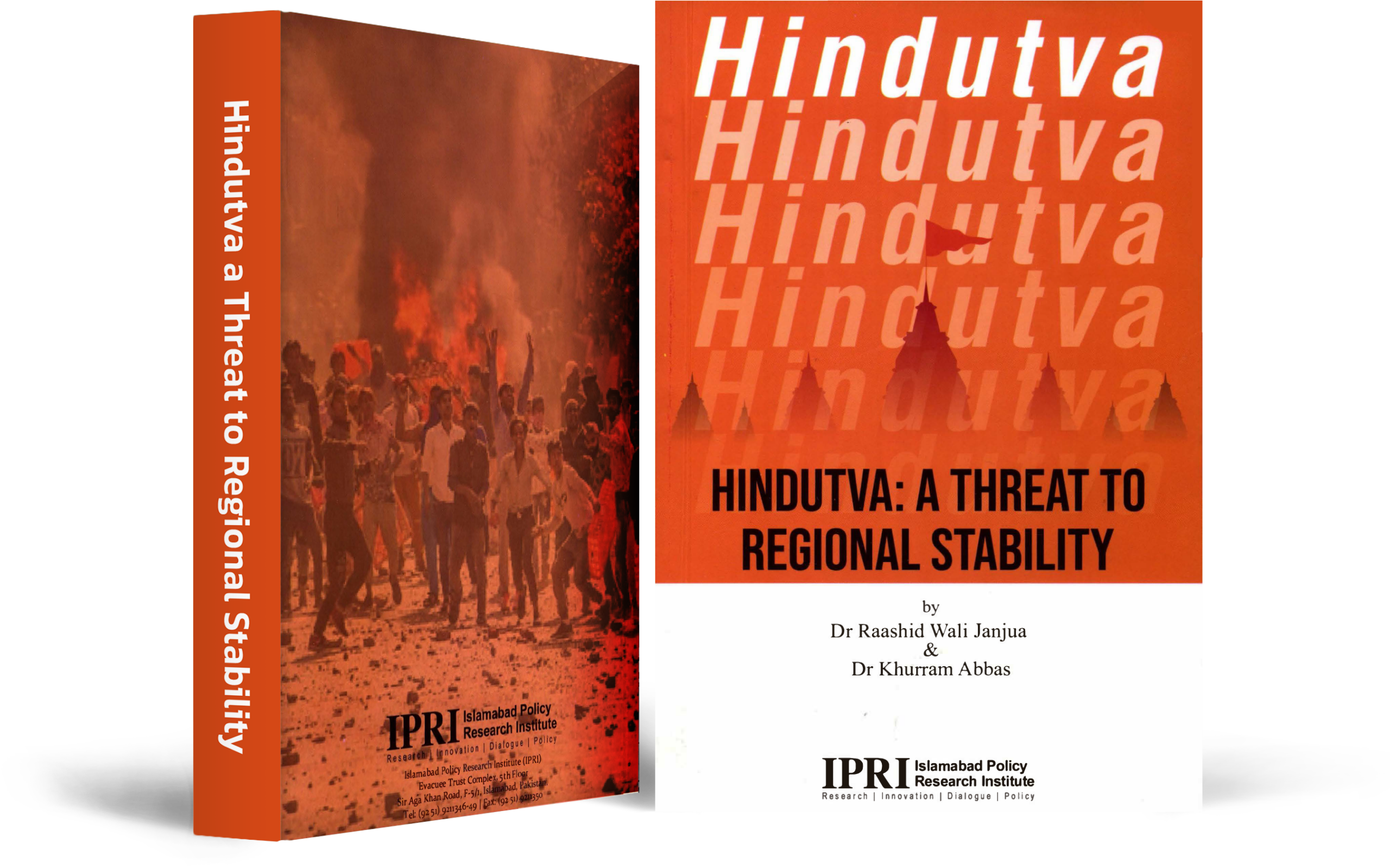
Book Profile
هندوتوا: تهدیدی برای ثبات منطقهای
Compiler & Author: Dr. Raashid Wali Janjua - Dr. Khurram Abbas
Hindutva: A Threat to Regional Stability examines the ideology of Hindutva and its implications for India’s domestic politics and South Asian security. The authors argue that religious nationalism can intensify communal tensions and reshape regional dynamics. The book analyzes its impact on India’s relations with neighboring countries, particularly Pakistan, and the Kashmir dispute. It warns that the expansion of Hindutva ideology may pose significant challenges to regional stability.
Shivaji, leader of the Bhonsle Maratha family, revolts against the Mughal rule. Some consider this period the beginning of Hindu political awakening.
Raja Ram Mohan Roy and Dwarkanath Tagore ignited the dormant political awareness of Hindus by launching a campaign to reform Hinduism and introducing a syncretic version called Brahmo Samaj.
The Congress Party is formed to protect Hindu interests and splits into two main streams: Nehruvian secular nationalism and traditional nationalism based on religious nationalism.
Madan Mohan Malaviya, a Hindu nationalist, establishes the Hindu Sabha.
The Hindu Sabha transforms into the Hindu Mahasabha.
Vinayak Damodar Savarkar defines the Hindutva ideology in his book "Essentials of Hindutva."
Vinayak Damodar Savarkar presents Hindutva as a "majoritarian nationalist ideological project."
Dr. Keshav Baliram Hedgewar, a Brahmin and doctor from Nagpur, establishes the Rashtriya Swayamsevak Sangh (RSS) to "revive Hindu supremacy in India."
1948 (Phase 1 of RSS): The organization primarily focuses on the spiritual education of Hindu youth.
Shri Madhav Sadashiv Golwalkar is introduced by Dr. Hedgewar as his successor.
Golwalkar instructs RSS volunteers not to participate in Gandhi's Quit India Movement.
Sardar Patel warns that if Muslims want peace, they must abandon partition and live in a united India.
RSS experiences its darkest period, including a nationwide ban by the Congress government due to Gandhi's assassination by Nathuram Godse (a former RSS member).
In 1949, RSS faces a nationwide ban by the Congress government.
The RSS constitution is adopted and amended until July 1, 1972.
RSS sees increased popularity, expanded funding channels, and a growing political presence in the Indian Parliament.
RSS separates the Jana Sangh faction from the Janata Party and establishes the Bharatiya Janata Party (BJP).
1991: BJP achieves electoral success through active support from RSS and its affiliates like VHP.
RSS becomes one of the largest non-governmental organizations in the world.
The demolition of the Babri Masjid takes place.
The Bombay riots occur.
1999: Atal Bihari Vajpayee's government (BJP) moves towards rapprochement with Nawaz Sharif's government (Pakistan), leading to the signing of the Lahore Declaration.
Mridula Mukherjee and Aditya Mukherjee publish an article titled "Communalization of Education: The History Textbook Debate" addressing the cleansing of history books from 'undesirable statements'.
The Gujarat riots and the Godhra train burning incident occur.
Uma Bharti, following RSS dreams of implementing Manusmriti as the constitution, bans cow slaughter.
Pritam Singh publishes "Hindu Bias in India's Secular Constitution: Probing Flaws in Governance Instruments" addressing the undermining of secularism by institutionalized fundamentalism.
Nepal transitions from a monarchy to a republic, ceasing to be the world's only Hindu state.
Sujit Kulkar releases "The Lost Years of RSS."
The number of RSS branches exceeds 40,000.
Narendra Modi calls for "zero tolerance" against Naxalites, labeling them as terrorists.
Narendra Modi is elected as the Prime Minister of India.
Invitation of the Dalai Lama to the World Hindu Congress opening leads to Chinese protests.
Dinananth Batra is appointed as the head of the state committee responsible for educational reform in Gujarat.
The number of RSS branches reaches approximately 43,000.
Gaikwad publishes "Dinananth Batra's Books Must Be Read in Gujarat Schools."
Ahmad Noorani publishes "Dangerous Belief," referring to Golwalkar.
Elizabeth Roche publishes 'RSS Resistance to Land Bill', highlighting RSS's ability to halt opposing laws.
BJP officials and ministers participate in RSS coordination meetings.
Reuters publishes 'Special Report: The Battle for India's Soul, State by State'.
Mandakini Gahlot publishes 'New Indian Textbooks Favor Hindu Nationalist Themes, Worry Minorities'.
Anahita Mukherji reports that RSS branches have expanded to 39 countries.
Hemant Ojha publishes "India-Nepal Crisis," referring to India's border blockade in 2015.
RSS increases its service projects to 165,000.
The number of RSS branches reaches approximately 58,000.
RSS adds a debate techniques course to its third-year training camp in Nagpur.
Falak Jawad publishes "Militant Hindutva and Pakistan," referring to Ajit Doval's theory on asymmetric warfare.
Vinugopal Vasuda publishes "RSS hires top business school experts to attract youth".
Surya Rao publishes "This theory explains why BJP won in Muslim-majority areas".
Moha Chatterjee publishes "RSS-affiliated trade union opposes Air India privatization".
Mohan Bhagwat, RSS chief, speaks on the importance of small industries and micro enterprises.
The Modi government makes significant revisions to GST.
Revati Krishnan publishes "M.S. Golwalkar, the RSS Chief who remains a 'Guruji' to some and a 'bigot' to others."
Siddhartha Roy publishes "Half a Century of India's Maoist Insurgency."
Rashid Wali Janjua publishes "The Rise of Indian Nationalism as a Barrier to Regional Peace" in the Brussels Times.
Pawan Burugula publishes "Air India Should be Run by an Indian Company, Says RSS Chief Mohan Bhagwat."
Maria Thomas publishes "India's Growth Story Overlooks Its Muslim Minority."
India faces economic turmoil in 2018 due to BJP government policies.
Sudha Bharadwaj, a human rights lawyer, is arrested under the Unlawful Activities Prevention Act and has been in pre-trial detention since 2018.
Web Desk publishes, "Hindus directly called 'terrorists', those linked with Naxals 'alleged supporters': Shiv Sena".
Ayaz Ashraf publishes, "Modi's 10% quota for upper classes is a political gamble that may not pay off (just like demonetization)".
Alf Gunvald Nilsen publishes, "Is BJP really concerned about India's poor?"
Niranjan Sahoo publishes "From Bihar to Andhra, How India Fought and Won Its 50-Year War with Left-Wing Extremism."
"Inside the RSS of India: The Secretive Group of Hardline Hindus Dedicated to Re-electing Narendra Modi" is published.
D.K. Singh publishes "Why RSS has decided to remind Modi-Shah of its key role in BJP's big electoral wins."
The Indian Air Force violates Pakistani airspace and conducts retaliatory strikes in Balakot after the Pulwama attacks.
The Congressional Research Service publishes "India: Religious Freedom Issues."
Rohan Mukherjee publishes "Climbing the Escalation Ladder: India and the Balakot Crisis."
India unilaterally revokes the special status of occupied Jammu and Kashmir.
Amit Shah, the Home Minister, announces in Lok Sabha that 'every inch of Aksai Chin will be taken back from China.'
The opposition demands an apology from the ruling BJP for 'cheap politics' on the issue, indicating a shift in Congress's foreign policy.
Arun Budhathoki publishes 'India's Updated Political Map Sparks Controversy in Nepal,' referring to India's territorial claims.
The Citizenship Amendment Act (CAA) is passed in India, granting amnesty to non-Muslim migrants from three neighboring countries.
Nayanima Basu publishes 'Bangladesh Seeks Written Assurance from India to Take Back Migrants Post-CAA.'
Nalin Mehta publishes "Digital Politics in India's 2019 General Elections."
David James Strohl publishes "Love Jihad in India's Moral Imaginations: Religion, Kinship, and Citizenship in Late Liberalism."
BJP wins 303 seats in the elections.
Pakistan's trade with India is 16.8 million dollars.
Shrikant Bhadekar publishes "See Where Bangladesh Has Reached and What Has Happened to Pakistan - Prime Minister Modi."
Rana Ayyub publishes 'Opinion: The Erosion of India's Judicial Independence is Almost Complete.'
Web Desk publishes 'The Entire Muslim Community Cannot Be Held Responsible for the Crime of a Group: Naqvi on Tablighi Jamaat Controversy.'
Kalol Bhattacharjee publishes 'Nepal's New Political Map Raises Territorial Claims Against India.'
Rashid Wali Janjua publishes 'What a Loss' in the Brussels Times, highlighting the role of the Srivastava Group in misinformation campaigns.
Document 'Irrefutable Evidence' is presented regarding India's support for state terrorism in Pakistan.
Marusha Muzaffar publishes "The Secret Facebook Rules Modi Uses to Create an Image of Invincibility."
Rashid Wali Janjua publishes "What a Loss," highlighting India's role in misinformation campaigns.
Wired reports that "India is no longer a democracy, but an electoral autocracy."
R.N. Bhaskar publishes "Judiciary: Is India a Democracy?"
"These Eight Leaders Decide in RSS" is published.
Web Desk publishes "Assam Election Results 2021: NDA led by BJP nears victory; State Congress chief resigns."
Online conference "Dismantling Global Hindutva" is held.
Mubarak Zeb Khan publishes "Pakistan's exports to Afghanistan have sharply declined after the Taliban takeover."
Editorial publishes "Trouble in Bangladesh: On attacks against Hindus."
Hannah Ellis-Petersen and Redwan Ahmed publish "Hindu-Muslim violence spreads from Bangladesh to India."
Javed Naqvi publishes "Learning Curve for Aryan Khan" referring to the arrest incident of Shah Rukh Khan's son.
Top Indian brands retreat after threats from Hindu extremists.
Kamal Dev Bhattarai publishes "Nepal's New PM Deuba Seeks Better Ties with India."
Rana Ayyub publishes "Opinion: Why the Success of an Indian Film at the Box Office Should Worry Us."
Jonathan Miller's YouTube video "Sewa International Planning Violence" is released by Channel 4 News UK.
Jawed Naqvi publishes "The Harmful Debate on Savarkar."
Publishes "Pakistan Condemns 'Provocative and Irresponsible' Remarks by RSS Chief Mohan Bhagwat."
Aakar Patel publishes "What is Hindu Rashtra."
Narendra Modi engages in political activities under the exclusive ideology of RSS.

AI Assistant
Fast and reliable answers