



1949 - Communist Revolution in China
The Communist revolution occurs in China, destroying the regressive social structure and paving the way for economic growth.
Book Podcast
Book Profile
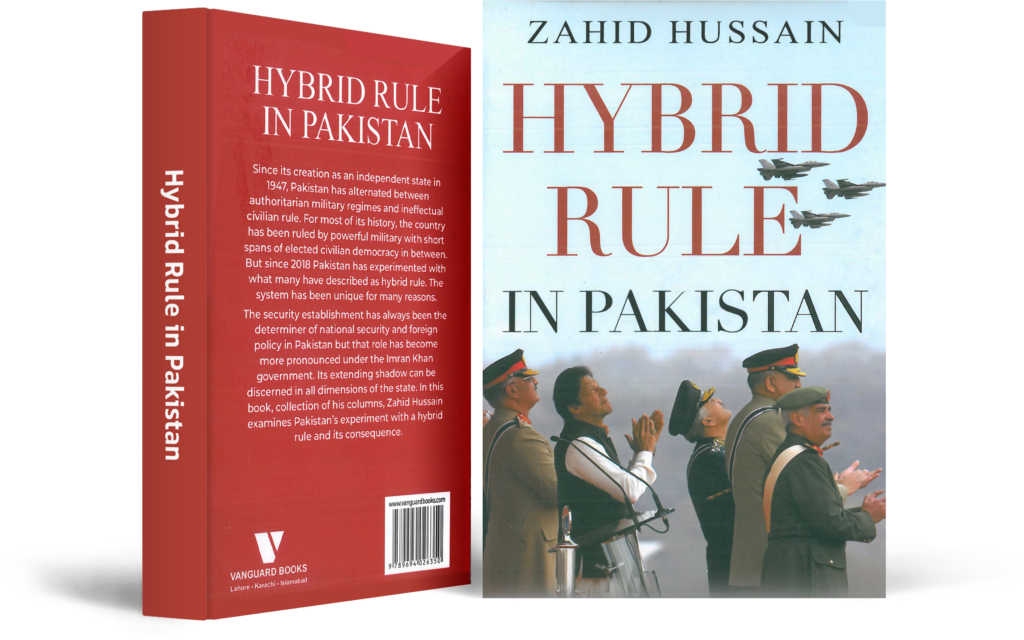
حکمرانی هیبریدی در پاکستان
Compiler & Author: Zahid Hussain
Hybrid Rule in Pakistan explores the phenomenon of hybrid governance, where power is shared—or blurred—between elected civilian institutions and the military establishment. Zahid Hussain analyzes how the security establishment’s influence has expanded, particularly in recent years. The book examines the implications of this arrangement for democracy, civil institutions, and foreign policy. It presents a critical assessment of how hybrid rule has shaped Pakistan’s political stability.
The Communist revolution occurs in China, destroying the regressive social structure and paving the way for economic growth.
Religious riots occur in Lahore, followed by Chief Justice Muhammad Munir writing a report on the dangers of religious extremism.
General Ayub Khan imposes martial law.
Zulfikar Ali Bhutto establishes the Pakistan People's Party (PPP).
A disastrous war with India occurs, leading Bhutto to leave Ayub Khan's military government.
The student movement in Pakistan begins against General Ayub Khan's military regime, leading to his downfall. Leftist movements also start in Western Europe and South America.
The war between India and Pakistan.
The 1973 Constitution of Pakistan is enacted.
A bilateral protocol is signed between India and Pakistan to facilitate visits to border sacred sites.
The Representation of the People Act (ROPA) is enacted.
The Herald magazine becomes a political monthly. Zulfiqar Ali Bhutto faces opposition after the 1977 elections. General Zia-ul-Haq's martial law begins, and press censorship is enforced.
China initiates its reform and opening-up policy, leading to sustained economic growth.
General Zia-ul-Haq bans student unions in universities.
By 1990, Jihadi groups in Pakistan increase and serve as tools for the regional policy of the Pakistan military.
Herald is relaunched under Razia Bhatti's editorship with a new format.
Herald publishes the investigative story "The Poppy War."
General Zia-ul-Haq's era ends. Benazir Bhutto is elected Prime Minister. Razia Bhatti and other Herald members leave to establish Newsline.
The Islami Jamhoori Ittehad (IJI) is formed by General Hamid Gul, then ISI chief, to counter Benazir Bhutto's PPP. Newsline publishes its first issue in July.
Benazir Bhutto is ousted from power. Nawaz Sharif becomes Prime Minister. Lashkar-e-Taiba (LeT) is founded by Hafiz Saeed. Newsline publishes a prominent editorial on organized terrorism and besieged media.
LeT introduces itself with attacks on Indian forces in Kashmir. Benazir Bhutto becomes Prime Minister again.
Police raid Razia Bhatti's house and Newsline office, filing a criminal case against her. Retired General Durrani exposes a political bribery case known as Asghar Khan.
The PPP government falls and Asif Ali Zardari is imprisoned again.
Nawaz Sharif comes to power for the second time.
General Pervez Musharraf overthrows Nawaz Sharif's government in a coup. The National Accountability Bureau (NAB) is established by Musharraf's military regime.
Musharraf declares five Islamic extremist groups, including Lashkar-e-Taiba, illegal. Elections are held in Pakistan, and the Muttahida Majlis-e-Amal (MMA) comes to power in Khyber Pakhtunkhwa (KP).
The government of Pakistan lists Jamaat-ud-Dawa (JuD) as a terrorist organization.
Asif Ali Zardari is released after eight years in prison.
The MMA government in KP ends. Maulana Fazlur Rehman seeks US support to become Prime Minister. Musharraf suspends the constitution and declares a state of emergency. The Lawyers' Movement begins. Benazir Bhutto is assassinated.
General elections are held. Asif Ali Zardari becomes President. General Musharraf resigns under impeachment threat. The Pakistan Muslim League (Q) loses due to military manipulation in elections.
The PPP government grants General Ashfaq Kayani a second service extension.
The Supreme Court orders legal action against all involved in the Asghar Khan case (order never implemented).
Asif Ali Zardari completes his presidential term. Imran Khan believes the election was stolen from him. Maulana Sami-ul-Haq suffers a humiliating defeat in the elections.
The Pakistani Taliban attack an army school in Peshawar, killing 141 people. Imran Khan stages a four-month sit-in in Islamabad, demanding Nawaz Sharif's resignation.
Rao Anwar is accused of the murder of Naqeebullah Mehsud. The Supreme Court orders local elections to be held.
Nawaz Sharif appoints General Qamar Bajwa as the army chief. The Panama Papers scandal is revealed.
January: Six bloggers and civil rights activists disappear in Islamabad and Punjab.
Murder of Mashal Khan by classmates at Mardan University.
Wave of widespread protests in Pakistan.
Abdul Wahid Baloch returns after four months of disappearance. Protests over lack of census announcement.
Sharif family faces trial for corruption charges. Ruling party, PML-N, wins Lahore by-election.
Imran Khan requests Atif Mian's resignation for religious reasons. Maulana Fazlur Rehman, head of JUI-F, gathers opposition support.
TLYRA protests in Islamabad. Deal between government and TLYRA mediated by ISI.
Raza Khan, a civil society activist, disappears. NAB criticized for inhumane actions and chain arrests.
January: Naqeebullah Mehsud killed by police in Karachi. Political changes in Balochistan.
Shahbaz Sharif appointed as head of PML-N. Death of Asma Jahangir. Military threats due to Pulwama suicide attack.
Concerns over the 'Bajwa Doctrine' and the 18th Amendment. Senate elections are held. NAB arrests senior Punjab officials.
Military warns of hybrid warfare against Pakistan. Media faces censorship.
Supreme Court halts election delays. PML-N loses some seats.
NAB criticized for controversial candidate selections. Asif Ali Zardari arrested for money laundering.
Nawaz Sharif and Maryam Nawaz convicted of corruption. Steven Butler barred from entering Pakistan.
Imran Khan becomes Prime Minister. General Bajwa is appointed as army chief for the second time. Newsline ceases publication.
Imran Khan delivers his speech at the United Nations.
Imran Khan meets Donald Trump in Washington.
Inauguration of Kartarpur Corridor. Imran Khan attempts to mediate between Saudi Arabia and Iran.
General Musharraf is convicted of treason. The Supreme Court suspends the extension of General Bajwa's service.
Criticism of Imran Khan's economic policies.
The Supreme Court acquits judges of misconduct charges.
The Supreme Court criticizes NAB for its conduct.
Imran Khan celebrates his second year in office.

AI Assistant
Fast and reliable answers