



1916 - Publication of 'Castes of Punjab'
Denzil Ibbetson publishes 'Castes of Punjab', introducing Mirasis as a distinct caste.
Book Podcast
Book Profile
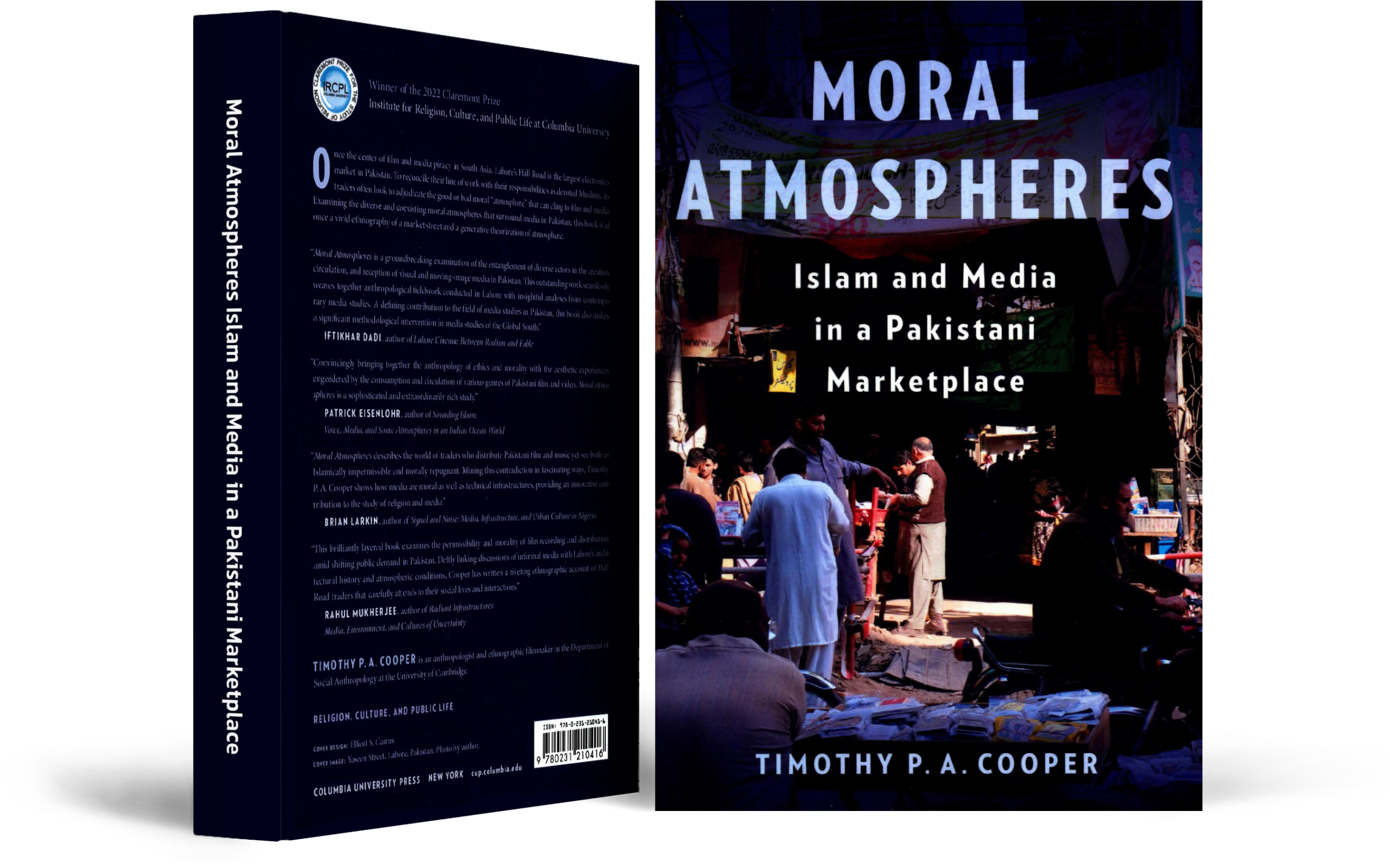
«فضاهای اخلاقی: اسلام و رسانه در بازار پاکستانی»
Compiler & Author: Timothy P. A. Cooper
Moral Atmospheres is an ethnographic study of the relationship between Islam, morality, and media in everyday Pakistani life. Focusing on urban marketplaces in Lahore, Timothy P. A. Cooper explores how the production, circulation, and consumption of media operate within simultaneously commercial and religious moral frameworks. He introduces the concept of “moral atmospheres” to describe how vendors, producers, clerics, and consumers negotiate questions of legitimacy, piety, and ethical boundaries. The book demonstrates that media in Pakistan is not merely entertainment but a dynamic arena where public morality and religious identities are shaped.
Denzil Ibbetson publishes 'Castes of Punjab', introducing Mirasis as a distinct caste.
The National Council of Public Morals in Britain forms the 'Cinema Commission' to study the potential effects of cinema on British audiences.
Iran closes cinemas during the month of Muharram. Maulana Mufti Muhammad Shafi publishes 'Islamic Rulings on New Tools'.
The first film made in Lahore, 'Daughters of Today', is released.
The Indian Cinematograph Committee publishes a comprehensive report on the effects of cinema in the Indian subcontinent.
Ilm-ud-din is executed for the murder of a Hindu publisher in Lahore, an event later depicted in films and public discussions.
Muhammad Iqbal publishes 'The Reconstruction of Religious Thought in Islam', exploring the relationship between ideals and reality, as well as materialism and cinema.
The first air-conditioned cinema in the subcontinent, 'Regal', opens in Bombay.
Syed Abul A'la Maududi watches a film in Delhi.
The partition of the Indian subcontinent leads to the establishment of Pakistan. Hall Road in Lahore becomes known as a commercial area with radio shops and electronic parts importers.
The Indian Constituent Assembly debates the Cinematograph Amendment Bill for classifying films for adults.
The Government of Pakistan establishes the 'National Film and Tape Lending Library' in Karachi. Radio Pakistan halts music broadcasts during the first ten days of Muharram.
Rashid Turabi delivers his first 'Majlis-e-Sham-e-Ghariban' speech on Radio Pakistan.
The 'Golestan' cinema, Pakistan's first air-conditioned cinema, is built in Dhaka (then East Pakistan). The Indian film 'Jaal' leads to the 'Jaal riots' and a film trade agreement with India.
General Ayub Khan stages a coup in Pakistan.
1961: A government report on the state of Pakistan's national film industry cites cinema air conditioning as a major concern.
The Film Censorship Act is passed, later replaced by the '1979 Motion Picture Ordinance'.
The Indo-Pakistani War leads to a ban on the import of Indian films into Pakistan.
The growth in consumer electronics sales leads to a boom in audio and video cassette shops on Hall Road.
The Bangladesh Liberation War leads to the separation of East Pakistan.
Rashid Turabi, a famous preacher, passes away. Anarkali's tomb is officially designated as the Federal Government Archive of Pakistan.
The Punjabi film "Khatarnak" faces police cases after controversies over deleted and reinserted scenes.
General Zia-ul-Haq stages a coup in Pakistan. Jamil Dehlavi films "Blood of Hussain."
Rafi Group is founded and begins constructing commercial plazas. The Bangladesh Film Archive is established.
The Islamic Revolution in Iran occurs. The Motion Picture Ordinance of 1979 replaces the 1963 Film Censorship Law. Films "Maula Jatt" and "Dubai Chalo" are released. General Zia-ul-Haq announces the "Islamic System" and orders cinema closures.
The government of Pakistan begins controlling zakat by directly deducting from citizens' bank accounts.
Hall Road becomes a major hub for informal film production due to the availability of production and distribution materials. Rafi and Zaitoon Plazas are built to support the home entertainment industry. Shalimar Recording Company (SRC) widely distributes cassettes.
A case is brought to court against the producers of the film "Maula Jatt" due to deleted scenes.
The Women's Action Forum (WAF) protests against Zia-ul-Haq's Hudood Ordinances at the entrance of Hall Road.
Durrani Electronics is established.
A Sharia decree is passed requiring television organizations to reduce the number of advertisements featuring women and urging cinema producers to remove film billboards with images of women from public places.
The guidebook 'Film Acting Training' is published by S.M. Shahid.
The demolition of the Babri Mosque in Ayodhya, India, leads to damage or destruction of Hindu temples in Lahore.
Mubarak Hussain begins work at the Punjab Archives.
Pervez Musharraf lifts the ban on importing Indian films. Militant attacks on cinemas in Peshawar are initiated by the Muttahida Majlis-e-Amal (MMA). Shalimar Recording Company (SRC) declines, and original master copies are sold to scrap dealers.
The MMA in Khyber Pakhtunkhwa cracks down on electronic ownership and burns "unauthorized" CDs and video cassettes.
Militant groups carry out attacks on CD and video stores in Islamabad.
Hall Road's Anjuman-e-Tajiran burns sixty thousand discs containing "obscene" content in response to a bomb threat.
Following the 18th Amendment to Pakistan's Constitution, censorship activities are decentralized and divided among provincial boards.
The "Day of Love for the Prophet" leads to riots and the destruction of dozens of cinemas nationwide, in reaction to the "Innocence of Muslims" video.
The last in-house celluloid film processing lab at Evernew Studios closes.
Field research begins in Pakistan.
National elections in Pakistan lead to the first peaceful transfer of power.
Grenade and bomb attacks on 'Shama' and 'Picture House' cinemas in Peshawar kill dozens.
A dispute over converting an Islamic cultural center into a cinema in Karachi goes to court.
YouTube launches a local version for Pakistan, lifting the previous ban. Metropole Cinema in Lahore begins screening classic Lollywood films again.
Saudi Arabia lifts a 35-year ban on cinemas. Tehreek-e-Labbaik Pakistan (TLP) protests begin in Lahore.
2020: Extensive field research in Lahore, focusing on Hall Road.
2018 (Winter): The Orange Line Metro Train project is halted due to legal challenges and then resumed.
National elections in Pakistan bring Imran Khan and the Pakistan Tehreek-e-Insaf party to power. The Indian film "Padman" is banned in Pakistan.
Karachi's Empress Market, located at Rainbow Center, is demolished in a government anti-encroachment operation.
Pakistan Talkies Cinema ceases its operations.

AI Assistant
Fast and reliable answers