


1948
Afghanistan protested Pakistan's claim over Pashtun territories; Pakistan hosted the West Indies team, the first Test-playing team to visit after independence.
Book Podcast
Book Profile
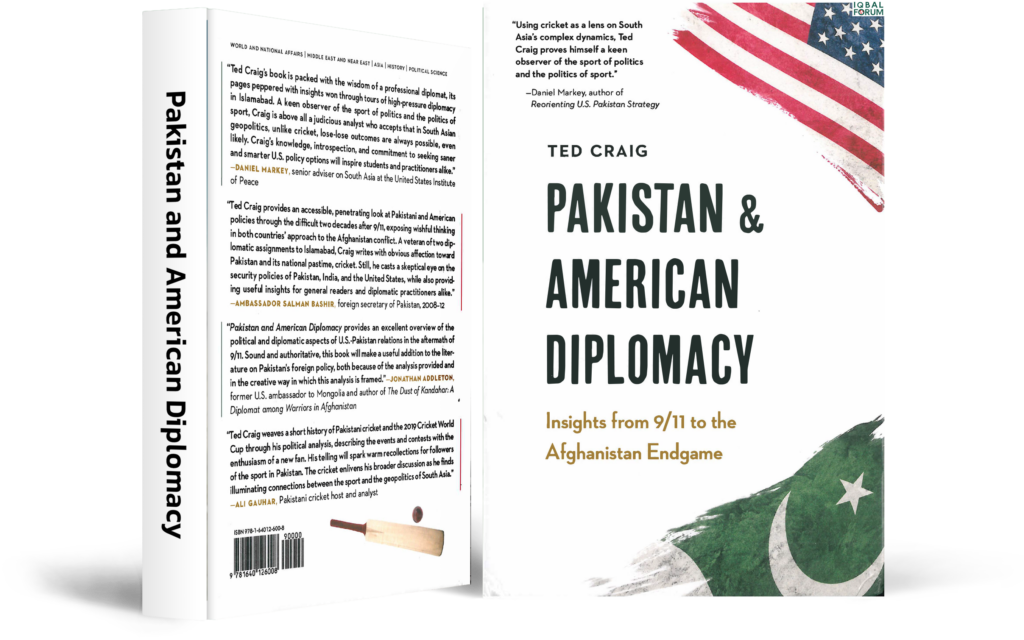
پاکستان و دیپلماسی آمریکا
Compiler & Author: Ted Craig
Pakistan & American Diplomacy examines the diplomatic relationship between Pakistan and the United States from the aftermath of 9/11 to the endgame in Afghanistan. Drawing on his diplomatic experience, Ted Craig analyzes key developments in bilateral relations, cooperation and tensions during the War on Terror, and the complexities of Islamabad–Washington engagement. The book explores issues such as Pakistan’s military role, Afghan policy, mutual mistrust, and shifting regional dynamics. It provides a pragmatic assessment of both the possibilities and constraints of this strategic partnership.
Afghanistan protested Pakistan's claim over Pashtun territories; Pakistan hosted the West Indies team, the first Test-playing team to visit after independence.
The United States and Pakistan form an alliance, with Washington strengthening Pakistan's military.
The United States rapidly strengthened Pakistan's military to act as a bulwark against Soviet expansionism.
Pakistan became a full member of the ICC; Pakistan played its first international Test series in India and won in Lucknow.
Pakistan played its first home Test in Dhaka (now Bangladesh) against India, which ended in a draw.
An English team kidnapped Pakistani players in Peshawar.
Pakistan toured the West Indies and Hanif Mohammad scored a record 337 runs.
Pakistan ceded part of the high Karakoram mountains to China to revive strategic relations.
Sports sanctions against South Africa began due to apartheid, lasting 22 years.
Pro-democracy protests against Ayub Khan's military government began across Pakistan; the UK Foreign Office pressured the MCC to tour troubled East Pakistan.
Bengali nationalist rival, Pakistani opponent Roquibul Hassan, plays in Dhaka with a map of future Bangladesh on his bat.
Bangladesh gains independence from Pakistan after the defeat of the Pakistani army and intervention by the Indian army.
1977: Abdul Hafeez Kardar served as the chairman of the Pakistan Cricket Board (PCB).
West Indies won the first Cricket World Cup; Pakistan's team visited there for the first time after Bangladesh's independence.
The West Indies team dominated Test and ODI cricket.
The Soviet Union invaded Afghanistan; West Indies won the second Cricket World Cup.
ICC admitted Sri Lanka as a Test member; Imran Khan transformed from a swing bowler to an aggressive fast bowler.
India shocked the cricket world by winning the third Cricket World Cup.
The Soviet Union withdrew from Afghanistan, and the United States left Pakistan to its own devices.
India abandoned its role as peacekeeper in Sri Lanka.
Pakistan, led by Imran Khan, won the Cricket World Cup; South Africa made its first World Cup appearance after the end of apartheid.
Afghanistan established its national cricket team in Pakistan.
Sri Lanka won the Cricket World Cup.
India detonated a nuclear bomb, followed by Pakistan detonating five bombs.
Pervez Musharraf's military coup against Prime Minister Nawaz Sharif in Pakistan; Bangladesh achieved Test cricket status and participated in its first Cricket World Cup.
2001: A leaked version of the Hamoodur Rahman Commission Report (on the 1971 war) was published.
The United States killed Osama bin Laden in Pakistan.
Terrorist attacks in the United States followed by the U.S. invasion of Afghanistan.
James Harris was elected as the chairman of the South African Cricket Board.
2003: Pakistani security forces launched operations against Al-Qaeda remnants in northwest Pakistan.
The Cricket World Cup was held in South Africa, and India defeated Pakistan.
An insurgency in Balochistan began following the killing of prominent tribal leader Bugti in a military operation.
The Pakistani government attacked the Red Mosque; the Tehrik-i-Taliban Pakistan (TTP) was formed from Pashtun tribal resistance in Pakistan.
Benazir Bhutto, the prime minister candidate, was assassinated in Rawalpindi.
A major truck bombing at the Marriott Hotel in Islamabad killed 54 people.
Lashkar-e-Taiba carried out multiple terrorist attacks in Mumbai, India.
Musharraf resigned from the presidency, and civilian government returned to power.
2013: The Pakistan People's Party (PPP) governed with heavy military influence.
Sri Lanka ended the civil war against the Tamil Tigers (LTTE); The Kerry-Lugar Bill funded Pakistan with $1.5 billion annually in military and economic aid, but imposed conditions on civilian control over the Pakistani military.
Gunmen attacked a bus carrying the Sri Lankan cricket team in Lahore, resulting in 8 deaths and 5 players injured.
Richard Holbrooke was appointed as the senior U.S. diplomat in Afghanistan; Devastating floods occurred in the Indus River in Pakistan.
Salman Taseer, Governor of Punjab, was assassinated for supporting a Christian woman accused of blasphemy.
Shahbaz Bhatti, Minister of Minority Affairs and a Christian, was assassinated for supporting religious freedom.
The United States killed Osama bin Laden in Abbottabad, Pakistan; the Pakistani military launched a campaign to arrest Pakistanis who had helped the US locate bin Laden.
The "Salala incident" occurred when NATO forces attacked two Pakistani military posts near the Afghan border, resulting in the deaths of 28 Pakistani soldiers.
Pakistan experienced its first civilian transfer of power at the end of a full government term from PPP to PML-N.
Imran Khan launched widespread protests against the PML-N government.
Tehrik-i-Taliban Pakistan executed two dozen captive soldiers.
Tehrik-i-Taliban Pakistan attacked Jinnah International Airport in Karachi, killing 36 people.
Tehrik-i-Taliban Pakistan attacked an army public school near Peshawar, killing 149 children and teachers.
Afghanistan qualified for the Cricket World Cup for the first time.
Tehreek-e-Labbaik Pakistan (TLP) was formed.
The Panama Papers revealed Nawaz Sharif and his children’s involvement in large bank accounts and expensive foreign properties.
Four militants attacked an Indian Army base in Uri.
Tehreek-e-Labbaik Pakistan (TLP) began protests to block roads against changes in the oath of office.
Pakistan's Supreme Court disqualified Nawaz Sharif from politics over corruption evidence.
Imran Khan called the Pakistan cricket team 'cornered tigers' in a famous speech.
The murder of a Pashtun shopkeeper in Karachi led to the formation of the Pashtun Tahafuz Movement (PTM).
President Trump halted US aid to Pakistan citing 'lies and deceit' regarding Afghanistan.
Pakistan's national elections saw Imran Khan's victory, with significant involvement from the military.
The US Embassy congratulated Imran Khan, the elected Prime Minister.
India revoked Kashmir's special autonomy under its constitution; Pakistan increased condemnations and expelled the Indian High Commissioner.
The Supreme Court of Pakistan overturned Asia Bibi's conviction.
The Balochistan Liberation Army (BLA) attacked the Chinese consulate in Karachi.
A white nationalist-inspired attacker killed 51 people in two mosques in Christchurch, New Zealand.
BLA attacked the Pearl Continental Hotel in Gwadar.
A PTM-affiliated MP was accused of inciting violence during a May 2019 protest where security forces killed 13 protesters.
Pakistan suffered a disastrous defeat against the West Indies in the Cricket World Cup.
Pakistan won against England in the Cricket World Cup.
The Pakistan vs Sri Lanka match in the Cricket World Cup was canceled due to rain.
Pakistan lost to Australia in the Cricket World Cup.
Pakistan lost to India in the Cricket World Cup.
Pakistan won against South Africa in the Cricket World Cup.
Pakistan won against New Zealand in the Cricket World Cup.
Pakistan won against Afghanistan in the Cricket World Cup.
Imran Khan made his first official visit to Washington as Prime Minister.
President Trump stated that the Indian Prime Minister asked the US to mediate in Kashmir.
Pakistan won its last Cricket World Cup match against Bangladesh but did not reach the semi-finals.
Pakistan released Asia Bibi.
Sri Lanka returned to Pakistan for the first international test match since 2009.
Pakistan and China announced that the second phase of CPEC (CPEC 2.0) will focus on industrialization, agriculture, and socio-economic development.
The crash of PIA flight in Karachi resulted in 97 deaths; Pakistan's aviation minister announced that nearly one-third of Pakistani pilots have fake licenses.
Tahir Naseem, a Pakistani-American accused of blasphemy, was killed in a courtroom in Peshawar.
Anti-Shia terrorism intensified in Pakistan.
The Pakistani government banned Tehreek-e-Labbaik Pakistan and arrested its leader.
The Taliban took control of Afghanistan.
Imran Khan delayed approving the military appointment to replace Lieutenant General Faiz Hameed as ISI chief.
TTP attacks increased in Pakistan's border areas.
Pakistan continued its accusations against India even after Indian diplomats left Afghanistan.
Imran Khan was removed from the position of Prime Minister.
Attempted assassination of Imran Khan.
General Bajwa retired as Army Chief, and General Asim Munir was appointed by Prime Minister Sharif.
India will host the Cricket World Cup, the first time without a South Asian co-host.

AI Assistant
Fast and reliable answers