


1600
1754: Establishment of the East India Company and recruitment of local forces for security in India.
Book Podcast
Book Profile
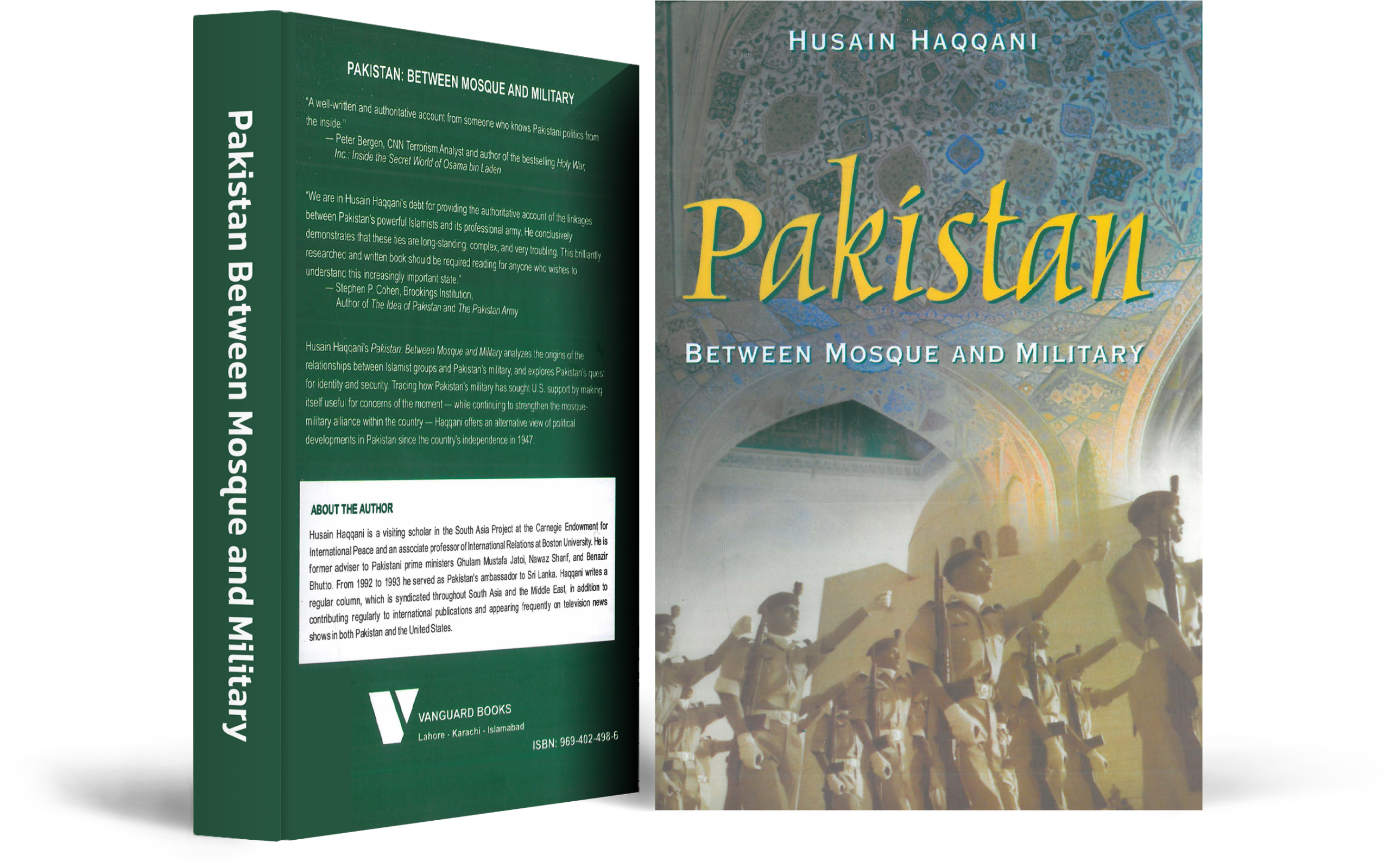
پاکستان: میان مسجد و ارتش
Compiler & Author: Husain Haqqani
Pakistan: Between Mosque and Military examines the complex relationship between political Islam and the military’s role in Pakistan’s politics. Husain Haqqani argues that political and military elites have used religion to legitimize both domestic authority and foreign policy objectives. The book explores the roots of state-sponsored Islamism, the military’s alliances with religious groups, and the impact of the Cold War, Afghanistan, and Kashmir. Haqqani warns that this nexus between mosque and military has been a major obstacle to democratic development and internal stability in Pakistan.
1754: Establishment of the East India Company and recruitment of local forces for security in India.
Arrival of the first group of British Army (Royal forces) in India.
Beginning of East India Company's deployment of forces on overseas missions.
Formation of the Sindh Frontier Force to counter Baloch tribes.
Formation of the Punjab Frontier Force to maintain order on the northwestern borders.
Significant shift in British army recruitment policy in India after the rebellion, with a greater focus on northern and northwestern regions.
Formation of separate staff corps for officers of each presidency army.
The Punjab Frontier Force was placed under the operational control of the Commander-in-Chief of India.
Lord Curzon established the Imperial Cadet Corps for Indian princes and noble families.
Field Marshal Lord Horatio Herbert Kitchener was appointed as the Commander-in-Chief of India.
Official use of the title "Indian Army".
Lord Curzon resigns due to a dispute with Kitchener over military structure.
Abolition of the Military Supply Department, making the Commander-in-Chief the most powerful position after the Viceroy.
Arrival of the first group of the Royal Flying Corps in India.
Lifting of the ban on Indians entering officer ranks with the Royal Commission.
Creation of ten positions for Indian cadets at the Royal Military Academy Sandhurst.
Official establishment of the Royal Indian Air Force.
Initiation of the eight-unit plan for complete indigenization of certain army units.
Reorganization of the Royal Indian Navy along combat lines.
The first Indian officer (Mohammad Sadiq Chaudhry) was introduced as a midshipman in the executive branch of the Royal Indian Navy.
The Royal Indian Navy was transformed with the enactment of the Indian Navy (Discipline) Act.
The Muslim League adopted the Lahore Resolution, calling for the creation of a homeland for South Asian Muslims.
Sardar Baldev Singh was appointed as the Minister of Defense in the interim government, marking the first time an Indian political leader held this position.
The Muslim League demanded the division of the British Indian Army.
Liaquat Ali Khan, the future Prime Minister of Pakistan, formally demanded the division of the army.
Britain's decision to divide the Indian Army between India and Pakistan.
Military division completed. Joint Defense Council (JDC) established.
Pakistan requests weapons and equipment from the United States.
Dissolution of Supreme Command Headquarters at India's request.
Withdrawal of regular British forces from border posts in North and South Waziristan.
Appointment of Major General Muhammad Ayub Khan as Commander-in-Chief in East Pakistan.
Formation of the first East Bengal Infantry Regiment.
Death of Muhammad Ali Jinnah, 13 months after Pakistan's independence.
Suspension of diplomatic relations between Pakistan and Afghanistan begins.
Appointment of Major General Ayub Khan as the first Commander of the Pakistan Army.
Assassination of Liaquat Ali Khan, Pakistan's first Prime Minister. Ghulam Muhammad is appointed as Governor-General.
Martial law imposed in Lahore following anti-Ahmadiyya riots, providing the military with direct experience in civil administration.
Vice Admiral Mohammad Siddiq Chaudhry appointed as the first Commander of the Pakistan Navy.
Dissolution of the Constituent Assembly by Governor-General Ghulam Muhammad.
Pakistan and the United States signed a mutual defense cooperation agreement.
Pakistan began receiving American weapons.
Major General Iskander Mirza was appointed as Governor-General.
Pakistan joins the Baghdad Pact, later known as CENTO.
The first permanent constitution of Pakistan is adopted.
Air Marshal Muhammad Asghar Khan is appointed as the first commander of the Pakistan Air Force.
Iskander Mirza abrogates the 1956 constitution and declares martial law; General Ayub Khan is appointed as Chief Martial Law Administrator (CMLA).
The Supreme Court declares martial law as legitimate.
Ayub Khan announced land reforms for West Pakistan.
The Public Offices Disqualification Order (PODO) was issued to remove political leaders from public life.
The Elective Bodies Disqualification Order (EBDO) was issued.
The Basic Democracies system was launched; Ayub Khan was promoted to Field Marshal.
The first Basic Democracies elections were held at the local level.
Ayub Khan was confirmed in a presidential referendum and sworn in as the first elected president.
The master plan for Islamabad as the capital was approved.
Family laws were introduced to reform traditional/Islamic family laws.
Ayub Khan announced a new constitution.
End of martial law and beginning of Ayub's 'guided democracy'.
The Political Parties Act was passed, legalizing political party activities.
The border conflict between China and India began.
Islamabad began functioning as the official capital.
Negotiations between India and Pakistan over the Kashmir issue.
The second BD elections were held.
Ayub Khan was re-elected in the presidential elections.
A limited war occurred in the Rann of Kutch between India and Pakistan.
The full-scale war between India and Pakistan began.
Sheikh Mujibur Rahman introduced the 'Six-Point Plan'.
The Frontier Works Organization (FWO) was established.
The Agartala conspiracy was uncovered in East Pakistan.
The International Arbitration Court's decision on the Rann of Kutch was accepted.
Protests against Ayub Khan began in West Pakistan.
The Democratic Action Committee (DAC) was formed to demand constitutional reforms.
Ayub Khan announced his withdrawal from power.
General Agha Mohammad Yahya Khan imposed martial law and removed Ayub Khan.
The princely states of Chitral, Dir, and Swat were merged with West Pakistan.
The Monopolies and Restrictive Trade Practices Order was issued.
The unified province of West Pakistan was dissolved and four new provinces were established.
The Legal Framework Order (LFO) set parameters for general elections and constitution drafting.
General elections were held in Pakistan. The Awami League won the majority in East Pakistan, and the Pakistan People's Party (PPP) won in West Pakistan.
An Indian Airlines plane was hijacked to Lahore.
Talks between Yahya Khan and Mujibur Rahman failed.
The army intervened to suppress the popular uprising in East Pakistan.
Pakistan was defeated in the war with India, and East Pakistan became Bangladesh. Yahya Khan resigned, and Zulfikar Ali Bhutto became President and Chief Martial Law Administrator (CMLA).
Bhutto nationalized emerald mines and ten key industries.
The life insurance industry was nationalized.
Martial law was lifted and a provisional constitution was implemented.
Language riots occurred in urban areas of Sindh.
The Federal Security Force (FSF) was established and military operations began in Sindh.
Arrest of 21 army officers and 14 air force officers accused of plotting a coup (Attock Conspiracy).
The United States eased the arms embargo.
First phase of Bhutto's land reforms.
Adoption of a new constitution with a parliamentary system and provincial autonomy.
Bhutto became Prime Minister and Fazal Elahi Chaudhry became President. The vegetable oil industry was nationalized.
All private banks were nationalized.
The National Awami Party (NAP) was banned by the federal government.
Over 2000 flour, rice, and cotton ginning factories were taken over by the government.
The government decided to hold general elections on March 7 and 10.
The coalition of nine opposition parties, Pakistan National Alliance (PNA), declared the election results fraudulent and launched widespread protests.
General Muhammad Zia-ul-Haq, the army chief, overthrew Bhutto's government and declared martial law.
The Supreme Court legitimized martial law under the "doctrine of necessity" but called for elections.
The Muslim League-Pagara and other PNA parties joined Zia's civilian cabinet.
The civilian President, Fazal Elahi Chaudhry, resigned and Zia-ul-Haq assumed the presidency.
Islamic Hudood Ordinances were issued.
PNA parties withdrew from Zia's cabinet.
Non-partisan local council elections held.
Soviet military intervention in Afghanistan.
Introduction of mandatory Zakat tax.
The Profit and Loss Sharing (PLS) banking system was launched.
The Movement for the Restoration of Democracy (MRD) was established.
The Provisional Constitutional Order (PCO) was issued, banning political parties and subordinating the judiciary to military rule.
The Federal Advisory Council was introduced.
The Ushr tax was implemented on agricultural products.
MRD initiated another movement against Zia-ul-Haq.
Zia-ul-Haq announced plans to civilianize the military government.
The new Evidence Law replaced the previous law.
A referendum was held to confirm Zia-ul-Haq as President.
Non-party general elections were held.
Muhammad Khan Junejo was appointed as Prime Minister.
Martial law was lifted.
Ban on political parties was lifted.
Muttahida Qaumi Movement (MQM) held its first public meeting in Karachi.
Tehreek-e-Nafaz-e-Fiqh-e-Jafaria (TNFJ) and Jamaat Ahl-e-Sunnat became political parties.
A bomb explosion in Karachi resulted in 73 deaths and over 200 injuries.
The Afghan Peace Accord (Geneva Accords) was signed by the Junejo government.
An explosion at the Ojhri ammunition depot affected Rawalpindi and Islamabad.
General Zia-ul-Haq died in a plane crash. General Mirza Aslam Beg took over army command. Ghulam Ishaq Khan assumed the presidency.
The Punjab High Court ruled the dissolution of assemblies illegal but refrained from reinstating them.
General elections were held in Pakistan. The Pakistan People's Party (PPP) led by Benazir Bhutto won.
A vote of no confidence against Benazir Bhutto's government in the National Assembly.
Police fired on MQM protesters in Hyderabad.
Benazir Bhutto was dismissed by President Ghulam Ishaq Khan.
General elections were held, and the Islamic Democratic Alliance (IJI) led by Nawaz Sharif won.
General Aslam Beg issued a statement on the growing threat of war with India.
General Aslam Beg retired and General Asif Nawaz Janjua succeeded him.
Establishment of the National University of Sciences and Technology (NUST).
Start of military operations in Sindh against MQM activists.
General Janjua passed away and General Abdul Waheed Kakar succeeded him.
Nawaz Sharif was dismissed by President Ghulam Ishaq Khan, but the Supreme Court overturned the order.
The political deadlock was resolved with the simultaneous resignation of the President and Prime Minister. Dr. Moeen Qureshi was appointed as interim Prime Minister.
General elections were held, and the PPP led by Benazir Bhutto returned to power.
Benazir's government appointed 20 judges to the Lahore High Court, 13 of whom were PPP activists.
The Supreme Court issued a significant ruling on executive powers for the appointment and transfer of judges.
Murtaza Bhutto, Benazir's brother, was killed by police in Karachi.
Benazir Bhutto was dismissed by President Farooq Leghari.
The Council for Defense and National Security (CDNS) was formed.
General elections were held, and Nawaz Sharif was elected as Prime Minister.
The Navy Commander resigned due to bribery allegations in defense deals.
Chief Justice Sajjad Ali Shah attempted to fill vacant Supreme Court positions, but the government opposed.
The Supreme Court suspended the 14th Constitutional Amendment regarding parliamentary defection.
Mob attacked the Supreme Court. President Leghari resigned. General Jehangir Karamat was appointed as Chairman of the Joint Chiefs of Staff Committee.
Pakistan officially became a nuclear power.
The "2010 Program for Good Governance and Socio-Economic Transformation" was launched by the government.
General Jahangir Karamat publicly called for the establishment of a National Security Council.
General Jahangir Karamat retired three months early, succeeded by General Pervez Musharraf.
Nawaz Sharif's government requested military assistance to address the severe law and order situation in Karachi.
The Supreme Court declared military courts unconstitutional.

AI Assistant
Fast and reliable answers