


Circa 1850
The emergence of Muslim individual identity and Islamic community in South Asia.
Book Podcast
Book Profile
پاکستان: فراتر از دولتِ بحرانزده
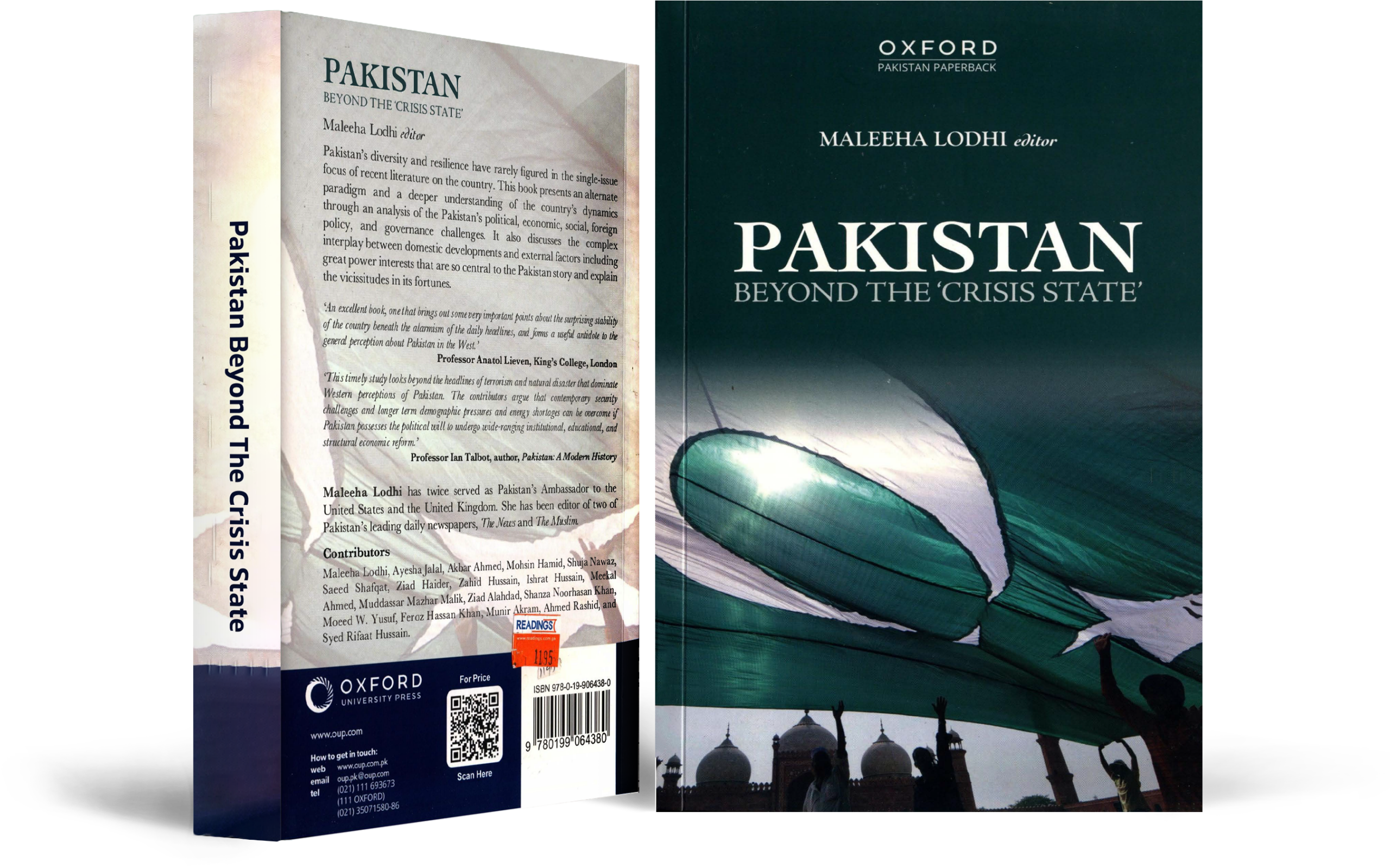
Compiler & Author: Maleeha Lodhi
Pakistan: Beyond the Crisis State seeks to present an alternative perspective on Pakistan—not merely as a “crisis state,” but as a country with the capacity for reform, adaptation, and resilience. The contributors address issues such as democracy, the military’s role, extremism, the economy, foreign policy, and civil society. They argue that despite serious challenges, Pakistan possesses the institutional and social resources to gradually overcome its difficulties. The book adopts a balanced and analytical approach, focusing more on solutions and future possibilities than on failures alone.
The emergence of Muslim individual identity and Islamic community in South Asia.
The Mughal Empire, after six great emperors (from Babur to Aurangzeb), was dismantled by the British.
The Muslim League Resolution, demanding autonomy or independent states for Muslim-majority areas.
Abul A'la Maududi founded Jamaat-e-Islami (JI).
Bernard Brodie called nuclear weapons "absolute weapons."
May 14: A letter from G. H. Hidayatullah, Sindhi leader, to Jinnah about the need to curb provincialism.
Muhammad Ali Jinnah, in his first speech to Pakistan's Constituent Assembly, presented his vision for a progressive, just, and impartial state.
Official ceremony of power transfer to Pakistan; Lord Mountbatten suggested Emperor Akbar as a model of a tolerant Muslim ruler to Jinnah, but Jinnah introduced the Prophet of Islam as a more enduring and inspiring model.
Muslims in West Punjab began reacting to horrific stories from India.
Jinnah spent his first and only Christmas as a guest of the Christian community.
The Pakistani army used jihad to mobilize tribes for an attack on Kashmir.
February: Muhammad Ali Jinnah recorded his speech for the people of the USA, declaring that Pakistan would not be a theocratic state.
The death of Muhammad Ali Jinnah.
The resolution outlined the principles of Pakistan's future constitution with an emphasis on Islam.
The Ministry of Interior issued the Warrant of Precedence, specifying the ranking of civil and military officials for ceremonial purposes.
Particularly concerning Urdu as the sole national language, leading to tensions.
Street protests led by Islamic parties demanding Ahmadis be declared non-Muslims.
Warned of ideological dangers and the lack of a state-defined Islam.
Huseyn Shaheed Suhrawardy briefly served as Prime Minister, emphasizing national identity based on public consent.
Military coup led by General Ayub Khan, marking the start of martial law.
1971: The Pakistan Army governed the country.
Ayub Khan expressed his intent to clarify Pakistan's ideology, defining Islam as its core.
India-Pakistan War.
Signing of the Tashkent Agreement, a peace effort after the 1965 war.
1972: Shuja Nawaz worked as a broadcaster and producer for Pakistan Television, covering the 1971 war with India.
General Yahya Khan succeeded General Ayub Khan.
The first free and fair elections were held in Pakistan.
A crushing military defeat by India led to the secession of East Pakistan and the formation of Bangladesh, weakening the 'Two-Nation Theory' and deeply impacting Pakistan's psyche.
1977: The rule of Zulfikar Ali Bhutto.
July 2: Signing of the Simla Agreement, a framework for normalizing relations between India and Pakistan.
August 27: The Delhi Agreement on prisoners of war was signed.
Pakistan hosted the second Islamic Conference Organization summit in Lahore and recognized Bangladesh.
India conducted its "Peaceful Nuclear Explosion" test.
Zulfikar Ali Bhutto invited the Imams of Masjid al-Nabawi and Kaaba to Pakistan to enhance his Islamic credentials.
General Zia-ul-Haq ousted Zulfikar Ali Bhutto and began the longest period of military dictatorship.
1988: General Zia-ul-Haq's rule.
April 14: Signing of the Delhi Agreement on the Salal Hydroelectric Project.
Islamic Revolution in Iran.
1985: Maleeha Lodhi taught politics and political sociology at the London School of Economics.
Four international oil companies were licensed to explore in Pakistan, but one major oil company halted its operations.
Dr. Mikal Ahmad received his PhD in Economics from the University of Oxford.
Adult literacy rate in Pakistan was 26%.
"The Sole Spokesman: Jinnah, the Muslim League and the Demand for Pakistan" by Ayesha Jalal was published.
N) came to power.
1988: Muhammad Khan Junejo's government.
December 31: Cultural cooperation agreement between India and Pakistan was signed.
The agreement to prohibit attacks on nuclear facilities between India and Pakistan was implemented.
1999: A period of democracy in Pakistan, alternating between the governments of Benazir Bhutto and Nawaz Sharif.
Mikal Ahmad was appointed by the Government of Pakistan as Senior Advisor to the Executive Director at the IMF in Washington D.C.
The book "The State of Martial Rule: The Origins of Pakistan's Political Economy of Defence" by Ayesha Jalal was published.
The net enrollment rate in primary schools was 33 percent.
The Delhi Agreement on prior notification of military exercises and troop movements was implemented.
August 17: The Delhi Agreement on preventing airspace violations and flight rights was implemented.
Maleeha Lodhi served as Pakistan's ambassador to the USA for the first time (until 1996).
Prelude to Pakistan" was published by Z. H. Zaidi.
Central Asian countries sought southern routes through Pakistan for energy exports, but Pakistan missed the opportunity.
Jamaat-e-Ulema Islam (JUI) became deeply involved with the Taliban regime in Afghanistan.
"From Dependence to Intervention: Soviet-Afghanistan Relations During the Brezhnev Era (1964-1982)" was published by Syed Rifaat Hussain.
Jinnah, the Muslim League and the Demand for Pakistan" (Second Edition) was published by Ayesha Jalal.
"Democracy and Authoritarianism in South Asia: A Comparative and Historical Perspective" was published by Ayesha Jalal.
The number of income taxpayers increased from 250,000 to 1 million.
Published by A. R. Siddiqi.
Published by Saeed Shafqat.
Agreement on joint working groups for comprehensive dialogue.
Pakistan carried out its nuclear tests.
First edition of "History, Culture and Political Economy" published by Ayesha Jalal and Sugata Bose.
Washington urged Islamabad and New Delhi to refrain from provocative actions and rhetoric.
Foreign minister-level talks resumed.
February 21, 1999: The Vajpayee-Sharif summit was held in Lahore, and three agreements were signed.
July 1999: The Kargil crisis brought India and Pakistan to the brink of war.
Nawaz Sharif signed a joint statement with President Clinton in Washington.
Strategic planning for Pakistan's national defense began.
India shot down Pakistan Navy's "Atlantic" aircraft.
Military coup led by General Pervez Musharraf, overthrowing Nawaz Sharif's civilian government.
2005: Tenure of Ashraf Hussain as the head of the State Bank of Pakistan.
2008: Pervez Musharraf's rule.
"Self and Sovereignty: The Muslim Individual and the Community of Islam in South Asia since c. 1850" by Ayesha Jalal was published.
The number of income taxpayers increased to 1 million.
September 11: The September 11 terrorist attacks in the United States.
2005: Maleeha Lodhi was a member of the UN Secretary-General's Advisory Board on Disarmament.
The United States launched Operation Enduring Freedom in Afghanistan.
February 2: Pervez Musharraf announced Pakistan's nuclear command and control structure and established the Strategic Plans Division (SPD) at the Joint Staff Headquarters.
The Anatomy of a Conflict" was published by Syed Rifaat Hussain.
General Musharraf pledged to end Pakistan's support for militants in Kashmir "forever."
Richard Armitage, Deputy Secretary of State, visited New Delhi and Islamabad, and both countries agreed to de-escalate tensions.
The India-Pakistan military crisis (Parakram) ended.
Pervez Musharraf issued the 'Legal Framework Order' and made 29 amendments to the 1973 Constitution.
Maleeha Lodhi served as Pakistan's ambassador to the UK until 2008.
By 2008, Pakistan's economic growth averaged 6% per year.
January: Pervez Musharraf and Atal Bihari Vajpayee met in Islamabad and resumed comprehensive dialogue.
Goldman Sachs introduced the concept of 'Next Eleven' (N-11) as a group of countries with the economic potential to become major players in the global system.
Bus service between Srinagar and Muzaffarabad resumed.
After the earthquake in Azad Kashmir, the Line of Control was opened at five points.
January: The railway line between Munabao in Rajasthan and Khokhrapar in Sindh resumed.
Launch of the second bus service from Kashmir, connecting Poonch in Kashmir and Rawalakot in Azad Kashmir.
1988) appointed as head of the Government Reform Commission (until 2008).
March: Pervez Musharraf attempted to dismiss Chief Justice Iftikhar Muhammad Chaudhry, leading to national protests.
Zahid Hussain published the book "Frontline Pakistan: The struggle with militant Islam".
Military operation against Lal Masjid in Islamabad.
Pervez Musharraf was re-elected in the presidential elections.
Pervez Musharraf issued the National Reconciliation Ordinance (NRO).
Benazir Bhutto returned to Pakistan.
Pervez Musharraf declared a state of emergency.
Pervez Musharraf resigned as army chief and handed over the position to General Ashfaq Parvez Kayani.
The Tehrik-i-Taliban Pakistan (TTP) was formed.
Benazir Bhutto was assassinated in Rawalpindi.
Ayesha Jalal published the book "Partisans of Allah: Jihad in South Asia."
General elections were held in Pakistan, and the Pakistan People's Party (PPP) emerged as the largest party.
Shuja Nawaz published the book "Crossed Swords: Pakistan, Its Army, and the Wars Within."
The Muttahida Qaumi Movement (MQM) joined the Sindh provincial government.
Pervez Musharraf was forced to resign.
Terrorist attacks in Mumbai.
Shuja Nawaz published the book "FATA: A Most Dangerous Place."
Barack Obama announced his first strategy for Afghanistan and Pakistan (Af-Pak).
U.S. drone attacks in Pakistan intensified.
A major military operation began in South Waziristan.
Mullah Omar, the Taliban leader, issued a statement showing signs of flexibility in peace talks.
Obama announced his strategy in Afghanistan, promising troop increases and a 'civilian surge'.
The Tehrik-i-Taliban Pakistan (TTP) was active across tribal areas and Khyber Pakhtunkhwa province.
Foreign remittances reached 9 billion dollars.
Shuja Nawaz published the book 'Pakistan in the Danger Zone: A Tenuous US-Pakistan Relationship'.
The ISI and CIA arrested several Taliban leaders, including Mullah Abdul Ghani Baradar, in Pakistan.
A Pakistani delegation met with President Obama in Washington for a "strategic dialogue."
The Prime Ministers of India and Pakistan met at the Nuclear Security Summit in Washington.
An Indian court convicted Ajmal Kasab of murder and waging war against India.
China agreed to provide Pakistan with two civilian nuclear reactors.
Major flood in Pakistan causing extensive economic damage.
Maleeha Lodhi edited and published the book "Pakistan: Beyond the 'Crisis State'."
Zahid Hussain published the book "The Scorpion's Tail: The relentless rise of Islamic militants in Pakistan."
Yousaf Raza Gillani extended General Ashfaq Parvez Kayani's term as army chief for another three years.
Induction of 4,000 Baloch soldiers into the army to increase their number to 10,000.
Pakistani authorities announced temporary additional taxes on income and doubled special indirect taxes on non-essential imports to address flood consequences.
Publication of "Modern South Asia: History, Culture and Political Economy" (3rd edition) by Ayesha Jalal and Sugata Bose.
Annual energy demand in Pakistan will rise to 198 million tons of oil equivalent.
28.2 million people in Pakistan will be deprived of education unless rapid progress is made.

AI Assistant
Fast and reliable answers