

Thousands of Years Ago
Cultural and linguistic identities were forming in ancient India, but the concept of a 'nation' as we know it today did not exist. Numerous groups with multiple internal identities existed.
Book Podcast
Book Profile
پاکستان: خاستگاهها، هویت و آینده
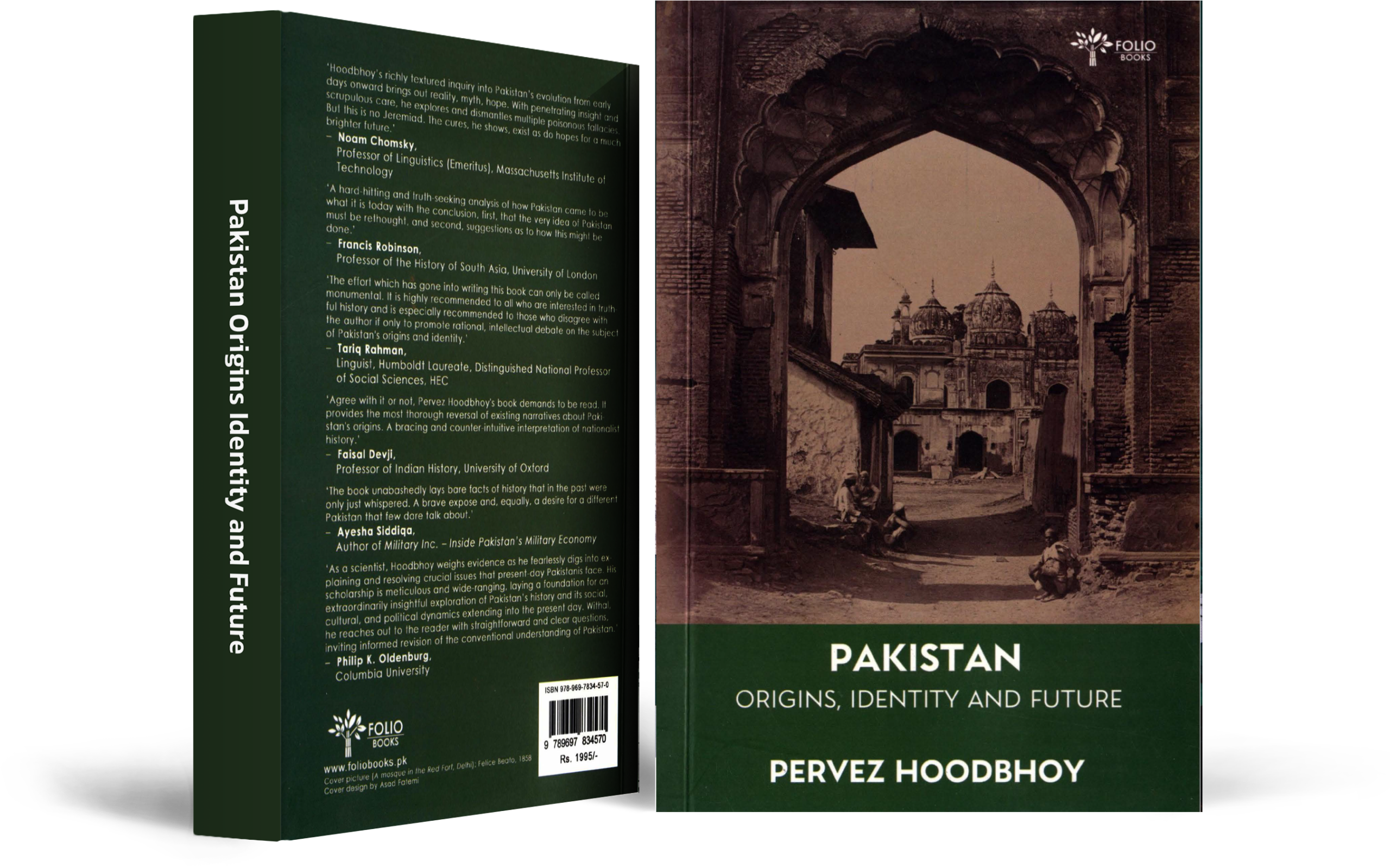
Compiler & Author: Pakistan Origins Identity and Future
This book explores the historical origins and ideological foundations of Pakistan. Pervez Hoodbhoy analyzes the country’s national identity through religion, politics, and education. He critically examines extremism, state policies, and intellectual trends. The book offers a thoughtful and analytical perspective on Pakistan’s future challenges.
Cultural and linguistic identities were forming in ancient India, but the concept of a 'nation' as we know it today did not exist. Numerous groups with multiple internal identities existed.
Slow migration of Indo-European speaking peoples from the north (possibly the Pontic-Caspian region) to India, leading to the development of Vedic Sanskrit/Hindu-Aryan.
Existence of ancient civilizations in the Indus region.
Zeno, the Greek philosopher, addressed the concept of space through motion in space.
The Prophet of Islam (PBUH) conquered the Arabian Peninsula and established a faith-based community in Medina.
The Rashidun Caliphate expanded the eastern borders of Islam to Iran and Afghanistan.
The first Muslim invasion of India by Muhammad bin Qasim. Beginning of Arab-Muslim contact with India. (The legend of Muhammad bin Qasim founding Pakistan was later created by Pakistani historians).
The beginning of Muslim invasions of India aimed at acquiring land and wealth, under the guise of religious justification.
1052 CE: Al-Biruni, a Muslim scholar, spent 13 years traveling and studying in northern India, describing the local people, including local Muslims with different customs.
The jagirdari system was likely developed by the Rajputs.
1530 CE: Zahir-ud-din Babur, the first Mughal Emperor, conquered India and defeated Ibrahim Lodi at the First Battle of Panipat (1526).
1605 CE: Emperor Akbar, during whose reign conservative Muslim clerics and missionaries like Sheikh Ahmad Sirhindi (1564-1624) opposed the integration of Hindu beliefs into Islam.
Robert Orme (historian of the empire) described India as one of the richest empires in the world.
1668 CE: The journey of François Bernier, a French physician, during the reign of Emperor Aurangzeb.
1707 CE: Emperor Aurangzeb ascended the Mughal throne, supported by conservative religious figures like Shah Waliullah.
1757 CE: Bulleh Shah, a mystic and Sufi poet, lived.
1762 CE: Shah Waliullah Dehlawi, the most prominent religious reformer of the Mughal era, known for his influence on political-religious movements like Jamiat Ulema-e-Hind and Jamaat-e-Islami, and the jihad movement of Syed Ahmad Barelvi.
The fall of three major Muslim empires: Ottoman, Safavid, and Mughal.
The Battle of Plassey where the British East India Company emerged victorious.
The beginning of the Mughal decline and the entry of the British East India Company.
Ahmad Shah Abdali defeated the Marathas in the Third Battle of Panipat, aiding local Muslim allies.
The Battle of Buxar, which secured the East India Company's complete victory over Indian rulers.
Robert Orme wrote that European merchants came to India for wealth and sailors for work.
1833: Raja Ram Mohan Roy, founder of Brahmo Samaj, campaigned against sati, dowry, and child marriage, and supported English education and thought.
1840: Haji Shariatullah led the Faraizi movement in Bengal.
1831: Syed Ahmad Barelvi, a Wahhabi preacher in India, initiated a holy war against the Sikhs.
The new land ownership system was introduced by Britain, allowing Hindus to become landowners.
Tipu Sultan, the Sultan of Mysore, was killed by the British in battle.
Britain imposed heavy taxes on the Indian people, leading to famine, poverty, and suffering.
Emperor Bahadur Shah Zafar II was deposed, and Emperor Shah Alam II passed away.
The East India Company established Haileybury College in England.
The emergence of Hindu revival movements like Shuddhi and Sangathan.
The Mahalwari system was introduced by the British, imposing heavy tax burdens on farmers and landowners.
Syed Ahmad Barelvi initiated a holy war against the Sikhs after returning from Mecca.
The East India Company removed the name of Mughal Emperor Shah Alam II from the rupee coin.
The first coin featuring the head of the British monarch was issued. English education was introduced.
1850s: The Ottomans allied with Britain in the Crimean War and did not support the Caucasian Muslims against Russian expansion.
The number of Muslim students in Bengal's colleges and government schools was 751 compared to 3,188 Hindus.
Punjab was annexed by Britain, ending the Sikh Kingdom.
The first eight-volume edition of "The History of India, as Told by Its Own Historians" by Sir Henry M. Elliot and John Dowson was published.
The scene changed regarding the number of Muslim and Hindu lawyers in the Calcutta High Court.
The Ottoman Empire established the first bank in a Muslim country (Ottoman Imperial Bank). The number of Muslim students in Bengal's colleges and state schools decreased to 731, while Hindus increased to 6,448.
End of centuries of Mughal rule and the War of Independence (Great Rebellion). Muslims were targeted more than Hindus for British retribution.
The East India Company was dissolved, and King's College London took on the responsibility of conducting competitive exams.
Pakistan was born only 90 years later.
Syed Ahmed Khan established the Muradabad Panchayat School.
Bishop Samuel Wilberforce spoke in Parliament, offending Hindus and Muslims.
Start of railway expansion in India.
Start of the American Civil War (which led to the abolition of slavery in the USA).
Child marriage and sati were still prevalent in India.
Syed Ahmad Khan published the book "Taleefat Ahmadi, Volume 1, Part 1, Page 135."
The Papal States came to an end.
The first British census in India categorized the population by religion.
Scottish historian William Hunter highlighted the poor condition of Muslims in Bengal.
Immanuel Kant wrote the book "Critique of Pure Reason."
The Arab Land Bank of Egypt, the second bank in a Muslim country, was established.
Syed Ahmad Khan expressed his view of Bengalis as an "effeminate race."
The Indian Education Commission report depicted a bleak picture of Muslim education.
Establishment of the Indian National Congress.
Syed Ahmad Khan delivered a speech in Lucknow warning about the rule of "Bengalis or other Hindus similar to Bengalis."
The Michelson-Morley experiment disproved the ether hypothesis.
1958: Abul Kalam Muhiyuddin Ahmed Azad was alive.
Syed Ahmad Khan proposed the 'Two-Nation Theory' and discouraged Muslims from joining the Congress.
The Ziarat Residency was constructed.
Muslims had a very low representation in educational positions in Bengal.
Mahatma Gandhi called for the defense of the British Empire during the Boer War.
A sense of orphanhood and search for a new identity among Muslims.
India had the fourth largest railway system in the world by track length.
1979: Maulana Abul A'la Maududi was alive.
Norway separated from Sweden.
Einstein's theory of general relativity.
Maulana Wahiduddin Khan, an Indian Muslim scholar, was introduced as "Syed, Mirza, and Afghan."
Major Shia-Sunni riots in Lucknow.
The Young Turks forced Sultan Abdul Hamid II to free his personal slaves.
Sir Syed Ahmad Khan wrote about his college in the Aligarh Institute Gazette.
Al-Hilal, the monthly magazine by Abul Kalam Azad, was published with unprecedented circulation.
Jinnah supported separate electorates for Hindus and Muslims in the Lucknow Pact.
1932: Fisher, Haldane, and Wright introduced their views on social evolution and population dynamics in population genetics.
Jallianwala Bagh massacre in India by the British.
Jinnah resigned from Congress.
The Soviet Union was established.
Chaudhry Rehmat Ali coined the name "Pakistan" at Cambridge University.
Kemal Atatürk abolished the Ottoman Caliphate in Turkey.
The Rashtriya Swayamsevak Sangh (RSS) was founded.
Turkey ratified the League of Nations Convention on the abolition of slavery.
Rajpal published the controversial book Rangila Rasul, leading to the Ilm-ud-din case.
Rajpal was assassinated by Ilm-ud-din.
Major Shia-Sunni riots in Lucknow.
Iqbal delivered his presidential address at the Allahabad session, calling for an autonomous Muslim state in northwest India.
1932: The Round Table Conferences, known as the 'Collective Prize', were held in London.
Britain estimated that there were 50,000 or more members of the Khudai Khidmatgar.
Pakistan formally ratified the League of Nations Convention on the Abolition of Slavery.
Iqbal wrote the article "Qadianis and Orthodox Muslims."
Major Shia-Sunni riots in Lucknow.
Elections where the Muslim League performed poorly.
Jinnah changed his stance on partition.
Death of Iqbal.
Start of World War II.
Adoption of the Lahore Resolution calling for a separate state for Muslims.
Jinnah gave a speech at Aligarh University, calling it the 'arsenal of Pakistan'.
Jinnah responded to Abdul Hafiz Siddiqui about the fate of remaining Muslims in India.
Congress announced the 'Quit India Movement'.
The League meeting was held in Delhi.
1945: The Communist Party of India instructed Muslim communists to join the Muslim League.
The Muslim League meeting was held in Karachi.
Jinnah accepted the Cabinet Mission Plan.
The Muslim League declared 'Direct Action Day', leading to the 'Week of the Long Knives' and violence.
Jinnah urged that Muslims in the NWFP should first identify as Muslims, then as Pathans.
Jinnah's famous speech on citizenship and the separation of religion from the state.
Creation of Pakistan.
5,000 people killed in Bengal (due to massacres).
Jinnah spoke about "freedom, brotherhood, and equality as mandated by Islam."
Jinnah called for the creation of 'Pakistan as the fortress of Islam'.
The First Kashmir War began, leading to the establishment of the Line of Control (LOC).
The Babra massacre occurred in the North-West Frontier Province.
Death of Jinnah.
Liaquat Ali Khan declared Urdu as the sole official language of Pakistan.
Jinnah spoke about 'Islamic democracy, Islamic social justice, and equality of men'.
Jinnah spoke about 'the foundations of our democracy based on true Islamic ideals and principles'.
Babra massacre in the Frontier.
Jinnah spoke about 'the foundations of our democracy based on true Islamic ideals and principles'.
Liaquat Ali Khan announced that Urdu would be the official language of Pakistan.
The population of East Bengal was 42 million, and West Pakistan was 33.7 million.
Discovery of natural gas in the Sui area (Balochistan).
Violent anti-Ahmadiyya riots in Lahore.
Only one Bengali was among the high-ranking military officers of Pakistan.
Pakistan was officially renamed the "Islamic Republic of Pakistan."
Huseyn Shaheed Suhrawardy became the fifth Prime Minister of Pakistan.
UN report suggested Islamabad's population could grow from 179 million in 2000 to 400 million by 2047.
Iskander Mirza declared the first martial law in Pakistan.
Ayub Khan's military coup.
The idea of 'Pakistan Ideology' was proposed by a Jamaat-e-Islami member during political party law discussions.
The Second Kashmir War began (Operation Gibraltar).
India launched an attack on Pakistan.
Zulfikar Ali Bhutto first called for a nuclear bomb for Pakistan.
Karachi police opened fire on workers, killing several.
Zulfikar Ali Bhutto dismissed the National Awami Party (NAP) government in Balochistan and ordered military action.
Abul Kalam Azad's confidential documents were made public.
Arab-Israeli War.
India tested a nuclear device in the Pokhran desert. Ahmadis were officially declared non-Muslims by parliamentary decree.
Earthquake victims were deprived of emergency aid (due to diversion of funds to the nuclear program).
Military coup by General Zia-ul-Haq.
Death of Abul A'la Maududi. Zia-ul-Haq introduced the Hudood Ordinance. U.S. Embassy siege in Islamabad.
Report of the Indian Education Commission.
Subrahmanyan Chandrasekhar, Indian physicist, won the Nobel Prize in Physics.
Operation Blue Star and the assassination of Indira Gandhi.
Pakistan had a deliverable nuclear warhead.
Start of the uprising in Kashmir.
Collapse of the Soviet Union.
Demolition of Babri Mosque by Hindu mobs.
Ban on student unions.
Nawaz Sharif attempted to pass the Sharia implementation bill in parliament.
India tested its nuclear weapons. Pakistan did the same 18 days later.
Kargil Operation, the fourth Kashmir war.
Parts of the Hamoodur Rahman report were leaked to Indian and Pakistani newspapers.

AI Assistant
Fast and reliable answers