


1857 Rebellion
The Indian Rebellion or War of Independence begins in the Bengal Army, rooted in dissatisfaction with British officers and the introduction of new cartridges.
Book Podcast
Book Profile
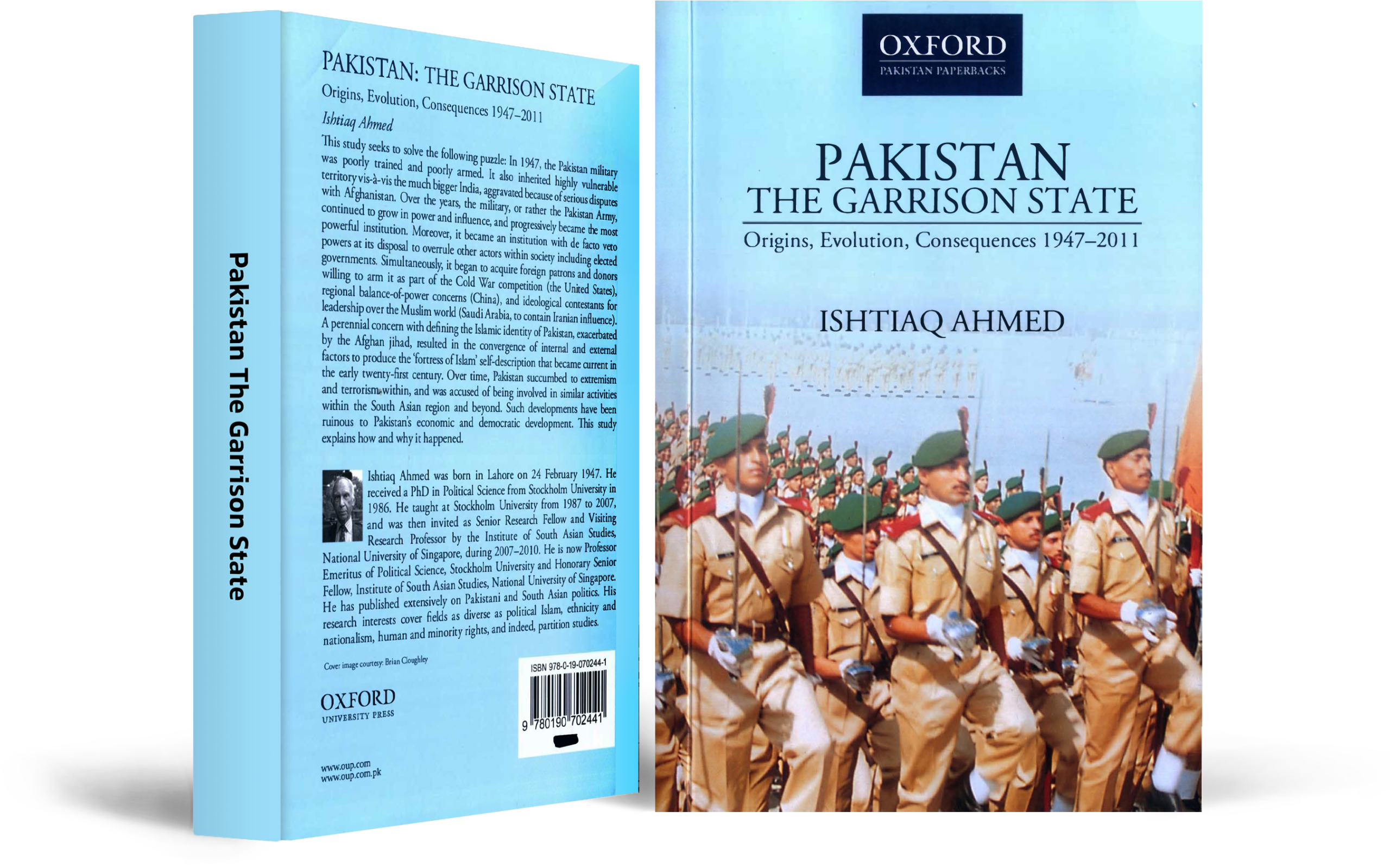
پاکستان: دولت پادگانی – خاستگاهها، تحول و پیامدها (۱۹۴۷–۲۰۱۱)
Compiler & Author: Ishtiaq Ahmed
This book examines the dominant role of the military in shaping Pakistan’s political structure from 1947 to 2011. Ishtiaq Ahmed explains the concept of a “garrison state” and analyzes how military institutions came to overshadow civilian governance. He explores the impact of wars, coups, and rivalry with India on strengthening military influence. The book assesses the long-term consequences for democracy and development in Pakistan.
The Indian Rebellion or War of Independence begins in the Bengal Army, rooted in dissatisfaction with British officers and the introduction of new cartridges.
The existing military structure is reorganized into the Indian Army, with recruitment priority given to Punjabis.
Vladimir Lenin publishes his famous work "Imperialism, the Highest Stage of Capitalism," outlining the Soviet stance on colonialism.
The Hijrat Movement begins in India, with Muslims migrating to the Soviet Union.
In 1928, Muhammad Ali Jinnah delivers four speeches advocating for the "Indianization of the army" and increased Indian representation in the officer corps.
The Dehradun Military Academy is established.
Harold Lasswell introduces the concept of the "garrison state" to describe societies dominated by violence specialists.
The Lahore Resolution is adopted by the Muslim League, calling for a separate Muslim state.
Muhammad Ali Jinnah demands 50:50 representation in government, despite Muslims making up about a quarter of India's population.
The "Quit India" movement begins, and Congress leaders are arrested.
Dr. J. Adhikari formulates his theory that the Muslims of India are a nation.
The Labour Party comes to power in Britain, and Clement Attlee becomes Prime Minister.
Lord Wavell prepares the 'Breakdown Plan' for the rapid partition of India if security deteriorates.
1946: The Muslim League wins regional elections with widespread Muslim support.
The British Cabinet Mission is sent to examine the prerequisites for the transfer of power to India.
The Cabinet Mission announces its plan for the transfer of power, rejects the demand for Pakistan, but acknowledges Muslim concerns.
The Muslim League accepts the Cabinet Mission plan for forming an interim government, but the Congress rejects it.
Jawaharlal Nehru announces at a press conference that the Congress will not adhere to any agreements after entering the Constituent Assembly.
In response to Nehru's statements, the Muslim League withdraws its support for the Cabinet Mission plan and threatens 'Direct Action' to achieve Pakistan.
The Muslim League observes 'Direct Action Day' across India, leading to widespread violence.
Liaquat Ali Khan writes to the U.S. chargé d'affaires in India, expressing concern over the massacre of Muslims in Bihar.
Clement Attlee announces that the British government will transfer power to India by June 1948 and appoints Lord Louis Mountbatten as the last Viceroy.
The Indian National Congress supports the Sikhs' demand for the partition of Punjab.
Mountbatten assumes power as Viceroy of India and begins negotiations with Indian leaders.
It is determined that both India and Pakistan will remain in the British Commonwealth.
The Indian Independence Act is passed, determining the status of princely states.
The Joint Defense Council is renamed to the 'Partition Council', with Muhammad Ali Jinnah replacing Abdul Rab Nishtar.
Sir George Cunningham returns as the Governor of the North-West Frontier Province (NWFP).
Nehru informs Mountbatten that a British Commander-in-Chief and several senior British officers will remain in India.
Jinnah informs Mountbatten that the Commander-in-Chief of Pakistan and several senior British officers will also remain there.
In the 65th committee meeting, it becomes clear that British officers will not play a role in the event of a war between India and Pakistan.
The Indian Army Headquarters prepares a top-secret document prohibiting the use of British forces to protect Indians in ethnic conflicts after August 14.
The state of Kalat in Balochistan declares independence.
Pakistan gains independence.
Lord Mountbatten is appointed as the supreme commander of the armies of India and Pakistan.
The Radcliffe Award, which determines the boundary between India and Pakistan, is published.
Jinnah amends the Government of India Act 1935 to legalize Dr. Khan Sahib's government in NWFP and appoints a Muslim League government led by Abdul Qayyum Khan.
The uprising in the Poonch region of Kashmir begins.
Jinnah gives an interview to Life magazine, presenting Pakistan as a "frontline state" against Soviet communism.
In a cabinet meeting, Jinnah emphasizes Pakistan's alignment with Britain and the United States.
Mountbatten informs Field Marshal Auchinleck that the Indian government wants his removal.
Indian forces attack the states of Junagadh and Manavadar.
Hari Singh requests assistance from India.
Colonel Iskander Mirza provides Cunningham with information about tribal invasions in Kashmir.
Maharaja Hari Singh signs the Instrument of Accession to India.
Jinnah orders General Gracy to attack Kashmir, but his superior, Auchinleck, rejects it.
The Indian government refers the Kashmir dispute to the United Nations.
Sheikh Abdullah becomes the Prime Minister of Jammu and Kashmir.
The state of Kalat joins Pakistan under pressure.
The UN Security Council adopts the Kashmir resolution, calling for a plebiscite.
Hyderabad State is forcibly annexed by India.
ISI is established.
A ceasefire in Kashmir is established under UN supervision.
Mao Zedong proclaims the People's Republic of China.
Liaquat Ali Khan visits the United States and expresses Pakistan's support for the US stance on Korea.
President Truman approves a study highlighting the strategic importance of India and Pakistan to the United States.
March 1951: At the U.S. Ambassadors' Conference in Sri Lanka, the need to nurture Pakistan as a friendly nation is emphasized.
A pro-Soviet military coup in Pakistan is thwarted by Ayub Khan.
The first shipment of arms from the United States arrives in Pakistan.
Khawaja Nazimuddin declares support for Urdu as the sole national language of Pakistan, leading to unrest in East Bengal.
Anti-Ahmadiyya riots begin in Pakistan.
John Foster Dulles visits India and Pakistan.
The United Front wins the East Bengal regional elections against West Pakistan dominance.
The US-Pakistan Mutual Defense Agreement is signed.
The United Front government is dismissed and the Communist Party is banned.
Iskander Mirza becomes Governor-General.
The Suez Crisis occurs.
The 1956 Constitution of Pakistan is declared, establishing the "Islamic Republic."
General Ayub Khan becomes the commander of the PAF.
The Eisenhower-Dulles Doctrine is proposed to contain Soviet influence in the Middle East.
Iskander Mirza abolishes the constitution, declares martial law, and appoints Ayub Khan as President.
Ayub Khan dismisses Mirza and becomes President himself.
1969: The "Decade of Development" in Pakistan begins under Ayub Khan's leadership.
The United States and Pakistan sign a formal military alliance.
Ayub Khan is elected as President by the Basic Democrats.
India takes Goa from the Portuguese.
Ayub Khan announces Pakistan's new constitution.
The Sino-Indian border war occurs.
Ayub Khan writes to Kennedy, complaining about India's military threat against Pakistan.
1965: Fatima Jinnah runs as an opposition candidate against Ayub Khan in the presidential election.
The Rann of Kutch conflict occurs between India and Pakistan.
Zulfikar Ali Bhutto claims in a Karachi press conference that the US is providing military aid to India.
Ayub Khan expresses his disappointment to the people of Pakistan over the US's lack of understanding of the Indian military threat.
Operation Gibraltar is launched.
Johnson expresses concern over the conflict between India and Pakistan.
Ayub Khan signs a directive titled "Political Objective for the Struggle in Kashmir."
Operation Grand Slam begins.
Command of Operation Grand Slam is transferred from General Akhtar Malik to General Yahya Khan.
India opens the Lahore and Sialkot fronts, starting a full-scale war with Pakistan.
China condemns India's aggression.
The U.S. Department of State announces an arms embargo on India and Pakistan.
Ayub Khan and Bhutto travel to Beijing and meet with Zhou Enlai.
Ayub Khan visits Washington.
Sheikh Mujibur Rahman presents the Six-Point Program for the autonomy of East Pakistan.
The state of Swat is integrated into NWFP.
Zulfikar Ali Bhutto publishes his book 'The Myth of Independence'.
General Yahya Khan announces that law and order have been restored and the next goal is to return to democracy.
Yahya Khan introduces the Legal Framework Order (LFO) as the basis for elections and transfer of power.
The LFO is finalized, dissolving the One Unit in West Pakistan and replacing parity with 'one man, one vote'.
Ethnic tensions begin between Sindhis and Urdu-speaking migrants in Sindh.
The 'Black September' uprising in Jordan is suppressed by the Royal Army.
General Hakim Arshad Qureshi claims that the Awami League used coercive tactics during the election campaign.
Sheikh Mujibur Rahman's Awami Party wins the general elections in East Pakistan.
The directive for 'Operation Blitz' is signed and issued by Yahya Khan.
Yahya Khan and some other generals visit Bhutto in Larkana.
General Tikka Khan is appointed as the military commander of East Pakistan.
March 24, 1971: The stance of Awami League leaders hardens, and they openly talk about a 'Confederation of Pakistan.'
March 26, 1971: Operation 'Searchlight' begins and Mujib is arrested.
The situation in Pakistan begins to deteriorate and the United States expresses concern over Pakistan's security.
Pakistan starts a war with India, leading to Pakistan's defeat and the creation of Bangladesh.
Henry Kissinger meets with Indira Gandhi.
Kissinger arrives in Pakistan and states the likelihood of war with India is 'two to three'.
China gains membership in the United Nations.
Full-scale Indian military attack on East Pakistan begins.
Pakistan's ambassador to the US, Agha Hilaly, protests US support for India.
The United States initiates proceedings in the UN Security Council.
Pakistan surrenders in Dhaka.
Zulfikar Ali Bhutto announces the nationalization of major heavy industries.
Bhutto's land reforms are introduced under Martial Law Regulation No. 115.
The Simla Agreement is signed between India and Pakistan.
The Pakistani government claims to have discovered a shipment of weapons at the Iraqi embassy in Islamabad.
The Balochistan government is dismissed.
The first clash occurs at Tandoori near Sibi.
The army enters the Mari region.
Colonel Imam is sent to the United States for training.
India conducts its nuclear weapon test.
The Islamic summit is held in Lahore.
Bhutto plans for the 1977 general elections.
The government announces that general elections will be held on March 7.
The Pakistan National Alliance (PNA) is formed as a right-wing Islamic coalition.
Bhutto claims the United States is funding an 'international conspiracy' to remove him.
General Muhammad Zia-ul-Haq conducts a military coup against Bhutto's government.
Bhutto is arrested for the political murder of an opposition leader in 1974.
A rebellion occurs in the Nuristan region of Afghanistan.
France withdraws from the nuclear reprocessing plant deal with Pakistan under US pressure.
A peace treaty is signed between Afghanistan and the Soviet Union.
Hafizullah Amin seizes power in Afghanistan and Taraki is killed.
Zia-ul-Haq issues the Hudood Ordinance.
The government postpones national and provincial elections and bans political parties.
News of the attempt to seize the Kaaba in Mecca is released.
The Soviet Red Army enters Afghanistan and Amin is assassinated.
The Federal Shariat Court is established.
A directive is issued for female government employees mandating Islamic dress.
Zia-ul-Haq introduces the blasphemy law.
Zia-ul-Haq visits Delhi.
30,000 Pakistani military personnel are deployed abroad, mainly in the Middle East.
Deputy Assistant Secretary of State Marshall expresses U.S. concerns about Pakistan's nuclear program.
Zia-ul-Haq organizes a referendum on the Islamic nature of Pakistan.
The Muttahida Qaumi Movement (MQM) is founded by Altaf Hussain.
Indira Gandhi is assassinated.
Zia-ul-Haq holds national elections with non-party candidates.
Zia-ul-Haq visits India, and both countries agree not to attack each other's nuclear facilities.
Penalties for blasphemy become harsher, including the death penalty.
It becomes clear that the Red Army will soon be forced to withdraw from Afghanistan.
Dr. Abdul Qadeer Khan claims that Pakistan has succeeded in enriching uranium to weapons-grade.

AI Assistant
Fast and reliable answers