



The Security Imperative Pakistan

Book Podcast

Book Profile

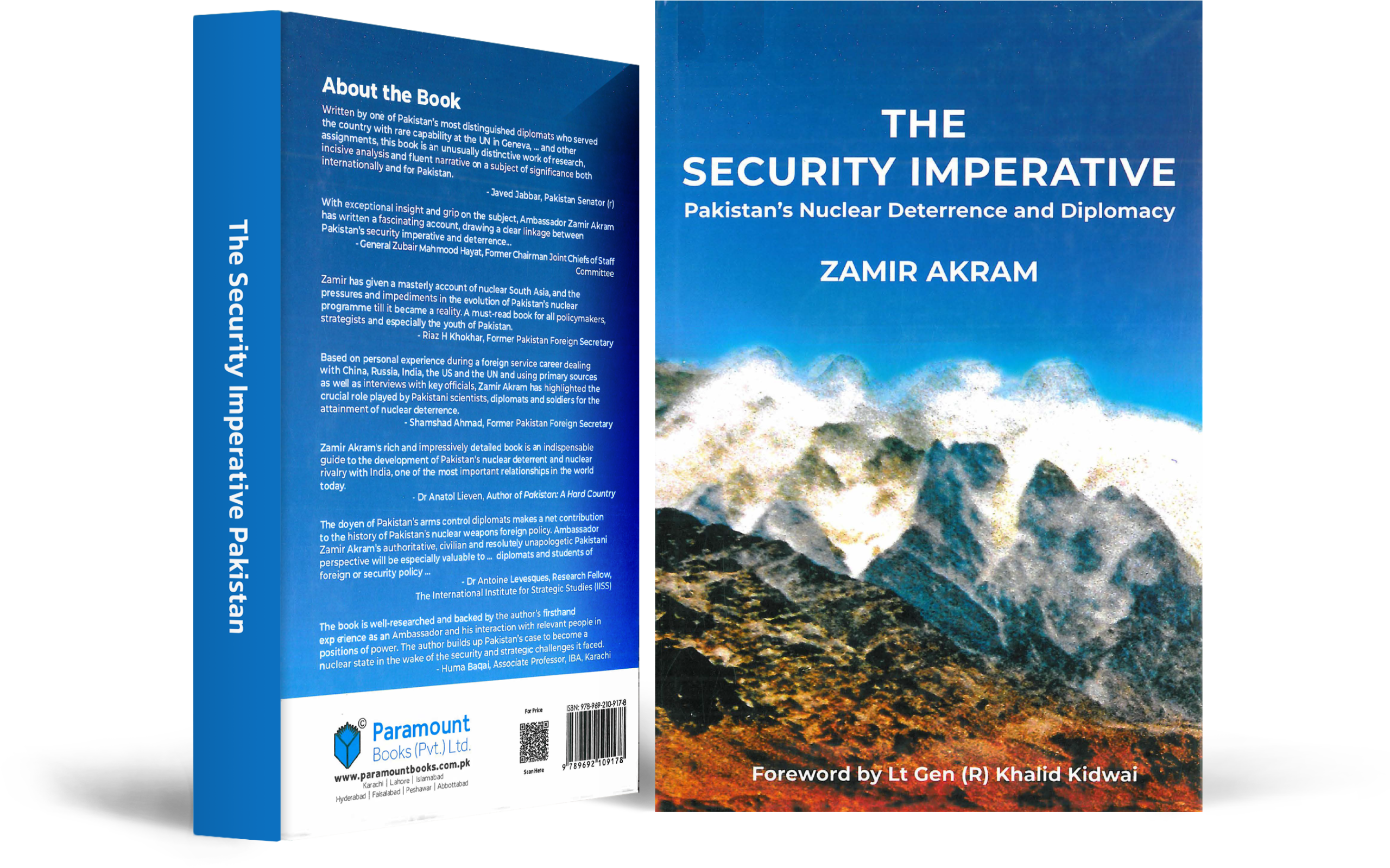
The Security Imperative Pakistan

الزام امنیتی: بازدارندگی هسته‌ای و دیپلماسی پاکستان

Compiler & Author: Zamir Akram

This book examines Pakistan’s nuclear policy and the strategic logic behind its deterrence doctrine. Zamir Akram draws on his diplomatic experience to analyze the evolution of Pakistan’s nuclear program and its engagement with the international community. He discusses the role of regional rivalry, particularly with India, in shaping security policy. The book offers a strategic insight into the relationship between national security and diplomacy.

Pages 509
Timeline Stops 97
Book Timeline

Book Timeline

1946

Nehru, the interim Prime Minister of India, declares that "there are only four great powers in the world - the United States, the Soviet Union, China, and India" and states India's intention to use atomic energy for peaceful purposes, but to defend itself with all means if threatened.

1947

The emergence of Pakistan as an independent country.

1948

Muhammad Ali Jinnah, the founder of Pakistan, passed away.

1951

Liaquat Ali Khan, the Prime Minister of Pakistan, was assassinated.

1952

Dr. Rafi Chaudhry launched a 1.2 megavolt nuclear particle accelerator in Pakistan.

1954

Dr. Rafi Chaudhry established a high voltage laboratory at Government College Lahore for nuclear research.

1955

India's first research reactor, ASPARA, was built with British assistance. From 1955 to 1974, over a thousand Indian scientists and engineers were trained in the US under the 'Atoms for Peace' program.

1956

The Pakistan Atomic Energy Commission (PAEC) was established with Dr. Nazir Ahmad as its first chairman.

1957

Pakistan and the United States signed an agreement to supply a research reactor and assist in its design, construction, and operation. The International Atomic Energy Agency (IAEA) was established to ensure safeguards and international oversight.

1961

India signed a nuclear cooperation agreement with the Soviet Union.

1962

The Sino-Indian War led to U.S. military aid to India and pressure on Pakistan not to exploit the situation in Kashmir.

1963

Ratification of the Limited Test Ban Treaty.

1964

Lal Bahadur Shastri, Prime Minister of India, approved a nuclear test plan.

1965

The Indo-Pakistani War. The United States cut military supplies to both countries.

1965 - Agreement with Canada for CANDU Power Reactor

137 MW in Karachi, Pakistan (KANUPP) was approved.

Zulfikar Ali Bhutto stated

"If India builds the bomb, we (Pakistanis) will eat grass, even go hungry, but we will have one of our own."

1966

Bhutto formed a nuclear working group in the Ministry of Foreign Affairs.

1967

Ratification of the Outer Space Treaty.

1968

Ratification of the Nuclear Non-Proliferation Treaty (NPT).

1970

The NPT came into force.

1971 - India-Pakistan War

The war between India and Pakistan led to the separation of East Pakistan and the creation of Bangladesh.

1972 - Bhutto's Nuclear Meeting

Bhutto, President and later Prime Minister of Pakistan, convened a meeting of nuclear scientists in Multan, tasking them to accelerate the nuclear program.

1973 - Reprocessing Plant Agreement

Pakistan signed an agreement with the French company Saint Gobain Techniques Nouvelles (SGN) for the preliminary design of a large-scale reprocessing plant.

1974 - India's Nuclear Test

India detonated its first nuclear device (Operation Smiling Buddha). This event led to the nuclearization of South Asia.

Nawaz Sharif's Response

"We will never allow Pakistan to fall victim to nuclear blackmail."

1975

PAEC began work on the Chemical Production Complex (CPC) to produce natural uranium dioxide for fuel fabrication.

1976

Bhutto signed a strategic agreement with China that included civilian nuclear cooperation.

1977

General Zia-ul-Haq's 'Islamization' policy began in Pakistan.

1978

The bomb design in Pakistan was completed.

1979

Assassination of Zulfikar Ali Bhutto.

Soviet invasion of Afghanistan in December 1979.

1980

PAEC announced Pakistan's self-sufficiency in nuclear fuel production from natural uranium.

1981

An earthquake in September 1981 caused the collapse of about 4,000 centrifuges at the Kahuta plant.

1982

'Proximity talks' under UN auspices began in Geneva for Afghanistan.

1983

India prepared to attack Pakistan's nuclear facilities.

Pakistan conducted a 'cold' nuclear test on March 11, 1983.

1984

Dr. Abdul Qadeer Khan publicly announced in an interview with 'Qaumi Digest' that Pakistan had acquired the capability to enrich uranium to weapons-grade.

1985

Mikhail Gorbachev came to power.

Start of work on Khushab Plutonium Production Reactor (KCP)

I).

1986

An agreement was signed between Pakistan and China to build two 325 MW power reactors at Chashma.

1987

Arshad Pervez incident; a Canadian citizen of Pakistani origin was arrested for attempting to illegally export maraging steel to Pakistan.

1988

Official signing of the agreement between India and Pakistan not to attack each other's nuclear facilities.

1989

The Soviet Union withdrew from Afghanistan.

1990

The United States imposed Pressler sanctions on Pakistan.

1991

The First Gulf War against Iraq.

1992

India and Pakistan signed an agreement to not acquire, develop, deploy, or use chemical weapons.

1993

Bill Clinton became the President of the United States.

1994 - Mullah Omar founded the Taliban.

1994

The United States offered a one-time waiver for F-16 delivery in exchange for "containing" Pakistan's nuclear program.

1995

Benazir Bhutto visited the United States.

1996

Bill Clinton signed the Brown Amendment.

1997

The construction of the Khushab-2 plutonium production reactor was completed.

1998

India conducted nuclear tests in Pokhran (Operation Shakti).

Pakistan proposed a Strategic Restraint Regime

SRR) to the United States.

Final settlement of the F-16 issue

between Pakistan and the USA.

1999

India and Pakistan signed the "Lahore Declaration" and "Memorandum of Understanding".

General Pervez Musharraf, Army Chief, ousted Prime Minister Nawaz Sharif and took power (coup)

2000

Bill Clinton lifted sanctions against India and Pakistan.

2001

General Musharraf removed Dr. Abdul Qadeer Khan from his position as head of KRL.

Attack on Indian Parliament

The December 2001 attack led to military tensions between Pakistan and India in 2002.

2002

Mysterious killing of 35 Sikhs in Chittisinghpura village in Indian-controlled Kashmir.

Kidnapping and Murder of Daniel Pearl

The American journalist was kidnapped and murdered in January 2002.

2003

U.S. invasion of Iraq in March 2003.

Two failed terrorist attacks on President Musharraf in December 2003.

2004

Next Steps in Strategic Partnership Agreement (NSSP) signed between India and the United States.

UN Security Council Resolution 1540 in April 2004.

2005

New defense agreement between India and the United States.

Construction of Khushab Plutonium Production Plant

Construction of three reprocessing plants at Chashma and Nilore began.

2006

Pakistan issued an official statement on the India-U.S. nuclear deal.

Two Indian Companies Sanctioned

Balaji Amines Ltd and Prachi Poly Products Ltd were sanctioned under the Iran Nonproliferation Act.

2007

Terrorist explosion on the Samjhota Express train in India.

2008

Musharraf resigned in August 2008.

Asfandyar Wali Khan, leader of the National Awami Party, rejected the Kerry

Lugar-Berman bill.

Mumbai terrorist attacks in November 2008.

2009

Barack Obama became President of the United States.

Kerry-Lugar-Berman bill

Passed in the United States Congress.

2010

Obama visited India.

2010 - First Nuclear Security Summit held in Washington.

2011

Obama announced the "Pivot to Asia" strategy.

US-Afghanistan Strategic Partnership Agreement.

Afghanistan Strategic Partnership Agreement).

Operation Zarb-e-Azb in Pakistan against TTP.

e-Azab در پاکستان علیه TTP.

Pakistan announced its "Full Spectrum Deterrence" doctrine.

FSD) خود را اعلام کرد.

2012

The second Nuclear Security Summit was held in Seoul.

2013

General Khalid Kidwai announced the completion of Khushab III and IV reactors.

2014

The third Nuclear Security Summit was held in The Hague.

2015

Obama visited India.

2016

The fourth Nuclear Security Summit was held in Washington.

Logistics Exchange Memorandum of Agreement

LEMOA was signed between India and the United States.

2017

Donald Trump became the President of the United States.

2018

Pakistan formally applied for membership in the Nuclear Suppliers Group (NSG).

2019

Terrorist attack in Pulwama, India.

February 2020 - First COVID-19 Case

First case of COVID-19 in Pakistan.

2020

U.S.-Taliban agreement in February 2020.

January 2021

Revelation of India's 'false flag' operation in Pulwama/Balakot attack.

2021

Completion of the book "Security Necessity" by Zameer Ikram.

2022

Visit of Pakistan's Prime Minister, Imran Khan, to China.

China-Russia Joint Statement

Issued on February 4, 2022.