

1947 - Partition of India
The British partition of India, leading to the separation of Pakistan and India.
Book Podcast
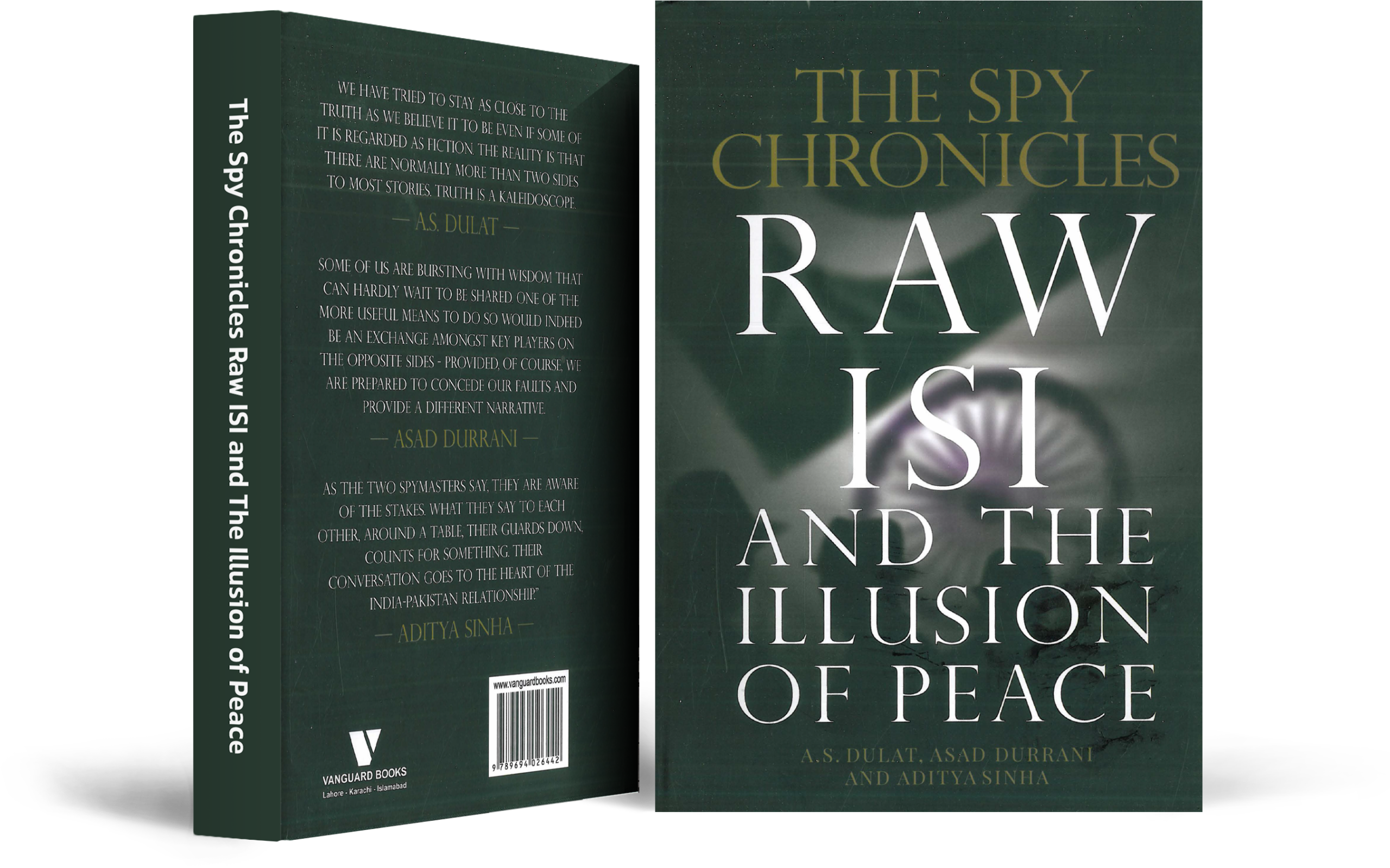
Book Profile
روایتهای جاسوسی: سازمان RAW، سازمان ISI و توهم صلح
Compiler & Author: A. S. Dulat - Asad Durrani - Aditya Sinha
This book presents a rare dialogue between former intelligence chiefs of India’s RAW and Pakistan’s ISI. The authors discuss Kashmir, terrorism, proxy conflicts, and the troubled relationship between the two countries. Through candid conversations, they reveal the hidden dynamics of security policies and historical mistrust. The book explores whether lasting peace is achievable—or merely an illusion.
The British partition of India, leading to the separation of Pakistan and India.
The wars between India and China, and India and Pakistan, led to the establishment of India's Research and Analysis Wing (RAW) from the Intelligence Bureau (IB).
The India-Pakistan wars are described as 'honorable wars' where civilians were not targeted.
The Research and Analysis Wing (RAW) of India was established.
Elections are held in Pakistan; Yahya Khan expects a hung parliament, but the Awami League and Pakistan People's Party win.
The ISI failed to predict the attack on East Pakistan during the 1971 war.
1977: Zulfikar Ali Bhutto became the Prime Minister of Pakistan.
Sheikh Abdullah makes peace with Indira Gandhi.
The Soviet Union invades Afghanistan; the ISI becomes involved in the Afghan jihad and increases its influence.
Asif Durrani is appointed as a military attaché in West Germany.
Terrorism begins in Punjab, India, and later spreads to Kashmir.
India occupies the Siachen Glacier.
1989: Rajiv Gandhi becomes Prime Minister of India.
Benazir Bhutto's government comes to power; General Hamid Gul oversees elections with incorrect predictions about Punjab and Sindh results.
A coup attempt in the Maldives is thwarted.
Rajiv Gandhi travels to Islamabad for the SAARC summit.
Rajiv Gandhi travels to Pakistan again.
Interaction between Sikh and Kashmiri militants is observed.
1990: The Kashmir uprising begins.
The kidnapping of Mufti Sayeed's daughter becomes a turning point in Kashmir.
Asif Durrani is appointed as the head of Military Intelligence (MI).
Asif Durrani became the Director General of the Inter-Services Intelligence (ISI).
General Durrani meets Gary Shankar Bajpai, head of RAW, in Singapore.
Ekta Yatra was organized in Kashmir (attended by Narendra Modi).
The All Parties Hurriyat Conference was formed.
President Farooq Leghari visits India; it is decided that Hurriyat leaders can meet with the Pakistani High Commissioner in Delhi.
Benazir Bhutto's government falls.
Asif Durrani publishes an article titled "Who is Afraid of the Indiana Wolf?" arguing that the Bharatiya Janata Party (BJP) is not dangerous for Pakistan.
India conducts nuclear tests in Pokhran (May 11 and 13). Pakistan conducts nuclear tests (May 28 and 30). An emergency hotline is established to prevent misunderstandings.
Vajpayee travels to Lahore by bus.
The Kargil War broke out between India and Pakistan.
Musharraf is dismissed by Nawaz Sharif, leading to a military coup.
The IC-814 airplane was hijacked.
Attack on the Indian Parliament.
September 11 attacks in the United States; the US asks Pakistan to cooperate in the 'War on Terror'.
State elections are held in Jammu and Kashmir.
Operation Parakram by India (troop deployment at the border).
Ceasefire between India and Pakistan.
Vajpayee offers to negotiate with Pakistan.
Asif Durrani attends the Pugwash Conference in Delhi.
Pakistan sends the army to South Waziristan, leading to the formation of Tehrik-i-Taliban Pakistan (TTP).
The Bharatiya Janata Party (BJP) loses the elections.
2005: General Pervez Musharraf meets US President George W. Bush to negotiate financial aid in exchange for anti-terrorism cooperation.
Musharraf proposes a four-point formula for resolving Kashmir.
Asif Durrani and Ajit Doval meet for the first time in Oman.
Indian Foreign Minister travels to Islamabad to sign the 'landmark agreement' including the launch of the Kashmir bus service.
Lal Masjid attack in Islamabad.
26/11 Mumbai attacks.
Asif Durrani presents a paper on intelligence cooperation at the Pugwash Conference in Berlin.
Osama bin Laden is killed in Abbottabad, Pakistan.
Two Indian soldiers are beheaded at the Kashmir border.
A paper on Kashmir is published at the University of Ottawa.
Narendra Modi becomes Prime Minister of India; Nawaz Sharif is invited to the inauguration.
State elections are held in Jammu and Kashmir.
Modi criticizes Pakistan for supporting terrorism in Dhaka.
Modi visits Lahore on his way back from Russia to attend Nawaz Sharif's granddaughter's wedding.
Kulbhushan Jadhav is arrested in Balochistan, Pakistan (espionage charges).
Burhan Wani, a commander of Hizbul Mujahideen, is killed, leading to months of unrest in Kashmir.
Uri attack on Indian Army camp; India announces a 'surgical strike'.
Ajit Doval meets former Pakistani High Commissioners and issues warnings.
Talks between Asif Durrani and E. S. Dulat with Aditya Sinha begin in Istanbul, Bangkok, and Kathmandu.
India and Pakistan publicly accuse each other at the UN General Assembly.
E. S. Dulat and General Ehsan ul Haq speak at the London School of Economics.
Siege of Islamabad by religious right (ongoing during the talks).
The book "Chronicle of Espionage" is published.
Elections are held in Pakistan.

AI Assistant
Fast and reliable answers