



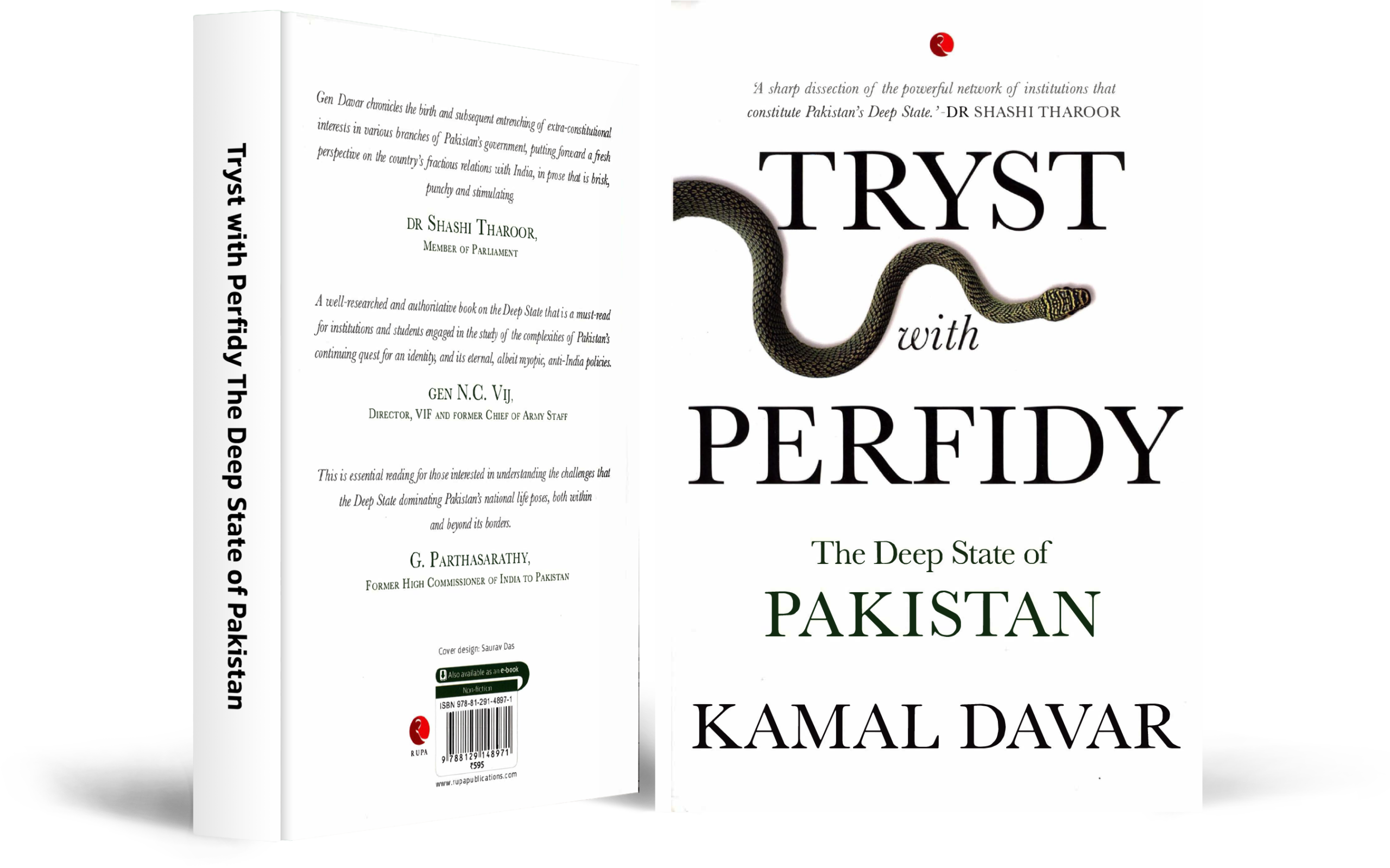
Tryst with Perfidy The Deep State of Pakistan

Book Podcast

Book Profile

Tryst with Perfidy The Deep State of Pakistan

همدستی با خیانت: دولت پنهان پاکستان

Compiler & Author: Kamal Davar

This book examines the structure and influence of Pakistan’s “deep state.” Kamal Davar analyzes the role of the military, intelligence agencies, and power networks in shaping domestic and foreign policy. He argues that these entrenched institutions have significantly affected democracy and regional stability. The book provides a critical assessment of Pakistan’s relations with its neighbors and global powers.

Pages 248
Timeline Stops 37
Book Timeline

Book Timeline

Late 19th Century

The emergence of Muslim political separatism in India led by Sir Syed Ahmad Khan. Initially aimed at enhancing Muslim political awareness and empowerment, this movement gradually sowed the seeds of a distinct identity among Muslim elites, laying the foundation for the 'Two-Nation Theory'.

1877

Establishment of the Anglo-Mohammedan Oriental College in Aligarh. Founded by Sir Syed Ahmad Khan, this college became the main center for nurturing separatist ideas and training a generation of political leaders who later founded the Muslim League and fought for the creation of Pakistan.

1906

The Muslim League achieved its first political victory by securing separate electorates for Indian Muslims. This success, supported by the British government's 'divide and rule' policy, institutionalized the political divide between Hindus and Muslims and strengthened the Muslim League.

1933

Chaudhry Rahmat Ali, a Cambridge University student, published a pamphlet titled 'Now or Never', proposing the name 'Pakistan' for an independent Muslim homeland. Although initially dismissed as 'fantastical and impractical', the idea quickly became the main slogan of the movement.

1940

The 'Pakistan Resolution' was passed at the annual session of the Muslim League in Lahore. This resolution formally called for the creation of an independent state for Muslims in the northwestern and eastern regions of India, giving a formal and decisive face to Muhammad Ali Jinnah's political struggle for partition.

August 11, 1947

Muhammad Ali Jinnah, the founder of Pakistan, outlined a surprising and secular vision for the new country in his speech to the Constituent Assembly. He declared that citizens were "free to go to their temples, mosques, or any other place of worship" and that religion "has nothing to do with the business of the state."

Mid-August 1947

The partition of India and the creation of Pakistan with its two wings, West and East, separated by thousands of miles, took place. This event was accompanied by the largest human migration in history and unprecedented sectarian violence that claimed the lives of nearly a million people and sowed seeds of enduring hostility.

October 22, 1947 - Start of the First Kashmir War

Pakistan organized and sent Pashtun tribal militias to Kashmir under 'Operation Gulmarg', initiating the First Kashmir War.

1326 - October 22, 1947 - Attack on Baramulla

The invaders entered Baramulla, destroyed the missionary hospital, killed patients and staff, and assaulted and murdered European nuns of St. Joseph's convent.

October 26, 1947

Maharaja Hari Singh, the ruler of Jammu and Kashmir, signed the Instrument of Accession to India in the face of an invasion by tribal militias. This legal act is the basis of India's claim over the region, which Pakistan has never recognized.

October 27, 1947

Indian Army troops landed in Srinagar to defend against the invasion. This timely intervention halted the attackers' advance, prevented the fall of Kashmir's capital, and initiated a full-scale war between the two countries.

1948

The Inter-Services Intelligence (ISI) was established by a British officer named Major General Walter Joseph Cawthorn. Initially created to coordinate intelligence among the armed forces, it quickly became the main tool of the 'deep state' for controlling domestic politics and operations.

January 1949

A ceasefire in Kashmir was brokered by the United Nations. This ceasefire ended the war but did not resolve the conflict, dividing Kashmir into two parts. This 'unfinished war' became a pretext for the military to justify its increasing influence in domestic politics.

1958

General Ayub Khan led Pakistan's first military coup and seized power. This coup, emerging directly from the political instability caused by the unfinished Kashmir war, cemented the military's dominance over the country's political structure for decades.

1960

Ayub Khan explained the process of 'official myth-making' in an article in Foreign Affairs. This policy aimed to promote the idea that the military, as the key institution and guardian of Pakistan's ideology, is superior to civilian institutions, thus creating a 'deep state'.

1965

The ISI suffered a major intelligence failure in assessing India's reaction to "Operation Gibraltar." Designed to incite rebellion in Kashmir, it instead led to a full-scale war with India, where Pakistan failed to achieve its objectives.

December 1970

The Awami League, led by Sheikh Mujibur Rahman, won a landslide victory in Pakistan's first nationwide elections. This victory implied that a Bengali should become the Prime Minister of all Pakistan, a prospect unacceptable to the West Pakistani political and military elite.

Night of March 25, 1971

The Pakistan Army launched "Operation Searchlight" to suppress the Bengali nationalist movement. The operation quickly turned into a state-sanctioned genocide; General Yahya Khan ordered: "Kill three million of them and the rest will eat out of our hands."

December 3, 1971

Pakistan officially started the war by launching preemptive airstrikes on Indian airbases. This action provided India with the justification it needed for direct military intervention in East Pakistan in support of the Bengalis.

December 16, 1971

The Pakistan Army surrendered in Dhaka to the joint Indian and Bengali liberation forces. With the surrender of 93,000 Pakistani personnel, Bangladesh was born as an independent nation, dealing a severe blow to the "Two-Nation Theory."

1972 - Simla Agreement Signed

The Simla Agreement was signed between Indira Gandhi, Prime Minister of India, and Zulfikar Ali Bhutto, President of Pakistan. The two countries agreed to resolve their disputes, including the Kashmir issue, through bilateral negotiations and renamed the 'ceasefire line' to the 'Line of Control'.

July 1977

General Zia-ul-Haq overthrew Zulfikar Ali Bhutto's government in a bloodless military coup. He came to power with a promise to hold elections within 90 days but ruled Pakistan for eleven years.

March 1976

Zia-ul-Haq, shortly after being appointed as army chief and before the coup, changed the army's motto from "Faith, Unity, Discipline" to "Faith, Piety, Jihad in the way of Allah." This symbolic move indicated the radicalization agenda for the country's most important institution from the start.

April 1979

Zulfikar Ali Bhutto was executed by Zia's regime despite international pleas for clemency. This action intimidated political opponents and paved the way for Zia's absolute rule and the Islamization of society without serious obstacles.

December 1979

The Soviet Union invaded Afghanistan. This event provided Zia with a golden strategic opportunity to turn Pakistan into a "frontline state" in the Cold War and garner extensive Western support.

August 17, 1988

General Zia-ul-Haq, along with the US ambassador and several senior Pakistani generals, was killed in a suspicious air crash. His death ended the longest period of military rule in Pakistan's history, but his legacy of jihadist infrastructure and an Islamist army remained.

Early 1980s

The ISI initiated 'Operation Tupac', a multifaceted strategy to train, fund, and arm Sikh separatists in Punjab and Islamist militants in Kashmir. This operation, led by the 'deep state', directly contributed to decades of violence and instability in the region.

June 1984

The Indian Army launched 'Operation Blue Star' at the Golden Temple in Amritsar in response to the occupation by Sikh militants. Although successful, the operation deeply hurt Sikh sentiments and led to the assassination of Prime Minister Indira Gandhi.

May 1998

Pakistan officially became a nuclear power by conducting six nuclear tests in the Chagai Hills of Balochistan, just weeks after India's nuclear tests. This action permanently altered the strategic balance in South Asia and emboldened the 'deep state'.

February 1999

Indian Prime Minister Atal Bihari Vajpayee made a historic bus trip to Lahore and signed the 'Lahore Declaration' with his Pakistani counterpart, Nawaz Sharif. The declaration aimed to reduce tensions and build trust between the two new nuclear powers, but its lifespan was short.

Summer 1999

The Pakistani Army violated the Lahore Agreement by sending its forces into the Kargil heights within Indian territory. The Kargil conflict was the first direct military confrontation between the two declared nuclear powers, shocking the world and ending with U.S. diplomatic pressure and Pakistan's military defeat.

December 13, 2001

Militants associated with the Jaish-e-Mohammed group, based in Pakistan, attacked the Indian Parliament building. This audacious attack brought the two countries to the brink of a full-scale war and led to the largest military mobilization on their borders since 1971.

Late 2001

Pakistan became a 'Major Non-NATO Ally' of the United States, providing crucial military bases and logistical support for the US-led war in Afghanistan. This alliance brought a significant influx of military and economic aid to Pakistan.

November 26, 2008

Coordinated terrorist attacks in Mumbai were carried out by the group Lashkar-e-Taiba, organized from Pakistan. The then ISI chief, General Shuja Pasha, later admitted: 'The people involved in the Mumbai attack were ours, but it was not our operation.' This shocking admission highlighted the involvement.

May 2, 2011

US special forces, in a covert operation, killed Osama bin Laden, the leader of al-Qaeda, in a residential compound in the garrison town of Abbottabad, near Pakistan's military academy in Kakul. This event exposed Pakistan's double policy to the world.

2014

The rise of Tehrik-i-Taliban Pakistan (TTP) as a serious internal threat peaked with the group's brutal attack on an army-run school in Peshawar. Over 140 people, mostly children, were killed. This tragedy highlighted the internal terrorism threat.

September 2016

After a terrorist attack on an Indian army base in Uri that killed 19 Indian soldiers, India responded with 'surgical strikes' on terrorist camps inside Pakistan-controlled Kashmir. This marked a shift in India's strategic restraint policy.