


Womansplaining

Book Podcast

Book Profile

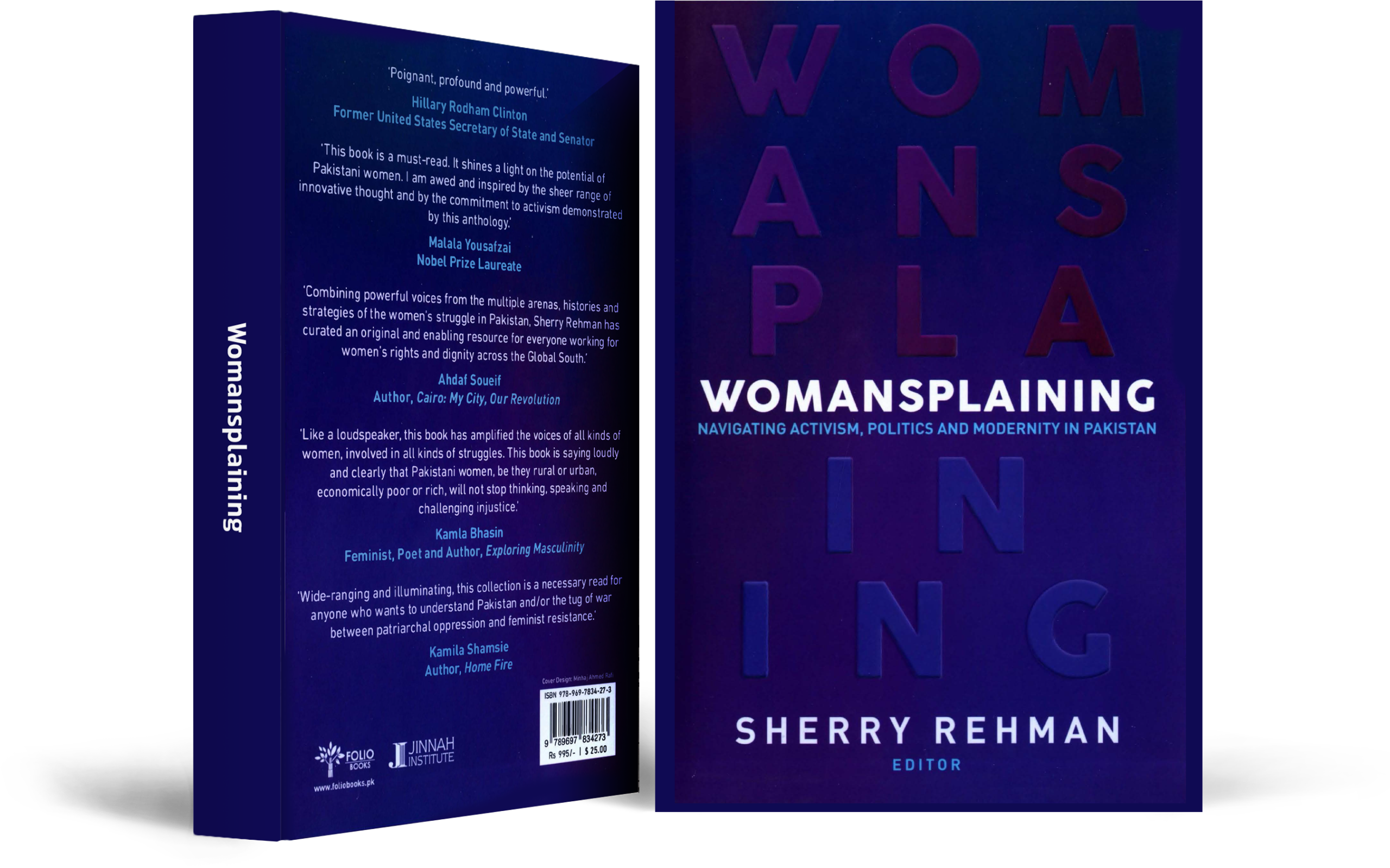
Womansplaining

زنانه‌گویی: پیمایش کنشگری، سیاست و مدرنیته در پاکستان

Compiler & Author: Sherry Rehman (Editor)

This book is a collection of essays examining women’s roles in activism, politics, and media in Pakistan. Edited by Sherry Rehman, it highlights gender challenges, political participation, and struggles for women’s rights. The contributors explore how Pakistani women navigate patriarchal structures and modern social change. The book offers a vibrant perspective on feminism and contemporary Pakistan.

Pages 291
Timeline Stops 39
Book Timeline

Book Timeline

1903

At the Muhammadan Educational Congress in Bombay, women for the first time collectively demanded the right to education. Significance: This event was one of the first collective actions to recognize women's right to education, turning it into a public demand.

1908

The 'Anjuman Khawateen Islam' was established. Significance: This was an early effort to create an organizational body aimed at improving the status of Muslim women, providing a platform for future activities.

1917

Women demonstrated for equal voting rights, and 'Bi Amma' challenged gender segregation norms by participating in the public sphere during the Khilafat Movement. Significance: These events marked the beginning of organized political participation by women and challenged established social norms.

1929

Muhammad Ali Jinnah, the founder of Pakistan, supported the Child Marriage Restraint Act. Significance: This support indicated high-level political backing for legal reforms related to women's rights in the early stages, legitimizing these demands.

1938

The Women's Wing of the All-India Muslim League was formed. Significance: This action institutionalized women's political participation within the Pakistani nationalist movement and provided a platform for future female leaders like Fatima Jinnah to play a central role in national politics.

1947 (Post-Independence)

The Women's National Guard was disbanded under pressure from religious parties. Significance: This event was an early example of religious forces' negative reactions against women's public participation and organization, becoming a recurring pattern in Pakistan's history.

1948

Thousands of women marched to the assembly in protest against the removal of the Sharia Bill report, which included women's inheritance rights, leading to the eventual passing of the Muslim Personal Law. Significance: This was a successful example of post-independence mass mobilization directly resulting in a significant legal achievement.

1948

The Democratic Women's Association (DWA) was founded in Lahore; a leftist movement focusing on working women's rights. Significance: This movement was the first feminist organization inspired by Marxism, linking women's struggles to class issues.

1954 - Women's Rights Charter

The 'Women's Rights Charter' drafted by Begum Shahnawaz was approved by the Constituent Assembly. Significance: This charter was a foundational legal document recognizing the economic and social rights of women in the newly established Pakistan.

1955 - United Front for Women's Rights

The 'United Front for Women's Rights' launched a campaign against polygamy. Significance: This campaign led to the formation of legal reform commissions and paved the way for the enactment of the key Muslim Family Laws Ordinance.

1961 - Muslim Family Laws Ordinance

The 'Muslim Family Laws Ordinance' was enacted. Significance: This law was a major milestone in women's legal rights, regulating polygamy and arbitrary divorce for the first time, and providing women with limited legal tools for self-protection.

1965 - Fatima Jinnah's Presidential Election Campaign

Fatima Jinnah contested against General Ayub Khan, the then military dictator, symbolizing women's political power.

1970-1977 - Zulfikar Ali Bhutto Era and Women's Political Engagement

During this period, the political space for women expanded, and they entered mainstream politics.

September 1981

The group 'Shirkat Gah' learned about the sentencing of a woman named Fahmida and a man named Allah Bakhsh under 'Hudood Ordinances', receiving 100 lashes and stoning, respectively. Significance: This event sparked organized action leading to the formation of the Women's Action Forum (WAF).

1981

The Women's Action Forum (WAF) was established in Karachi and quickly expanded to Lahore, Islamabad, and Peshawar. Significance: The founding of WAF was a pivotal event in the history of Pakistan's modern women's movement, providing a national, coordinated platform for resistance against dictatorship and oppression.

February 12, 1983

Protesting women marching to present a petition to the Chief Justice of Lahore against the proposed Evidence Law (which valued a woman's testimony as half of a man's) were brutally beaten by police. Significance: This day became a symbol of state violence against women.

1985

The Federal Shariat Court overturned the conviction of Safia Bibi, a blind woman who became pregnant after being raped and was accused of adultery. Significance: This was an important legal victory for the movement, highlighting the oppressive and unjust nature of the 'Zina Ordinance' nationally and internationally.

April 1986

Benazir Bhutto returned from exile. Significance: Her return raised hopes for political change through elections and led to a partial reduction in the street protest aspect of the women's movement, as many activists pinned their hopes on her political leadership.

August 17, 1988

General Zia-ul-Haq was killed in a plane crash, paving the way for the return of democracy. Significance: This event completely changed the political landscape and shifted the movement's strategy from confrontational politics against dictatorship to critical engagement with elected democratic governments.

1988

1990 and 1993-1996: Benazir Bhutto served two terms as Prime Minister. Significance: This period saw close collaboration between women's rights activists and the government, leading to tangible actions like establishing the first women's bank, appointing female judges in high courts, and creating women's police stations.

1991

The Women's Action Forum (WAF) declared its position as a secular and non-partisan entity. Significance: This was an important ideological clarification within the movement, solidifying its independent identity after the return of political parties to power.

1994

Benazir Bhutto's government introduced the 'Lady Health Workers' program. Significance: This was a revolutionary, women-centered intervention in the public health system, bringing primary healthcare services to rural doorsteps through a cadre of local women.

1995

The Fourth World Conference on Women was held in Beijing. Significance: This event marked the peak of collaboration between the government and civil activists, aiding extensive international networking, but also accelerated the 'NGO-ization' of the movement with the influx of international funds.

1996

The 'Saima Waheed' case regarding a woman's right to marry without guardian consent was pursued by her lawyer, Asma Jahangir, in the Lahore High Court. Significance: This was an important legal battle that ended in favor of women's choice rights, despite strong backlash from the religious right.

1999

A Senate resolution condemning the 'honor killing' of Samia Sarwar, who was killed by her family in her lawyer Hina Jilani's office, was rejected. Significance: This shocking event revealed the deep influence of patriarchal norms in high government institutions.

2002

A 17% quota system for women in national and provincial assemblies was introduced. Significance: This significantly increased women's political representation, altered parliamentary discourse, and turned women into key players in legislative processes.

2004

Honor killings were officially declared illegal under the Criminal Law Amendment. Significance: This was a major legal victory recognizing 'honor' killings as a criminal offense, although the final law was weakened by political compromises.

2006

The 'Protection of Women (Criminal Laws Amendment)' was enacted, effectively weakening the misogynistic adultery law. Significance: This was a major legal victory and the culmination of decades-long struggles initiated by the Women's Action Forum (WAF) against Hudood laws.

December 27, 2007

Benazir Bhutto was assassinated. Significance: This was a tragic loss of a prominent female leader who openly challenged religious extremism, and her death had a profound impact on Pakistan's political landscape.

2008

The 'Benazir Income Support Program' (BISP) was introduced, providing direct cash assistance to women heading households in extreme poverty. Significance: This was Pakistan's first comprehensive social safety net exclusively targeting women as primary beneficiaries.

2010

The government of Pakistan officially recognized February 12 as 'National Women's Day'. Significance: This marked the official acknowledgment of the historic 1983 protest and the women's movement struggles by the government.

2010

The Protection Against Harassment of Women at the Workplace Act was passed. Significance: This was a major legal achievement that prioritized women's safety in the workforce amidst increasing participation, defining acceptable workplace behavior for the first time.

2012

The National Commission on the Status of Women (NCSW) Act was passed, granting the body financial and administrative autonomy. Significance: This fulfilled one of WAF's primary demands for a permanent, independent watchdog for women's rights.

2016

A law was passed to strengthen protection against honor killings. Significance: This law aimed to block legal loopholes in honor killing cases by restricting the possibility of 'forgiveness' by the family.

February 2018

Asma Jahangir, a prominent human rights and women's rights icon in Pakistan, passed away. Significance: The loss of one of the most fearless and influential figures of the movement raised concerns about the future of human rights activism but also inspired a new generation to continue.

March 2018

The first 'Aurat March' (Women's March) was held on International Women's Day in major cities of Pakistan. Significance: This event became a symbol of a new wave of feminism in Pakistan; a grassroots, multi-layered, and creative mobilization that challenged social taboos with bold slogans.

April 2018

With allegations surfacing in Pakistan's entertainment industry, the global #MeToo movement gained momentum in the country. Significance: This movement led to widespread public discussions and legal battles over sexual harassment, breaking the culture of silence, especially among the urban educated classes.

2019

The Aurat March was held for the second year with greater participation and faced more organized and intense reactions from religious and media circles. Significance: This event demonstrated the persistence and growth of the new movement while highlighting deep ideological divides in Pakistani society.

September 2020

A gang rape of a woman on the Lahore highway in front of her children sparked nationwide outrage and public anger. Significance: This passionate public campaign, supported by WAF and Aurat March organizers, demonstrated widespread public support for women's safety and justice.