



Proxy Wars Reality (Part-1)
While Arab states historically launched multiple military conflicts and an oil embargo against Israel, the Iranian Revolution of 1979 fundamentally reshaped Middle Eastern geopolitics by replacing a pro-Western monarchy with an Islamic…
AI Analysis
Understanding Middle Eastern politics through slogans, emotional claims and a single narrative of “secret conspiracies” may be convenient, but history is rarely that simple. One question, however, deserves serious consideration: did the balance of power in the Middle East change after Iran’s 1979 revolution in a way that weakened the possibility of a united Arab front against Israel?
To answer that question, we need to move beyond slogans and examine history, wars and developments on the ground.
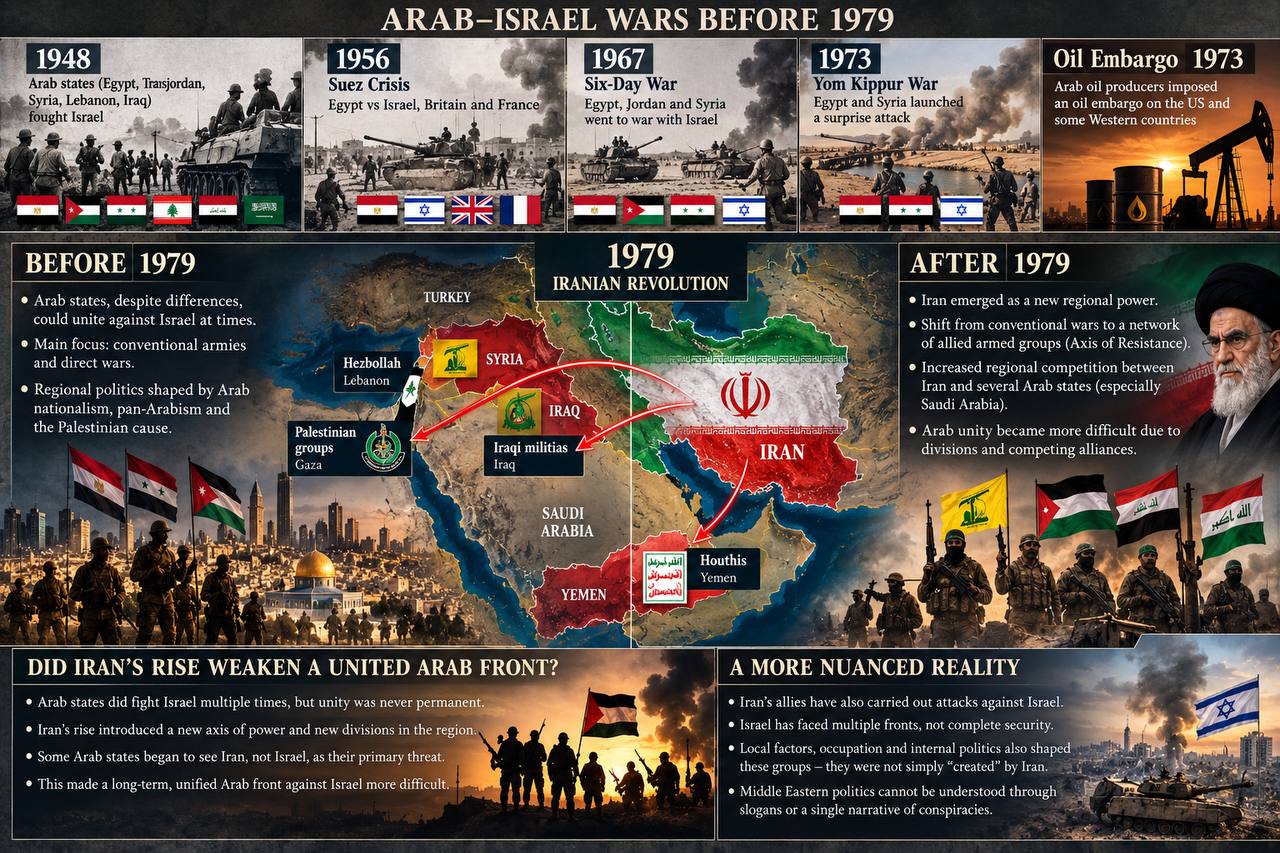
It would be historically inaccurate to suggest that Arab states never fought Israel. In 1948, the armies of Egypt, Transjordan, Syria, Lebanon and Iraq participated in the war, while Saudi Arabia also dispatched a military contingent that fought under Egyptian command.
In 1956, Egypt confronted Israel, Britain and France during the Suez Crisis. In 1967, Egypt, Jordan and Syria went to war with Israel. Within six days, Israel captured the Sinai Peninsula, Gaza, the West Bank, East Jerusalem and the Golan Heights.
Then came the 1973 war. Egypt and Syria launched a surprise attack on Israel, placing the Israeli military under considerable pressure during the initial phase. By the end of the war, however, Israel had regained much of its military position. The conflict also had consequences far beyond the battlefield: Arab oil-producing states imposed an oil embargo on the United States and some Western countries, sending shock waves through the global economy.
The first historical lesson, therefore, is clear: Arab states did fight Israel, but Arab unity was neither permanent nor uniform.
What changed in 1979?
The Iranian Revolution of 1979 represented a fundamental geopolitical and political transformation in the Middle East. The pro-Western monarchy of Shah Mohammad Reza Pahlavi was overthrown and replaced by an Islamic Republic under Ayatollah Ruhollah Khomeini. The new Iranian leadership made the projection of the revolution and opposition to Western influence important elements of its foreign policy.
A new form of regional competition began to emerge.
Rather than relying exclusively on conventional warfare, Iran expanded its regional influence through relationships with armed groups, providing varying degrees of financial support, training, weapons and political backing. This network is now commonly described as Iran’s regional armed network or the “Axis of Resistance”.
It has included Hezbollah in Lebanon, several armed groups in Iraq, the Houthis in Yemen and some Palestinian groups.
But an important qualification is necessary.
It would be an oversimplification to claim that Iran simply created proxies in every Arab country that had fought Israel. Hezbollah, for example, emerged in Lebanon during the 1980s amid the Israeli occupation of southern Lebanon and the particular political and social circumstances of the Lebanese Shia community. Iran and the Islamic Revolutionary Guard Corps subsequently provided it with substantial financial and military support.
Similarly, Iran’s role in Syria became closely associated with its support for Bashar al-Assad’s government. In Iraq, the influence of Iran-aligned militias was shaped by the political and security vacuum following the 2003 US invasion and later by the war against the Islamic State. In Yemen, the roots of the Houthi movement lie in local Zaydi politics and a prolonged conflict with the Yemeni state. Iran later provided the Houthis with varying forms of support, including technology and training. To describe the Houthi movement simply as an “Iranian creation”, however, would ignore its complex local origins.
Did Iran’s proxy strategy make Israel safer?
This is an important question, but it cannot responsibly be answered with a simple “yes” or “no”.
On the one hand, Iran has supported armed groups that have carried out attacks against Israel. Its relationships with Hezbollah and Hamas are prominent examples. The Houthis have also launched missiles and drones towards Israel and attacked shipping in the Red Sea linked to Israel.
On the other hand, Iran itself has directly attacked Israel. In April 2024, Iran launched a large-scale drone and missile attack directly against Israeli territory for the first time. Regional groups aligned with Iran also became involved in the wider confrontation. It is therefore inaccurate to claim that Iran has never fired a shot at Israel.
The more meaningful question may be different:
Has the confrontation between Iran and Israel contributed to diverting Arab states from the possibility of a common anti-Israel front towards dealing with their own competing security concerns?
There is a strong case for viewing this as one of the significant regional consequences.
Lebanon: Resistance or a State Within a State?
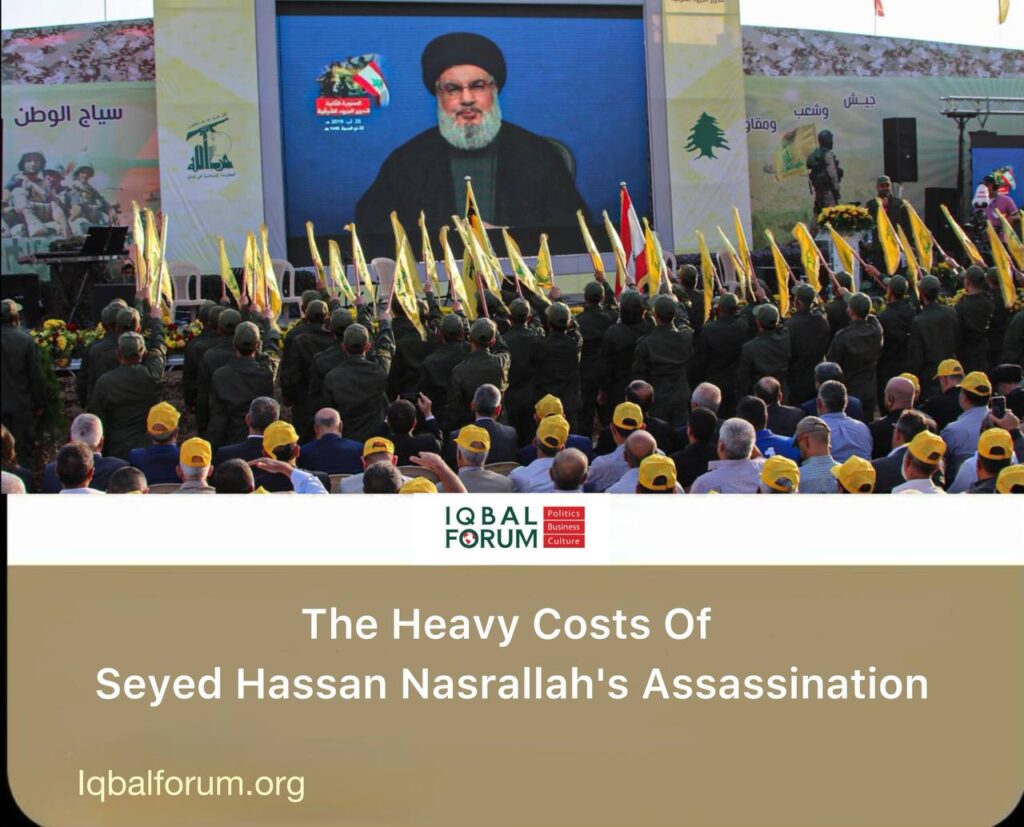
Hezbollah emerged in the name of resistance to Israel and developed into a powerful military force opposing Israeli presence in southern Lebanon. Over time, however, it also became a major actor within Lebanon’s political system.
This creates a fundamental dilemma. When a country has an exceptionally powerful armed organisation operating alongside the regular state military, questions of sovereignty and decisions about war and peace become considerably more complicated.
Lebanon’s predicament, therefore, is no longer simply a matter of Israel versus Hezbollah. It involves the Lebanese state, domestic politics, Iran, Israel and a range of regional actors whose interests intersect and often conflict.
Syria: From the Israeli Front to Civil War.
Syria fought Israel in 1948, 1967 and 1973. But after 2011, Syria itself became engulfed in a prolonged and devastating civil war.
Iran supported the government of Bashar al-Assad, while Hezbollah and other armed actors also fought on the government’s side. The conflict severely damaged Syria’s military and economic capabilities.
It would nevertheless be an unjustified attribution of motive to claim that Iran “destroyed Syria simply to prevent it from fighting Israel”. Such a claim would require compelling evidence.
The reality was considerably more complex. Syria’s war involved the government, opposition groups, Islamic State, Russia, Iran, Turkey, the United States and Israel, among others, with different actors pursuing different objectives at different stages.
The fall of the Assad government in 2024 also represented a major setback for Iran’s regional network.
Iraq and Yemen: What Is the Real Story?
Iraq fought Israel in the 1948 war and also participated militarily in the conflicts of 1967 and 1973. But the US invasion of Iraq in 2003 transformed the country’s political and security structure.
In the resulting environment, Iran-aligned Shia militias acquired considerable influence. Their importance increased further during the war against the Islamic State.
Yemen presents another complicated picture. The Houthi movement emerged from local political and social conflicts, but its military relationship with Iran subsequently deepened. Houthi missiles and drones have been used against regional targets, including Saudi Arabia, and against Israel.
It is therefore difficult to sustain the argument that Iranian-aligned armed groups target Muslims but never Israel. The available record shows otherwise.
Qatar Raises a New Question.
Recent tensions involving Iran and the United States have highlighted another reality: the costs of war are not merely military. They are economic as well.
Damage to Qatar’s Ras Laffan LNG infrastructure following Iranian missile attacks led QatarEnergy to invoke force majeure on gas supplies. Severe disruption to shipping through the Strait of Hormuz also affected the global LNG market.
By September 2026, QatarEnergy had warned that the Hormuz crisis could affect the schedules of new LNG projects, while disruptions were also affecting gas availability and prices in Asian markets.
The question, therefore, is not simply: “Who is whose agent?”
The more important question is: Who ultimately pays the economic price of regional wars?
About the Author

Dr. Anum Naz
The writer is a former Associate Professor at the Department of Mass Communication, NAML University, Karachi.
- Politics
How to Cite This Article
Naz, Dr. Anum. “Proxy Wars Reality (Part-1).” Iqbal Forum, September 26, 2026. https://iqbalforum.org/en/?p=49731.






Comments