



Nuclear arc
A recent Iranian state media broadcast guiding citizens on surviving a nuclear strike highlights the urgent need for regional de-escalation amidst spiralling conflict and political uncertainty in the US and Israel. Current…

AI Analysis
US-Saudi civilian nuclear pact and regional proliferation risks
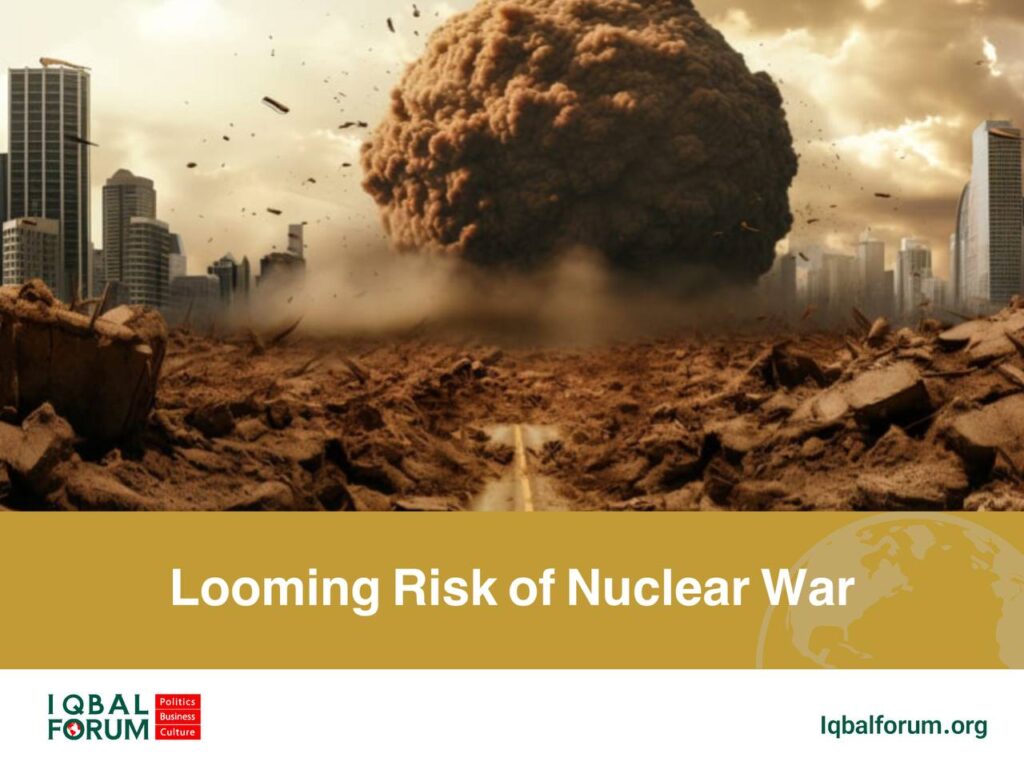
LAST week, Iranian state media broadcast instructions on how citizens could stay safe in the event of a nuclear strike. The broadcast covered what people should do if caught in an atomic flash, tips on decontaminating clothes, and what families should keep ready in a ‘nuclear emergency bag’. In the midst of a spiralling regional conflict, this dystopian broadcast is a chilling reminder of how much worse it could get — and so, of how urgently de-escalation is required, particularly as the US and Israel enter a period of political uncertainty following respective elections.
De-escalation efforts are underway, with Qatar reportedly pushing hard for a negotiated end to the conflict. These negotiations hinge on Iran agreeing to reopen its nuclear programme to inspections and accepting curbs on enrichment levels in exchange for US sanctions relief. Such a negotiated end would be very welcome, given how the spectre of nuclear conflict increasingly haunts the Middle East.
One factor that could influence the way this de-escalation proceeds is how the US Congress, freshly stuffed with Democrats, may tackle the US-Saudi civilian nuclear agreement reached this summer. The agreement for civilian nuclear cooperation paves the way for the US transferring technology to Saudi Arabia that would enable it to enrich uranium for nuclear energy production within the kingdom. This would be an exceptional agreement because, as Robert Einhorn points out in a brief for Brookings, Washington typically opposes the spread of fuel-cycle capabilities to new countries.
When announced, the deal rang alarm bells for nuclear non-proliferation experts because it does not require Saudi Arabia to adhere to the IAEA’s Additional Protocol, the legal mechanism which enables the IAEA to check for illicit weapons production. The kingdom refused to sign up to the AP on the basis that potential inspections around holy sites would be too sensitive. This, critics of the deal say, opens a loophole through which Saudi Arabia could divert enriched uranium for weapons production at undeclared sites — an uncomfortable scenario given that Riyadh has stated it would pursue weapons production if Iran acquired nuclear weapons.
The US-Saudi civilian nuclear pact will impact Iran’s strategy.
The Trump administration is willing to proceed with the deal for the following reasons: the civilian nuclear technology transfer will be governed by a Bilateral Safeguards Agreement, which will allow for inspection and monitoring of all declared sites. The US also envisions an exclusive arrangement with Saudi Arabia, meaning the latter would be locked into a ‘black box’ of US-supplied nuclear know-how, technology and equipment, enabling Washington to closely manage Saudi Arabia’s nuclear capability and production. Finally, Washington has reasoned that if it doesn’t reach an agreement with Riyadh, then Moscow or Beijing will instead, and those deals would inevitably have even fewer protections against nuclear weapons proliferation.
The agreement, currently pending with the Congress, would take effect in mid-December if not proactively blocked (an unlikely scenario given congressional priorities, a likely presidential veto of any block, and cross-party appetite to repair ties with Riyadh). But greater Democratic heft may temper the agreement, including renewed efforts to get Saudi Arabia to agree to the AP, limits on the transfer of sensitive enrichment technology, curbs on data sharing, and enhanced reporting on Riyadh’s compliance with non-proliferation terms to Congress.
In all scenarios, the US-Saudi civilian nuclear pact, and the proliferation risks it is perceived to en-
tail, will influence Iran’s approach to conflict resolution, potentially stymying progress on curtailing Tehran’s nuclear am-bitions. The prospect — howe-
ver distant — of a nuclear-armed Saudi Arabia in addition to Israel is unlikely to inspire Tehran to disarmament. It will also create regional appetite for more civilian nuclear deals with less adherence to the AP and more localisation of uranium enrichment. Turkey, for example, which has civilian nuclear cooperation deals with the US, Russia, and China, or the UAE, which has an existing agreement with the US that disallows uranium enrichment, may seek technology transfer to enable enrichment and reprocessing within their borders.
What are the security implications of a Middle East with varying degrees of enrichment capabilities subject to different inspections regimes? The idea is concerning, and requires sensible controls and scenario planning to prevent rampant proliferation. Above all, it requires trust among regional actors that civilian nuclear capability will not be repurposed for weapons production. Sadly, the mere potential for proliferation will exacerbate, not ease, the regional trust deficit.
Editor’s Note: This article was originally published in DAWN, Pakistan, and has been republished on the Iqbal Forum website with attribution to the original author and publication. The views expressed are solely those of the author and do not necessarily reflect the position of Iqbal Forum.
About the Author

Huma Yusuf
The writer is a political and integrity risk analyst.
- Politics
How to Cite This Article
Yusuf, Huma. “Nuclear arc.” Iqbal Forum, November 9, 2026. https://iqbalforum.org/en/?p=55299.






Comments