



Machinery of permanent war
Rising rhetoric from Washington indicates a potential for expanded military conflict with Iran, as President Donald Trump warns of existential consequences if Tehran rejects a new agreement. Following reports on Thursday, October…
AI Analysis
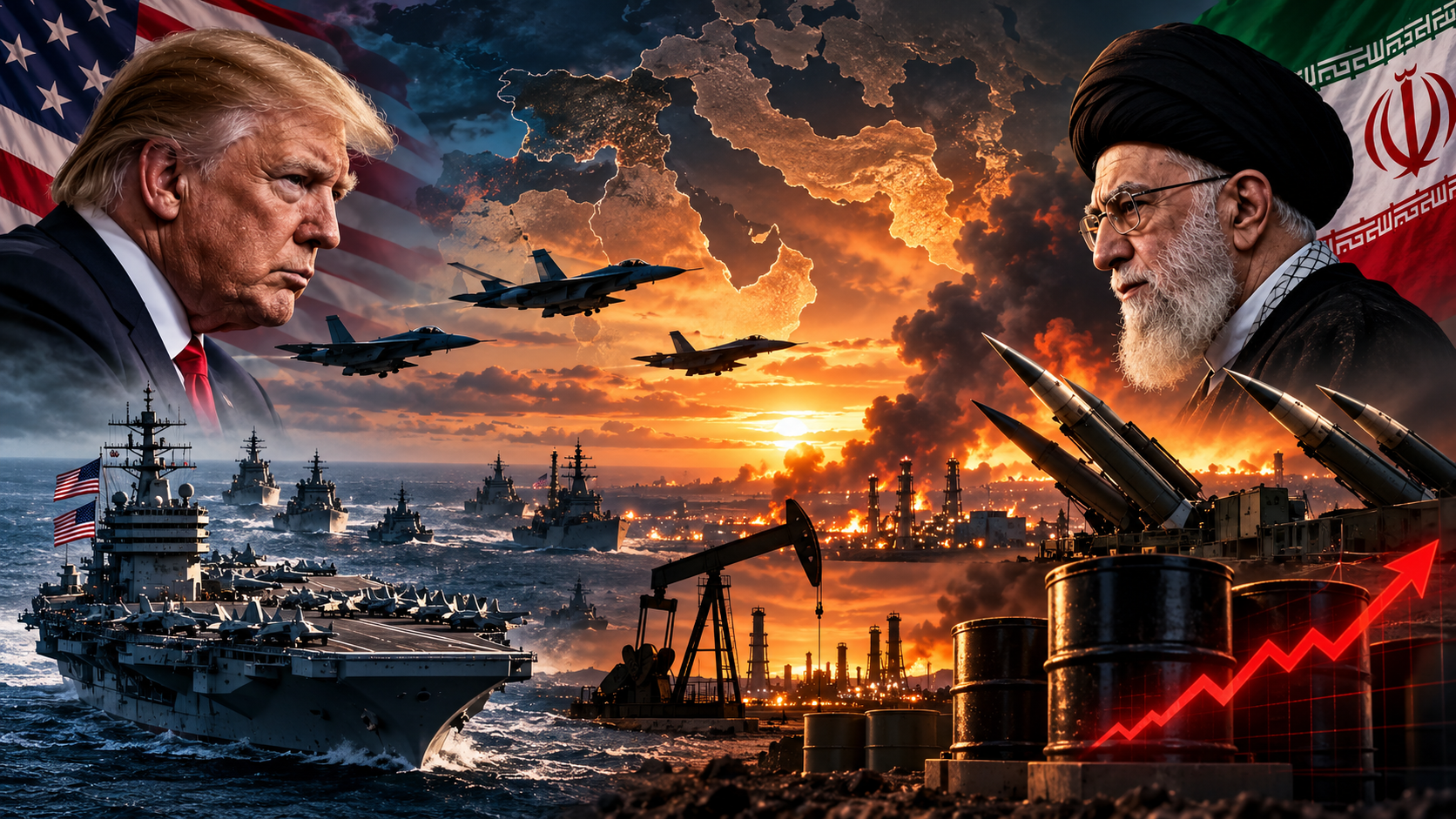
There is something disturbingly familiar about the language now emanating from Washington. US President Donald Trump says Iran may soon be “ending” one way or another. Tehran must accept what he calls a fair agreement or face consequences that he describes in existential terms.
Military deployments increase, oil prices jump, weapons manufacturers receive enormous new orders and another incident — this time aboard a commercial aircraft — is rapidly drawn into the vocabulary of terrorism, Iran and retaliation. The danger is not merely another war but the normalisation of permanent war as an instrument of policy. By Thursday, October 1, 2026, reports of an expanded American military presence in the Middle East had helped send oil sharply higher. Brent crude settled above $102 a barrel after reports that Washington was preparing additional forces and carriers for the region, compounded by China’s suspension of fuel-product exports.
This is the paradox at the heart of American policy. Washington presents military escalation as a route towards stability while markets immediately price it as instability. Threaten Iran, move carriers, replenish missile arsenals and contemplate another round of strikes — and petrol becomes dearer, diesel scarcer and transport more expensive across the world. War, unlike diplomacy, sends its invoices everywhere. Iran too has played its role in the Middle East’s disorders. Its governments have supported armed proxies, restricted political freedoms at home and repeatedly employed confrontation abroad. The Houthis have also contributed to regional instability.
Acknowledging this, however, does not require accepting Washington’s theory that overwhelming military superiority produces political solutions. America has tested that proposition repeatedly from Vietnam to Iraq and Afghanistan, and has repeatedly discovered that destroying things is easier than constructing settlements afterwards. Iran, a country of roughly 90 million people with a long history, a powerful state tradition and considerable regional networks, is unlikely to disappear because an American president declares that it might.
Indeed, negotiations have not vanished entirely. As recently as Wednesday, September 30, Iran said that it had received an American response to proposals intended to revive a Gulf ceasefire. Qatari-mediated indirect diplomacy had established areas of potential agreement even though substantial differences remained over sequencing and implementation. That is precisely why the renewed rhetoric of annihilation is so troubling. Diplomacy requires adversaries to leave one another an exit. Ultimatums require humiliation. And humiliation is not usually the foundation of lasting peace.
Meanwhile another machinery is turning. On Thursday (Oct 1) the United States Navy awarded RTX’s Raytheon division a contract worth up to $24.4 billion to expand production of SM-6 missiles. It follows a provisional $20.7bn AMRAAM deal and a much larger Patriot-interceptor arrangement as the Pentagon attempts to rebuild stocks depleted by conflicts in the Middle East and elsewhere. This does not prove that arms manufacturers manufacture wars. Governments make decisions about war and peace for strategic, ideological, domestic and security reasons. But it does reveal the political economy surrounding prolonged militarisation.
War creates constituencies of its own: factories expand, procurement programmes multiply, lobbying becomes more consequential and expenditure that might once have appeared extraordinary becomes routine. Lockheed Martin and RTX raised their 2026 forecasts earlier this year amid increasing demand for missiles and other weapons. There are expanding backlogs and rapidly rising revenues in several weapons divisions as governments sought to replenish arsenals depleted by conflicts including the Iran war. This is what US president Dwight Eisenhower warned about in 1961 when he described the emergence of a
“military-industrial complex”.
His warning was not that every weapon maker secretly starts wars. It was subtler: an enormous permanent defence establishment acquires economic and political weight that societies must consciously keep under democratic control. Sixty-five years later, the numbers would probably have astonished him.
Israel sits at the other centre of the regional crisis. Since October 2023, its security doctrine has increasingly relied upon overwhelming military power extending well beyond Gaza. Israel argues that it faces genuine threats from Iran and Iran-aligned armed groups. But security cannot mean granting one state an indefinite licence to bomb, occupy, assassinate or destroy whenever its government identifies a threat. Nor can American support for Israel substitute indefinitely for a political settlement involving Palestinians.
The central tragedy of the Middle East remains political rather than technological. No missile interceptor can answer the Palestinian question. No aircraft carrier can produce legitimate government in Lebanon, Yemen or Iran and hardly any bunker-busting bomb can reconcile Israelis and Palestinians. Military force can destroy a rocket launcher; it cannot manufacture consent. Yet every new confrontation provides political leaders with another opportunity to postpone those harder questions.
Consider the extraordinary aircraft episode of September 30. Flight FZ1073, travelling from Dubai to Tel Aviv, was diverted to Tabuk in Saudi Arabia after violence inside the cockpit. The Indian captain, Smit Machchhar, was reportedly stabbed by his co-pilot; passengers and crew intervened, and additional pilots aboard the aircraft ultimately helped land it safely. Flight-tracking information recorded both a general emergency signal and later the code associated with unlawful interference. Those are serious facts. What is not yet a fact is the motive.
The UAE attorney-general has ordered an investigation specifically to determine whether terrorism, advance planning or outside direction was involved. The airline has explicitly cautioned against premature speculation. Even Israeli PM Benjamin Netanyahu initially acknowledged that it was too early to establish the attacker’s motive. Trump nevertheless suggested that the attacker might have Iranian or Revolutionary Guard connections before investigators had established them.
Suspicion about the timing of the incident is understandable. Israel has an election approaching. Netanyahu has long presented himself as indispensable to Israeli security, and this airline affair immediately provided him with another security narrative during the campaign. Israeli opposition leader Yair Lapid accused Netanyahu’s camp of politically exploiting the episode, illustrating how quickly an aviation incident entered electoral politics.
The Indian captain’s nationality has also encouraged speculation about an India–Israel dimension. Indian PM Narendra Modi’s government and Netanyahu’s government have close political and strategic relations, and both leaders publicly praised Captain Machchhar. The more important question is how uncertain incidents become incorporated into the architecture of escalation. A suspicious episode occurs. Political leaders insinuate foreign responsibility. Television networks repeat the insinuation while military deployments acquire fresh justification. Retaliation is discussed before investigation is complete and by the time evidence catches up, political momentum may already have moved elsewhere.
Something similar should caution observers of the alleged Iranian plot against RAF Fairford in Britain. British counterterrorism police are investigating possible foreign-state involvement and on Thursday arrested a dual British-Iranian national. Yet five earlier suspects were released on bail, and police said no improvised explosive devices had been found. Iran denies involvement. States deserve protection against genuine threats. They also deserve protection against governments turning possibilities into certainties whenever certainty is politically convenient.
The wider cost is already visible. Oil above $100 is not merely a figure flashing on Bloomberg terminals. It filters into fertiliser, electricity, aviation, food, freight and household budgets. Poor countries pay disproportionately for conflicts they did not initiate. American and Israeli officials speak the language of deterrence; families thousands of miles away experience the consequences as inflation.
A durable Middle Eastern settlement will require concessions from Iran, Israel, Arab governments, Palestinian representatives and the US. It will require security arrangements, restraints on armed proxies, Palestinian political rights, regional guarantees and probably years of unglamorous negotiation. None of this provides the spectacle of an aircraft carrier steaming through warm waters. That may be precisely the problem.
About the Author

Dr Naazir Mahmood
The writer is dean of the faculty of liberal arts at a private
Profile and all publicationsHow to Cite This Article
Mahmood, Dr Naazir. “Machinery of permanent war.” Iqbal Forum, October 5, 2026. https://iqbalforum.org/en/?p=50760.




Comments