

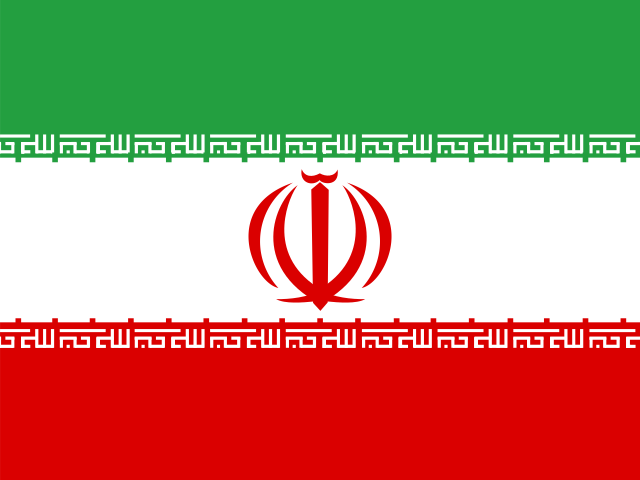


Muhammad Hussain Baqeri, Director of the Iqbal Forum , on the Future of the Iran–U.S.–Israel Conflict in an Interview with Suno News Pakistan
Control of the War and the Zionist Lobby This conflict was initiated solely in pursuit of Israeli interests. Netanyahu is not the sole decision-maker; rather, he represents the Zionist lobby in the United States and the West, as well as...

Control of the War and the Zionist Lobby
This conflict was initiated solely in pursuit of Israeli interests.
Netanyahu is not the sole decision-maker; rather, he represents the Zionist lobby in the United States and the West, as well as the leadership of Israel, which constitutes the primary driving force behind the war.
Therefore, neither ending nor continuing the conflict is entirely within Donald Trump’s control.
An Existential War
The confrontation between Iran and Israel is an “existential war” for survival.
Historically, wars of this nature have rarely reached their final resolution through negotiations. Instead, they tend to end only when one side is completely defeated or forced into unconditional surrender.
The current negotiations merely provide both sides with an opportunity to regroup and gain time.
Is World War III Approaching?
No. There are currently no clear signs of a Third World War, as such a scenario would require the direct involvement of major powers such as China and Russia in open confrontation with the West.
This conflict is fundamentally an ideological struggle between the Islamic Republic of Iran and the State of Israel.
According to this assessment, the primary objective of the United States and Israel was regime change in Iran as part of a broader plan to reshape the “New Middle East,” but that strategy has failed.
Iran’s Position in Negotiations and Its Preconditions
Iran will not discuss its nuclear program or uranium enrichment during the first phase of negotiations.
Its principal preconditions include:
The release of part of Iran’s frozen assets (estimated at approximately $100–120 billion) as a demonstration of good faith.
The removal of economic restrictions and pressure measures, allowing Iran to gradually reopen and normalize conditions in the Strait of Hormuz.
Trump is attempting to obtain at the negotiating table what he failed to achieve through military operations and pressure, a strategy viewed here as unrealistic.
The Strait of Hormuz: Iran’s Strategic Trump Card
Iran’s position is described as entirely serious: the status of the Strait of Hormuz will not simply return to pre-war conditions.
Ordinary commercial shipping will not face obstacles; however, hostile states would be expected to pay service-related costs for passage.
The strategic value of the Strait of Hormuz is considered by Iran to be more significant and effective than any nuclear weapon, and Tehran is making use of this leverage accordingly.
Trump’s Exit Strategy
Trump needs a political achievement that he can present to his domestic audience in order to exit the crisis.
Given Iran’s stated position, based on the Supreme Leader’s fatwa, that it does not seek nuclear weapons, Trump could potentially present an agreement on peaceful uranium enrichment levels (for example, 3–5 percent) as a diplomatic success and use it as a basis for de-escalation.
Tensions with Gulf States
Iran has clearly stated that any attack on its territory would be met with a strong response against U.S. military bases in the region.
According to this analysis, recent strikes in Kuwait were intended as retaliation for actions by U.S. Marines.
Regional governments understand that if the conflict expands and critical infrastructure—such as power plants and desalination facilities—is targeted during the peak summer season, the consequences for the entire region could be devastating.
For this reason, any confrontation between Iran and the United States is expected to remain limited to reciprocal strikes and deterrence measures rather than escalate into a full-scale regional war.
