



Jamnagar, Rubio, And Why The US Wants India To ‘Obey’, Not Negotiate
The 2026 US-India strategic partnership has shifted toward hyper-pragmatic, transactional diplomacy amidst economic friction, anti-Indian commentary, and tariff disputes. A central driver of this dynamic is the temporary pause on the Sanctions…
AI Analysis
The year 2026 has emerged as a defining litmus test for the strategic partnership between the United States and India. Characterised by an intricate dance of macroeconomic friction, anti-Indian commentary, and deep-rooted defense collaboration, the bilateral relationship is navigating a cycle of real structural turbulence. No single series of events captures this paradox better than the high-stakes diplomatic itineraries of US Secretary of State Marco Rubio. Following a critical repair mission in May 2026 to stabilise relations jolted by trade tariffs, Rubio’s tour in October 2026 to the financial, industrial, technology, and energy hubs of Mumbai and Jamnagar underscores a relationship shifting away from an all-encompassing strategic partnership towards hyper-pragmatic, transactional diplomacy.
To appreciate the current state of India-US ties, one must look back to the spring of 2026. The bilateral relationship entered the year under severe stress. The second Trump administration had introduced a series of aggressive economic manoeuvres, including the imposition of a 50% import tariff on certain Indian goods in August, 2025. Compounding these economic shocks were geopolitical grievances: Washington had renewed diplomatic engagement with Pakistan – which New Delhi viewed as insensitive to its counterterrorism challenges – and public praise from the White House for Pakistan’s military leadership had caused a severe trust deficit.
Advertisement – Scroll to continue
From the ‘repair mission’ of May 2026 when Rubio worked aggressively to reassure India of its status as a vital strategic partner, extended an invitation to PM Modi on behalf of President Trump to visit the White House, sought to address the 50% penalty import tariffs and trust deficit, pushed the ”Mission 500” to increase bilateral trade to $500 billion by 2030, and reaffirmed Quad cooperation in New Delhi, Rubio’s objectives in October, 2026 represented a transactional shift which coincided with a pause in the Sanctions of Russia and Iran Act seemingly triggered by broader U.S. conflicts with Iran and Russia.
It’s Business, Silly
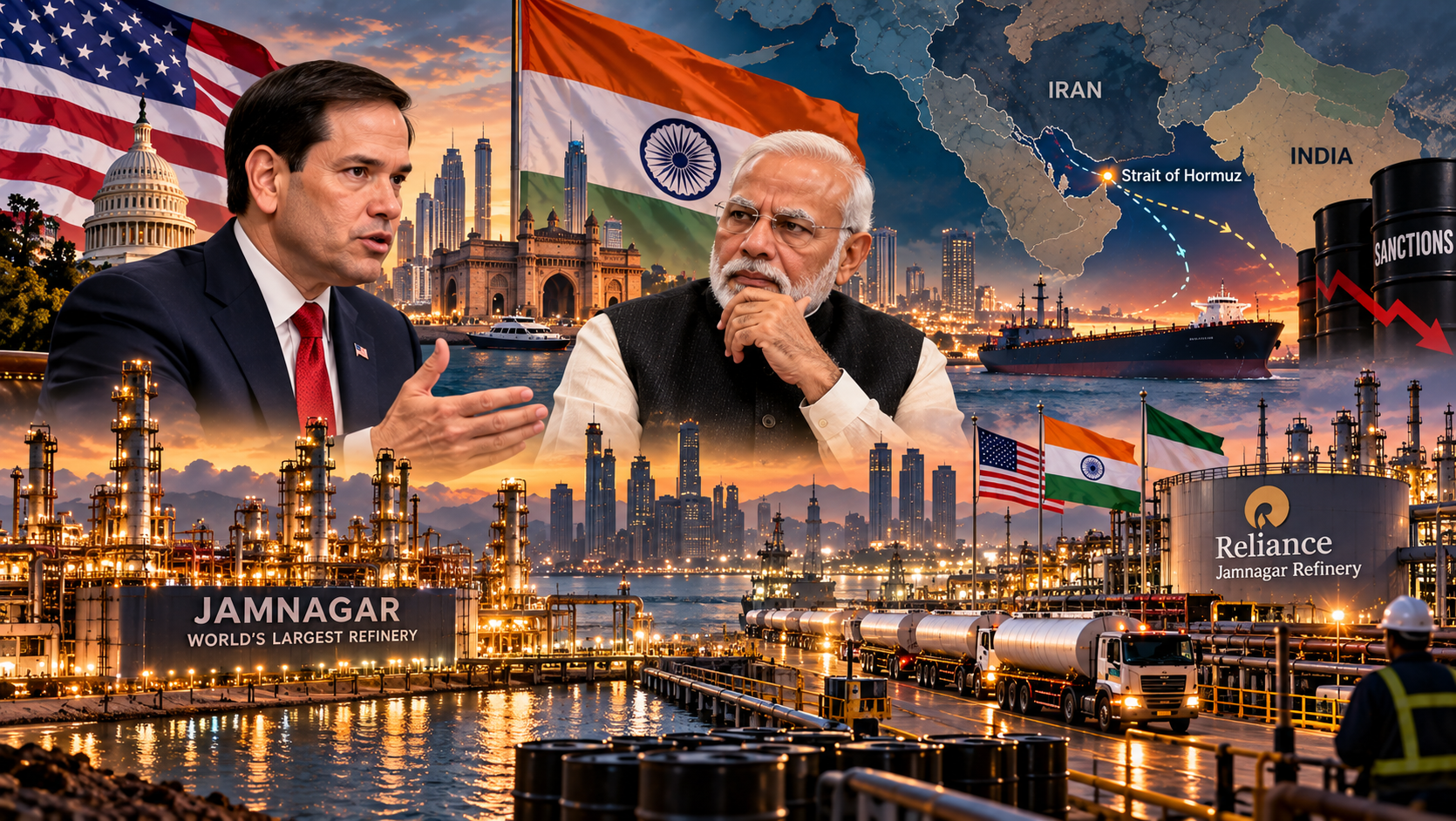
The October visit has been defined by hard, transactional realism. In a move that unnecessarily ruffled feathers among some political opposition circles in India, Rubio skipped the traditional diplomatic reception in New Delhi entirely. Instead, the State Department mapped an itinerary focused squarely on the economic and financial muscle of Mumbai and the energy infrastructure of Jamnagar in Gujarat – home to the world’s largest oil refining complex.
The backdrop to Rubio’s October arrival was the looming threat of the Lindsey O. Graham Sanctioning Russia and Iran Act. In a significant diplomatic decision just prior to Rubio’s departure, the Trump administration paused these sanctions as they applied to any country. Speaking on his way to India, Rubio stated directly that India is an “important ally” whose energy needs must be meticulously factored into US foreign policy calculations. Rubio equated energy security with national security and declared that America’s keenness to stop the Russia-Ukraine conflict has to be balanced with the impact that such measures might have on other countries. This argument sounds somewhat hypocritical, as such thinking seems to have been nowhere under consideration when penalty tariffs of 25% on account of India’s purchases of Russian oil were imposed in August 2025, while the largest importer of Russian oil and gas, China, was left untouched because of varying strategic considerations. It would have been tactless for Trump to have imposed sanctions on India on the eve of the Rubio visit. This would have totally left Rubio bereft of any negotiating leverage on what he sought to achieve. Moreover, it appears that the US today desperately wants more diesel to flow into the global markets to control the prices. In this context, the Reliance Refinery at Jamnagar, the world’s largest and one of the few with the capacity to refine the hard, sour crude from Venezuela, can meet the current US needs. It is in this context that Rubio was compelled to speak of India as a “Refining Superpower”. Rubio’s dash to India and to Jamnagar was to seek immediate reprieve for the shortage of diesel that the world is currently experiencing, and Trump’s hope that India could help in ameliorating the situation and thereby help him in his mid-Term performance.
Always A ‘Catch’
However, this relief comes with an explicit American counter-demand: Rubio emphasized a 60-day window for India to actively diversify its energy supply away from Moscow and toward American energy exporters, declaring that Washington “will not let Iran hold the global energy market hostage”.
The bilateral economic domain continues to remain a persistent battlefield. Long-running efforts to finalise an interim bilateral trade agreement have repeatedly stalled over market access, agricultural barriers, and tariff structures.
Yet, ahead of his October meetings with Jaishankar, Rubio injected a burst of optimism into the narrative, telling media outlets that negotiations were in their “last inches” and that a breakthrough was imminent. This push is tied to a broader political timeline: Washington is leveraging the trade agreement to set the stage for an official presidential visit by Donald Trump to India early next year. This could also be timed with PM Modi’s anticipated visit to Miami, Florida, for the G20 Summit in December 2026. Commerce and Industry Minister Piyush Goyal has highlighted that India wants to be assured of a position of comparative advantage relative to its global trade competitors.
However, the path to a finalised deal remains complicated by domestic policy incoherence in Washington. While the State Department attempts to cultivate India as the premier alternative to Chinese manufacturing supply chains, simultaneous crackdowns on Indian technology firms by US immigration authorities have severely strained the relationship. These immigration restrictions – implemented just as delegations attempt to pitch technology partnerships under the TRUST Initiative – have raised concerns in New Delhi about America’s predictability as an economic partner.
While public and media attention naturally gravitates toward high-profile tariff disputes and diplomatic scheduling snubs, an entirely separate reality is unfolding at the operational level. Beneath the turbulence, functional cooperation in defense, artificial intelligence, and semiconductor fabrication is accelerating at an unprecedented pace.
The Tech Train
The American private sector has decoupled its long-term strategic investments in India from the erratic cycles of official trade negotiations. Major US tech giants pledged a significant $68 billion in AI infrastructure investments in India over the past year. Furthermore, tangible components of the tech alliance are rapidly materialising:
1. Micron Technology officially opened its first semiconductor assembly and testing facility in India on February 28, executing a landmark supply chain diversification commitment.
2. Silicon Valley equipment heavyweights Applied Materials and Lam Research announced massive capital infusions into India’s emerging semiconductor ecosystem, providing the hardware foundation for New Delhi’s electronics manufacturing ambitions.
Simultaneously, the defence-industrial relationship has proven remarkably resilient against political volatility. This year, the US and Indian judiciaries and militaries are on track to complete a record number of joint military exercises.
Most notably, recent manoeuvres featured highly granular, combined air assault operations where American and Indian troops trained together just 30 miles from the line of control with China. This degree of tactical, frontline integration signals to Beijing that despite New Delhi’s refusal to join a formal military alliance, the operational interoperability between the US and Indian workforces is real, tested, and deeply entrenched.
The current state of India-US relations is defined by a fundamental structural shift: both countries are learning to separate their points of acute geopolitical divergence from their areas of critical convergence.
Growing Divergence
India’s foreign policy remains stubbornly anchored in multi-alignment. New Delhi has made it clear that its historic ties with Russia and its cautious, renewed diplomatic engagements with China are vital elements of its strategic autonomy. Conversely, Washington’s aggressive use of unilateral economic sanctions and volatile trade measures means that Indian policymakers will continue to harbour reservations about relying entirely on American promises.
Rubio’s visit signalled a distinctly transactional shift in bilateral engagement. Rather than framing the relationship around expansive grand strategy, the meetings were narrowly focused and issue-based, zeroing in almost exclusively on core pragmatic topics like energy security, trade, and investment collaborations. Critical, high-level strategic questions – such as peace and security, Washington’s relations with Pakistan, broader engagement through the Quad, or coordinated posturing on China – were notably absent from the front burner. This functional pivot underscores a broader systemic slowdown: major institutional dialogue mechanisms, including the flagship 2+2 Ministerial Dialogue that previously anchored the partnership, have not been held for nearly two years. As these vital bilateral forums are put on a pause mode, institutional momentum has perceptibly weakened. While pockets of resilience persist in immediate sector-specific cooperation, the overall trajectory reflects a decline in the ambition of diplomatic ties, replacing broad strategic alignment with narrowly scoped, transactional bargaining.
About the Author
Ashok Sajjanhar
Amb. Ashok Sajjanhar was with the IFS for over three decades. He was the ambassador of India to Kazakhstan, Sweden, and Latvia, and has worked in diplomatic positions in Washington, DC, Brussels, Moscow, Geneva, Tehran, Dhaka, and Bangkok
Profile and all publicationsHow to Cite This Article
Sajjanhar, Ashok. “Jamnagar, Rubio, And Why The US Wants India To ‘Obey’, Not Negotiate.” Iqbal Forum, October 23, 2026. https://iqbalforum.org/en/?p=52724.





Comments