



Can China Abandon Pakistan? (Part II)
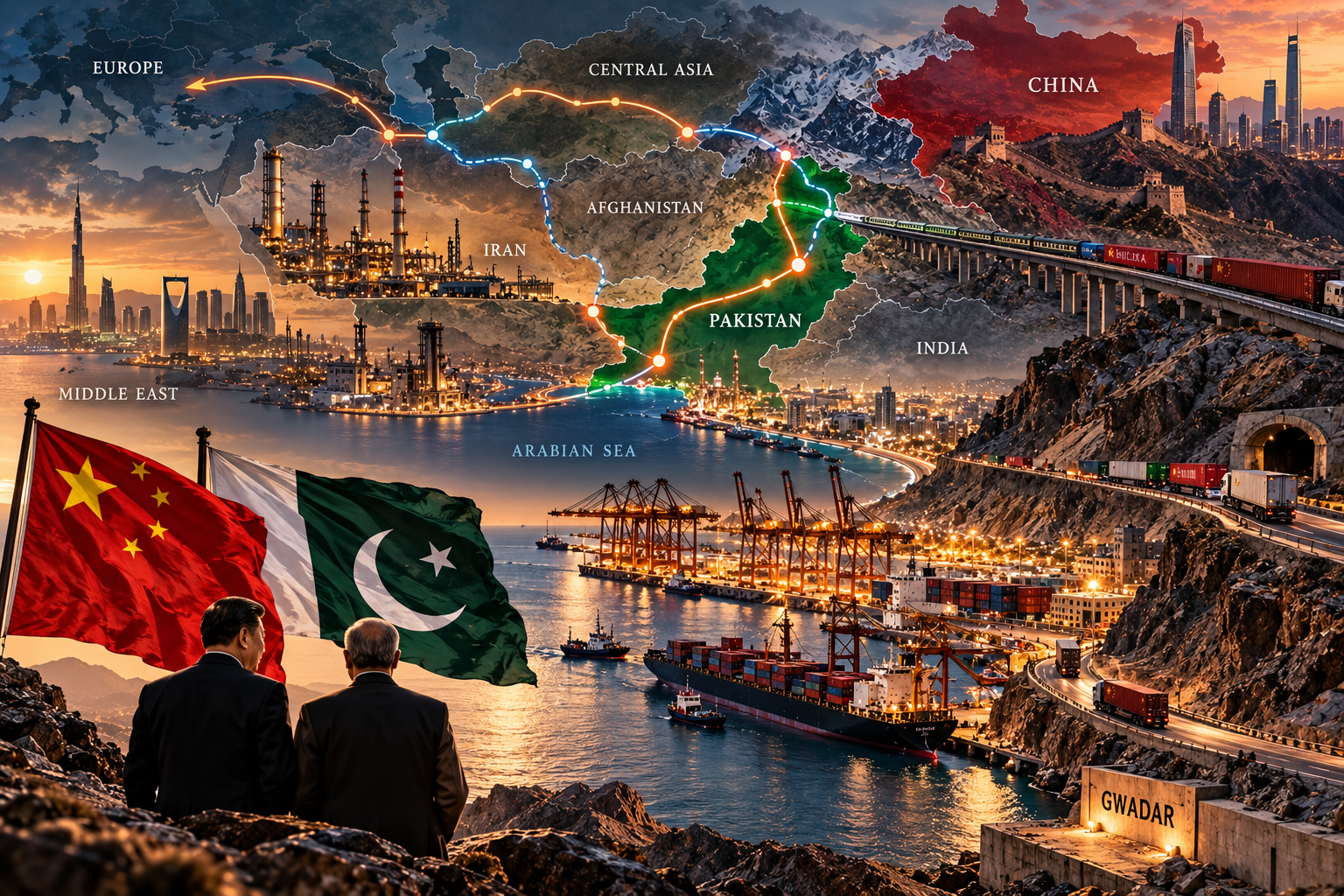
Geography forms the foundation of the resilient China-Pakistan partnership, offering Beijing a unique land-and-sea bridge to the Indian Ocean via CPEC and Gwadar while expanding Chinese connectivity toward Afghanistan and Iran. While…
AI Analysis
Part I argued that India’s rise and its intensifying strategic competition with China are important reasons for Beijing to maintain its “all-weather friendship” with Pakistan. Yet these factors, significant as they are, do not fully explain the remarkable durability of the China-Pakistan partnership. There is a deeper and more enduring factor at work: Geography.
Geography provides another, and perhaps even more compelling, answer.
It is geography that places Pakistan at the intersection of South Asia, Central Asia, the Middle East and the Indian Ocean, making it relevant not merely to China’s India policy but to Beijing’s broader regional and global ambitions.
No alternative route offers China quite the same combination of geographical proximity, strategic depth and access to the Arabian Sea.
China’s industrial heartland lies thousands of kilometres from the Middle East. Much of its imported energy passes through vulnerable maritime chokepoints, particularly the Strait of Malacca.
Pakistan offers China something few countries can: direct access to the Arabian Sea. Gwadar Port, together with the China-Pakistan Economic Corridor (CPEC), provides Beijing with a strategic outlet toward the Indian Ocean and the Gulf region.
CPEC has encountered delays, financing difficulties, security problems and criticism from within Pakistan. Yet neither Beijing nor Islamabad has abandoned it.
In fact, the two countries have continued to reaffirm an upgraded CPEC 2.0. Their May 2026 joint statement specifically called for high-quality development of CPEC 2.0, further work on the Karakoram Highway, and greater use of Gwadar as a regional connectivity hub.
No alternative route offers China quite the same combination of geographical proximity, strategic depth and access to the Arabian Sea.
Beijing increasingly views the region as an interconnected strategic space, stretching from the Arabian Sea and the Persian Gulf through Afghanistan and Central Asia to Western China.
In this wider geopolitical landscape, Pakistan occupies a position that few other countries can match. It is not merely a counterweight to India but a vital link in an emerging Asian arc, serving as the geographic hinge between China’s western frontier and the energy-rich and commercially significant regions beyond it.
This broader strategic vision helps explain why developments in Iran, Afghanistan and the smaller South Asian states are becoming increasingly relevant to China’s long-term calculations.
The 25-year China-Iran strategic partnership envisages enormous Chinese investment in Iranian energy and infrastructure.
Western sanctions, Israeli hostility and recurring tensions with Washington have steadily pushed Tehran eastward. Ironically, many policies designed to isolate Iran have accelerated its integration with China.
And Iran’s growing closeness to China does not reduce Pakistan’s importance. It enhances it. Pakistan-Iran relations, notwithstanding their chequered trajectory, have traditionally been characterised by cooperation tempered by caution.
Viewed from Beijing, Pakistan, Iran and increasingly Afghanistan constitute key segments of an emerging westward connectivity corridor linking China to its wider western strategic periphery.
If Iran strengthens China’s western reach, Afghanistan provides the geographic bridge between that western flank and China’s own Xinjiang region.
This explains why Beijing’s Afghan policy has evolved from cautious observation to active engagement, converting what was once regarded primarily as a security liability into a strategic opportunity within the emerging Asian arc.
Following the American withdrawal from Afghanistan in 2021, China has encouraged Afghan economic integration and strengthened diplomatic engagement with Kabul. It has also promoted trilateral cooperation among China, Pakistan and Afghanistan, with particular emphasis on security, trade, investment and connectivity.
No other country offers China the same combination of: strategic location; access to the Arabian Sea; leverage against India; proximity to Xinjiang; connectivity to Central Asia and the Middle East; long-standing military cooperation; the Karakoram gateway; CPEC and Gwadar; and consistent diplomatic support on sensitive issues such as Taiwan, Xinjiang and Hong Kong.
The real question, therefore, is not whether China will abandon Pakistan. It is whether Pakistan can fully capitalise on an opportunity that few nations possess.
China may occasionally get frustrated with Pakistan’s instability, security problems, economic management and political behaviour.
It does expect Islamabad to protect Chinese citizens and projects and to address the security threats that have damaged Chinese interests in Pakistan. But such frustrations are not likely to overwrite larger strategic calculations.
The relationship may change in form. Its economic priorities may shift. CPEC may evolve. Chinese patience may be tested. But the fundamental strategic equation will most likely survive.
History does offer many examples of great powers abandoning clients once their utility expires. But Pakistan is different.
Pakistan’s value to China does not arise from a transient government, a particular military leadership or a temporary geopolitical crisis. It arises from geography. And geography, unlike alliances, elections and foreign aid packages, does not change.
Barring a fundamental transformation in regional geopolitics, China is unlikely to abandon Pakistan.
But whether Pakistan, confronted by future strategic and economic pressures as well as the competing preferences and vested interests within its ruling elite, can continue to balance between Beijing and Washington with equal confidence – and whether its own art of hedging can withstand the growing pressures of great-power rivalry – is a far more complicated question.
About the Author

How to Cite This Article
Niazi, Khizar. “Can China Abandon Pakistan? (Part II).” Iqbal Forum, September 27, 2026. https://iqbalforum.org/en/?p=49808.






Comments