





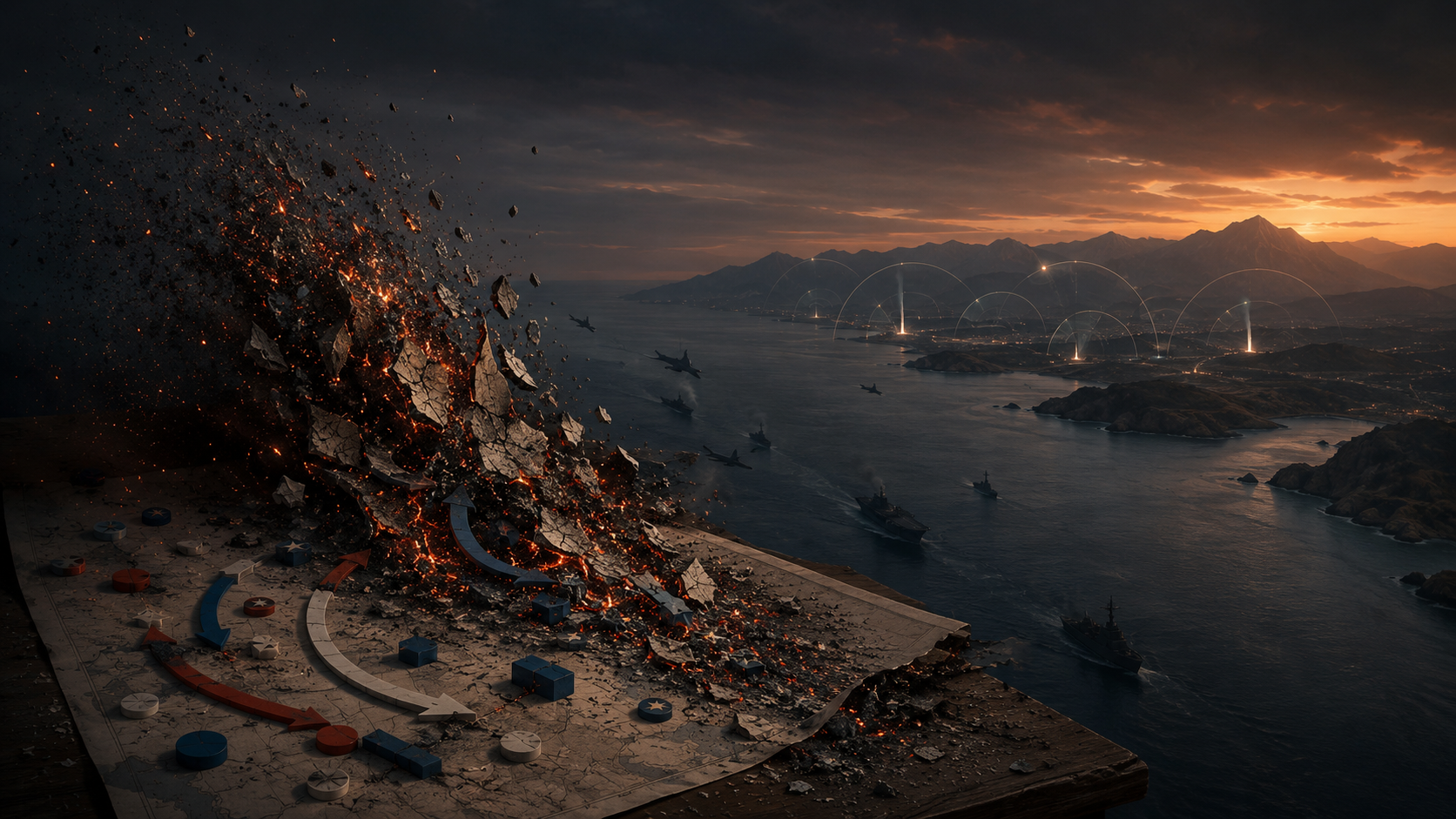
One by one, Trump’s strategic ambitions are turning into ashes
AI Analysis
Analyzing...
Loading more details...
Analysis error. Please try again.
On Monday, 3 August 2026, Major General Mohsen Rezaei officially revealed details of what he described as the U.S. plan for a ground invasion of Iran and explained how it was defeated. In a televised interview, he stated:
“During the final days of the war, Iran launched more precise waves of drone and missile strikes against U.S. bases—strikes that were even more intense than those carried out during the 40-day war.”
He added that these attacks were so precise and powerful that the U.S. base in Kuwait suffered severe damage, forcing most American forces to withdraw. As the defensive campaign continued, U.S. forces also evacuated Erbil in Iraq following heavy Iranian strikes, while American commanders stationed in Jordan were relocated to the occupied territories. As a result, CENTCOM’s command and logistical structure was pushed farther away from the Strait of Hormuz theater.
The Ground Invasion Scenario
Only eight days after the signing of the Islamabad Memorandum between Iran and the United States on 18 June 2026, the first U.S. military attack on Iranian territory began on 26 June 2026.
CENTCOM claimed the operation was retaliation for an alleged Iranian attack on a commercial vessel in the Strait of Hormuz, saying it targeted Iranian missile and drone storage sites as well as coastal radar installations.
However, the main wave of attacks began on 7 July 2026.
On that day, CENTCOM struck more than eighty locations across Iran’s southern coastline during a four-hour operation. Bandar Abbas, Qeshm Island, Sirik, Bushehr, Abu Musa Island, and areas surrounding Bandar Abbas were among the first targets.
On 12 and 13 July, the attacks intensified. Continuous explosions were reported in Bandar Abbas, Qeshm, Sirik, Jask, Abu Musa and Khark Island, leaving at least 38 people dead.
On 14 and 15 July, the campaign expanded further. Iranshahr Airport in Sistan and Baluchestan Province, the Aq-Qala railway bridge in Golestan Province, bridges in Bandar Khamir County, and water and electricity infrastructure in Mahshahr and Chabahar were struck.
At the same time, the U.S. Navy reinstated its naval blockade of Iranian ports.
Until 29 July, the attacks continued, with Bandar Abbas and Kish Island being bombed repeatedly.
The operational pattern fully matched the doctrine of preparing for a ground invasion: first neutralizing radar and air-defense systems, then destroying missile and drone capabilities, clearing maritime obstacles, andfinally establishing air and naval superiority—the essential prerequisites for any amphibious landing and coastal occupation.
Why Did the Scenario Fail?
Despite the unprecedented intensity of U.S. attacks, preparations for a ground assault failed to achieve their strategic objectives for two main reasons.
First: Geopolitical Constraints
The most important variable in international conflicts is geography.
Many analysts describe Iran as a natural fortress.
The Zagros mountain range stretches approximately 1,600 kilometers from northwest to southeast, while the Alborz range dominates the north.
Iran’s central plateau stands at an average elevation of about 900 meters and includes the Dasht-e Kavir and Lut deserts.
The country also possesses more than 390 mountain peaks above 2,000 meters, including Mount Damavand, the highest peak in the Middle East at roughly 5,700 meters.
Together, these geographical features make any large-scale ground invasion extremely difficult.
Iran covers approximately 1.6 million square kilometers—around four times the size of Iraq, a country whose occupation in 2003 required more than 300,000 American troops and still failed to produce long-term stability.
Iran also possesses approximately 2,450 kilometers of southern coastline, providing significant defensive advantages.
The Zagros Mountains extend close to the coast, making it extremely difficult to detect and destroy mobile missile and drone launchers from the air.
The Shahed drone, for example, requires only a simple launcher and can easily be concealed.
U.S. Vice President J.D. Vance recently stated:
“We’re not going to send 150,000 American troops into Iran.”
That statement reflects two major gaps inside the U.S. war room:
1. A political divide over decision-making.
2. An intelligence gap regarding Iran’s geopolitical realities.
Second: Neutralizing the Threat at Its Source
Iranian armed forces adopted a completely different strategy: neutralizing threats at their point of origin.
As soon as American operational preparations became apparent, Iran launched successive waves of missile and drone attacks against U.S. military bases across the region.
Among the targets were Ali Al Salem Air Base and Camp Arifjan in Kuwait, Al Udeid and Doha facilities, Sheikh Isa Air Base and the headquarters of the U.S. Fifth Fleet in Bahrain, and Al-Azraq Air Base in Jordan.
Iran claimed to have destroyed aircraft shelters, fuel depots, ammunition warehouses, Patriot radar systems, HIMARS launchers, and MQ-9 drones.
Iran also targeted American aerial surveillance facilities in Oman and Qatar.
These operations—combined with the closure of the Strait of Hormuz and the vulnerability of energy infrastructure belonging to Washington’s Arab partners—dramatically increased the cost of continuing military operations and effectively made any ground invasion impossible.
The Architects of Iran’s Maritime Power
How is it possible that a superpower with a defense budget of nearly $900 billion, equipped with some of the world’s most advanced weapons and deployed only a few kilometers from Iranian territory, has still failed to reopen the Strait of Hormuz?
The answer, according to this narrative, lies in a strategic transformation initiated years ago by the architects of Iran’s naval doctrine.
The concept had been built over decades, although few believed that one day Iran’s naval strategy in the Persian Gulf could place advanced military powers in such a difficult position.
The roots of today’s deterrence lie in earlier strategic thinking.
In October 1985, Iran’s late Supreme Leader stated aboard the destroyer Alborz:
“Closing the Strait of Hormuz is a completely practical option for Iran.”
Years later, the late General Qassem Soleimani declared:
“If America starts a war against us, not only is the Strait of Hormuz ours to control, but in defending our nation we have also thought about the Red Sea, the Mediterranean, the Atlantic, and beyond.”
Before his martyrdom , Admiral Ali Shamkhani stated on 30 January 2026:
“We have uncovered the enemy’s operational plan, have full intelligence on it, and at the appropriate time will strike the points that will suffocate that plan.”
On 10 February 2025, Rear Admiral Alireza Tangsiri warned:
“Our Navy has reached a point where it no longer needs to approach the coastline to launch cruise missiles.”
On 11 June 2025, the late Major General Hossein Salami declared:
“The IRGC Navy is fully capable of conducting both close-range and long-range naval warfare. Its combat readiness to respond to any threat and any scenario is complete.”
A Dream Reduced to Ashes
The attacks carried out on 16 and 17 July in Hormozgan Province, including the destruction of several key bridges connecting Bandar Abbas, Bandar Khamir, Lar, Kahorestan and surrounding areas, were intended to facilitate a future ground operation by severing all major access routes into Hormozgan from the west, east and north.
It has now become clear that Iran’s rapid response and precision strikes caused that operational plan to collapse before it could be implemented.
This, however, is described as only one of several American setbacks.
Another major setback occurred near Isfahan.
On 5 April, advanced enemy aircraft allegedly attempted an operation south of Isfahan under the pretext of rescuing an American pilot.
The operation ended in failure, with enemy aircraft—and what is described as their dream of defeating Iran—reduced to ashes.
Five months after launching its war against Iran, the United States still seems to have many lessons left to learn—and many more ambitions that could ultimately be reduced to ashes.
Article Authors
Related


Latest



Comments
Leave a comment
No comments yet.
