



MJDA: prospects and misgivings
On August 7, 2026, Turkiye, Saudi Arabia, and Pakistan established a defensive trilateral agreement (MJDA) leveraging Turkish technological defence capabilities, Saudi economic capital, and Pakistan's battle-tested military prowess. Driven by the evolving…
AI Analysis
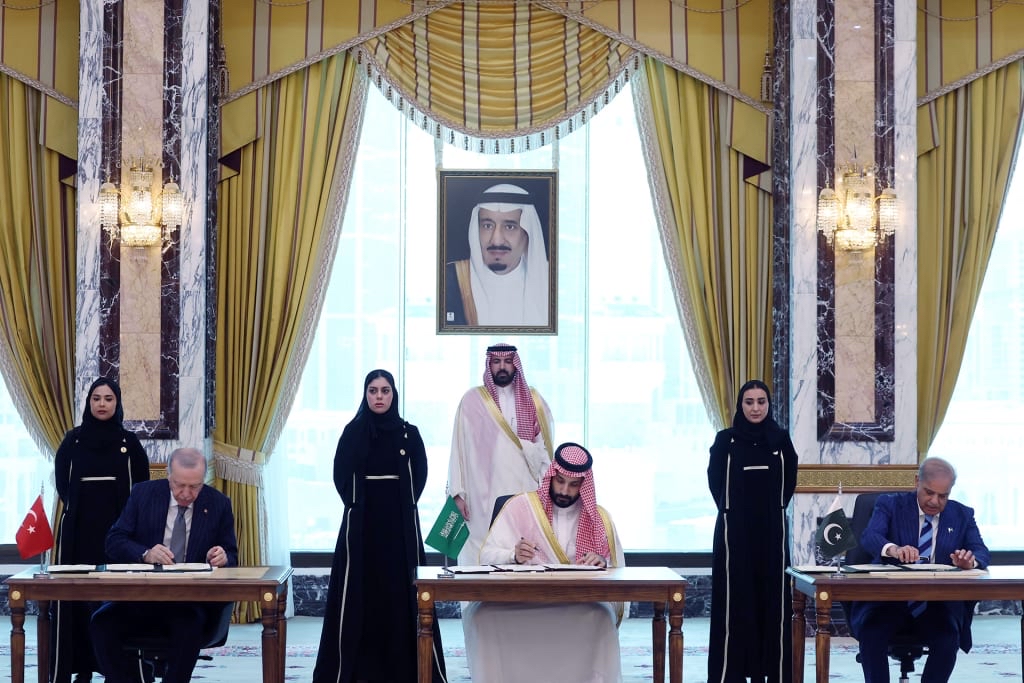
On August 7, 2026, Turkiye, Saudi Arabia and Pakistan signed a multilateral defence agreement in Riyadh, binding the three countries in a collective defence arrangement that leverages each country’s strengths.
Pakistan brings proven military capabilities, including a battle-hardened military, missile forces and a strong defence industrial base. Its nuclear capability, though out of formal treaty commitments, invests Pakistan with a strategic gravitas that is enjoyed by all nuclear powers in the world. Turkiye provides a strong defence industrial capability, evident in its $11.4 bn in defence exports in 2025.
Saudi Arabia brings its large economic potential and dominant position in the Gulf to the defence triad. Its continued progress on the defence front, and plans to localise 50 per cent of its defence production in line with its futuristic development vision – ‘Vision 2030’ – gain a visible boost by aligning with the two OIC countries. Before commenting on the prospects and potential of the multilateral defence agreement, it is important to take stock of the individual motivations of the three protagonists in this defence matrix.
The motivations of the three countries would be better understood in the context of the existing security architecture and geopolitical landscape in the Middle East. The rise of multipolarity and its influence on the Middle East is visible in additional global powers like China, Russia and a few Middle Powers staking a claim to regional economic and security capital. China’s increasing economic clout and the US desire for allies to share security obligations have created propitious conditions for new alliances.
The US reluctance to go beyond certain limits to force Israel into a behaviour that promotes positive peace has been evident in the present Israel-Iran-US conflict, a development that has forced a rethink amongst the Arab allies of the US about its reliability as a security provider in the region. The practical demonstration of this was the pivoting of the main weight of the US effort towards Israel’s defence when the Iranian missiles started hitting Israel as well as the US allies in the Gulf. The expansionist attitude of Israel and the US limitations in moderating Israel’s behaviour acted as a catalyst for Saudi Arabia’s search for alternative security arrangements for its defence.
Saudi rivalry with Iran, though significantly reduced prior to the Middle East conflict, also weighed on the Saudi mind, prompting a search for credible security alternatives to the US umbrella. The Houthi militia and its several variants in Yemen also threaten Saudi territorial integrity and economic interests through border incursions and blockade of the Bab al-Mandab chokepoint in the Red Sea. The MJDA, therefore, also signals Saudi resolve to address its security concerns vis-a-vis Yemen.
Turkiye’s motivations for the agreement stem from its desire to play an active leadership role in regional stability at a time when Iran and Israel are caught up in a destabilising conflict. Turkiye would feel confident joining the MJDA because Saudi influence in the Gulf would cover Turkiye’s flanks during a confrontation with any regional or extra-regional antagonist force.
Turkey ranks ninth out of 145 countries on the Global Firepower Index, has the second-largest military in the Nato alliance with a strength of 480000, and produces world-class exports, including UAVs like Bayraktar (TB2 & Akinci), precision munitions, naval platforms (MILGEM corvettes), and defence electronics.
Pakistan, being the only nuclear power of the Muslim world, has the fourth-largest military in Asia in terms of active military personnel, besides having an air force that is ranked seventh globally in the GFP index and which has given an excellent account of itself in the May 2025 conflict with India, shooting down its eight jets, including the much-vaunted Rafales.
With strong missile capabilities, effective training systems and a strong defence industrial base, Pakistan has proven its defence credentials as a battle-tested military. Pakistan would benefit from this trilateral defence alliance through greater prestige, more influence with Gulf allies and access to capital for its defence and economic needs.
The MJDA would formalise Pakistan’s existing defence collaboration with Middle East and Gulf allies like Saudi Arabia, Turkiye and Kuwait, as well as with others with which it does not have formal defence agreements. The alliance would also boost Pakistan’s military diplomacy and mediatory efforts.
Pakistan played an important role as a mediator in the Israel-Iran-US war not because of its geopolitical clout but because of its ‘geo-positional’ capital and the trust of the main antagonists – the US and Iran. How Pakistan earned the trust of both stakeholders is a subject of another article, but there is no doubt that it was Pakistan’s credibility as a neutral arbiter and a sincere interlocutor, with a genuine stake in regional peace that won it the confidence of both parties. It emerged as a middle power employing international law and diplomatic skills to defuse the crisis on multiple occasions when the warring parties appeared to cross the Rubicon.
The MJDA binds the three important countries in a symbiotic defence collaboration, leveraging Turkiye’s technological defence base, Saudi economic muscle and Pakistan’s battle-tested military prowess for the common defence. There are detractors who are branding the alliance as a Muslim Nato; however, nothing could be farther from the truth due to the purely defensive nature of the alliance. The alarmists also refer to Pakistan’s nuclear capability as part of the alliance, but there is no concept of the nuclear backstop in the agreement.
The agreement nevertheless needs to evolve to answer questions such as the formal command structure, basing infrastructure (rapidly deployable or permanent expeditionary force), a common threat matrix, interoperability modalities (given the diversity of equipment sources) and response options (operational contingencies based on threats). Since the alliance’s thrust is defence, it reflects a shared desire not to upend the existing security order in the Middle East.
Article Authors




Comments