



Regionalizing Power: The Mecca Pact and the Future of Global Security
Representing an attempt to construct a localized armed deterrence without direct Western sponsorship, the Pakistan–KSA–Turkey mutual defense pact signed in Mecca brings together the modern fulcrums of the Arab, Turkic, and Indus…
AI Analysis
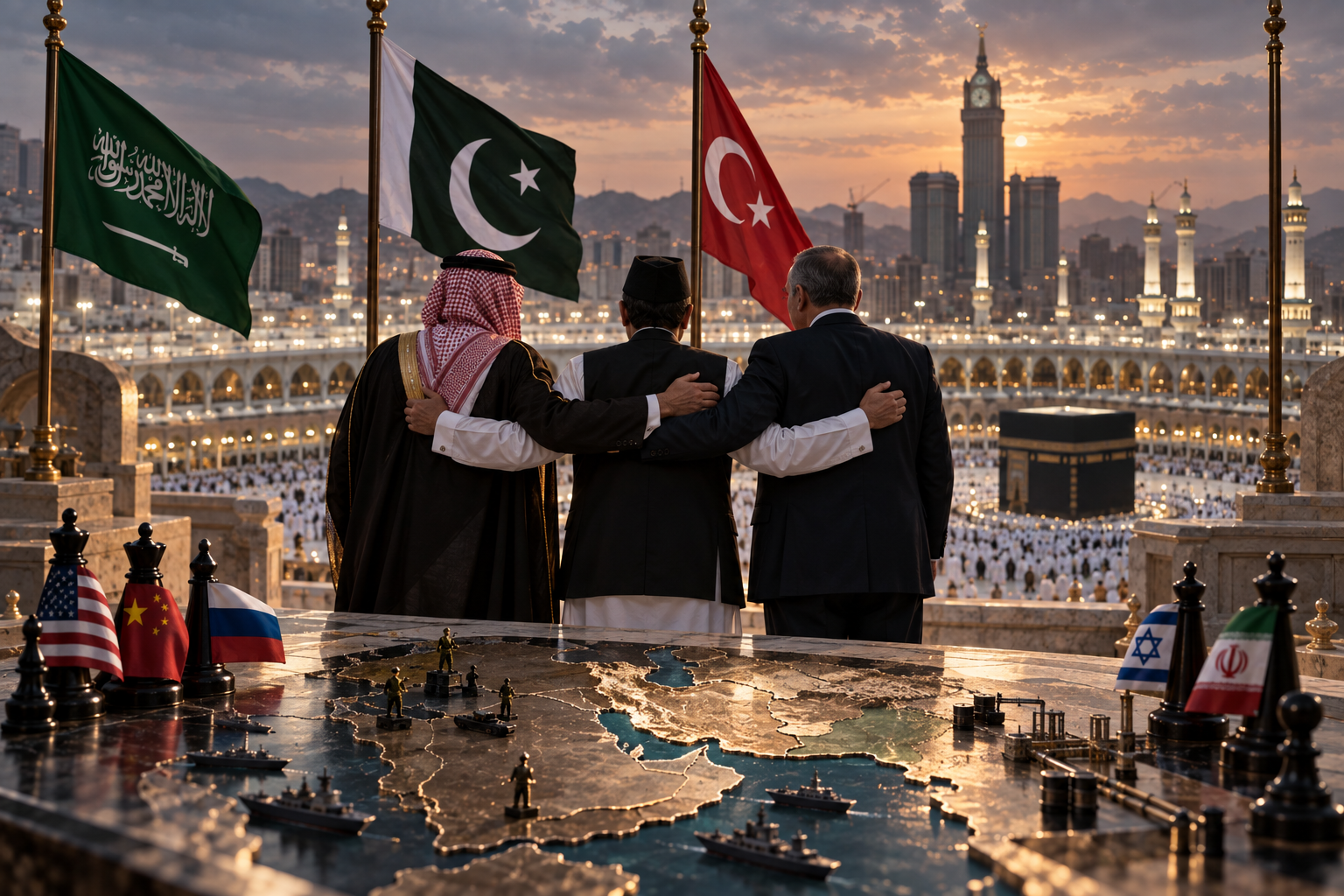
Pakistan–KSA–Turkey mutual defense in Mecca is perhaps among the most significant shifts in the power structure of the Middle East since the post–World War I settlement: an attempt to construct a localized and substantively effective armed deterrence without direct Western sponsorship or leadership, while avoiding antagonism with the three members’ individual alliances and strategic relationships with the West, especially the United States. Undoubtedly, if this agreement develops the required organizational capacity, it could significantly influence larger questions of the Middle East, including Palestine, the Abraham Accords, the security of the Strait of Hormuz, and the region’s oil and defense industries.
However, there is something more interesting here than the need-based exchange of firepower and money among the three member states. Historically, the wider region, stretching from the Mediterranean to Kashgar, has been culturally and politically shaped by four great, strategically competing but deeply interconnected worlds: the Turkic, Arab, Persian and Indus worlds. Their territorial boundaries overlapped and shifted throughout the age of empires; they competed, cooperated, fought and influenced one another over centuries. Nevertheless, each developed its own distinctive geographical and cultural centre of gravity, and the interaction among these centres has shaped the socio-political outlook of this wider region for more than a thousand years.
Significantly, the three partners of this Pact represent the principal contemporary fulcrums of three of these civilizational worlds—Saudi Arabia of the Arab, Turkey of the Turkic, and Pakistan of the Indus world. This Pact could therefore mark the beginning of a larger integration process in the region. Defense occupies a critical place in the national psychology of any society, and once states begin to converge on something as fundamental as collective security, the possibilities of convergence in economic, political and cultural spheres become considerably greater.
The argument that this is an anti-Iran alliance—or, for that matter, an anti-Israel alliance—makes sense, particularly in view of the circumstantially intense military mobilizations across the region. However, Saudi Arabia and Iran had already initiated a normalization process after decades of sectarian and geopolitical rivalry following Iran’s 1979 revolution. That process came under severe strain after the U.S.-Israeli attacks on Iran and the subsequent Iranian and Iran-aligned attacks on American installations in Gulf states. Interestingly, Iran itself has so far avoided interpreting the Mecca Pact as an inherently anti-Iran arrangement, while the three signatories have publicly presented it as defensive rather than directed against any particular state.
Moreover, the agreement sends an important signal regarding Israel and the Abraham Accords. For states such as Bahrain, Morocco and the UAE, which normalized relations with Israel, it demonstrates that normalization at the state level cannot by itself remove the Palestinian question from the regional political equation. Palestine remains deeply embedded in Arab public opinion and also resonates strongly across the wider Turkish and Pakistani political spaces. In that sense, the emerging alignment may not necessarily be anti-Israel, but it could make any future regional order that attempts to bypass the Palestinian question increasingly difficult to sustain.
Apart from its regional significance and impact, this Pact carries an important and long-term global dimension. The emergence of a powerful middle-power alliance in a region like the Middle East— historically at the centre of great-power rivalry and struggles over resources—may signal the gradual erosion of the post-World War II assumption that regional security must ultimately be managed by global powers through aircraft carriers, military bases, sea lines of communication and distant spheres of influence.
This does not mean the end of American power or presence; rather, it suggests that the age of its exclusive management of regional security is giving way to greater regional agency. This may ultimately be good news both for the American taxpayer and for the peoples of these regions, because conflicts rooted in local psychology, geography, history and cultural complexities are difficult to manage sustainably from across the Atlantic.
However, regional ownership is not automatically more peaceful: local powers can generate their own tensions unless emerging arrangements are accompanied by institutions, dialogue and political restraint. This is where the deeper meaning of multipolarity lies. Multipolarity should not be understood merely horizontally, as a redistribution of global power among Washington, Beijing and Moscow; it must also be understood vertically, through the growing capacity of middle powers to come together, construct their own regional security architectures and address their problems through more organic and intrinsic mechanisms. In this sense, the emerging global order may not simply consist of multiple competing superpowers, but of increasingly capable regions organizing themselves from within.
And finally, here comes perhaps the most important point of this argument. The three countries that have initiated this architecture now bear a responsibility to turn it into a successful case study of regional security cooperation for others in Africa, Central Asia, East Asia and Latin America. If this experiment succeeds, others may follow. But success will depend on transforming an agreement on paper into a genuinely institutionalized security architecture. For example, NATO, despite its very different historical and political context, demonstrates the importance of institutional depth—integrated planning and execution, interoperable forces and weaponry, clearly defined command-and-control structures, joint exercises, and permanent mechanisms for political and military coordination.
The responsibility is considerable because the emerging century may leave no single superpower with either the resources or the political capacity to indefinitely manage global security amid rising populations and contested resources. If regional powers are to carry a greater share of that burden, this experiment must demonstrate that regional ownership can not only produce a diplomatic theatricality, but durable institutions for collective security. Its success or failure could therefore become a significant case study of whether the regionalization of power can evolve into a workable and sustainable global security system— capable of securing sea lines of communication and global trade routes while contributing to larger peace and human security—or not. The real test of the emerging world order will not be the democratization or distribution of power itself, but what that power ultimately delivers to the human beings living within these regions. Without that human dividend, a wider distribution of power may produce not a more secure world, but merely more centres of disorder.
Article Authors

Syed Wajahat Ali
Syed Wajahat Ali is an author. Further details about his life, nationality, and rank are not specified.
View Profile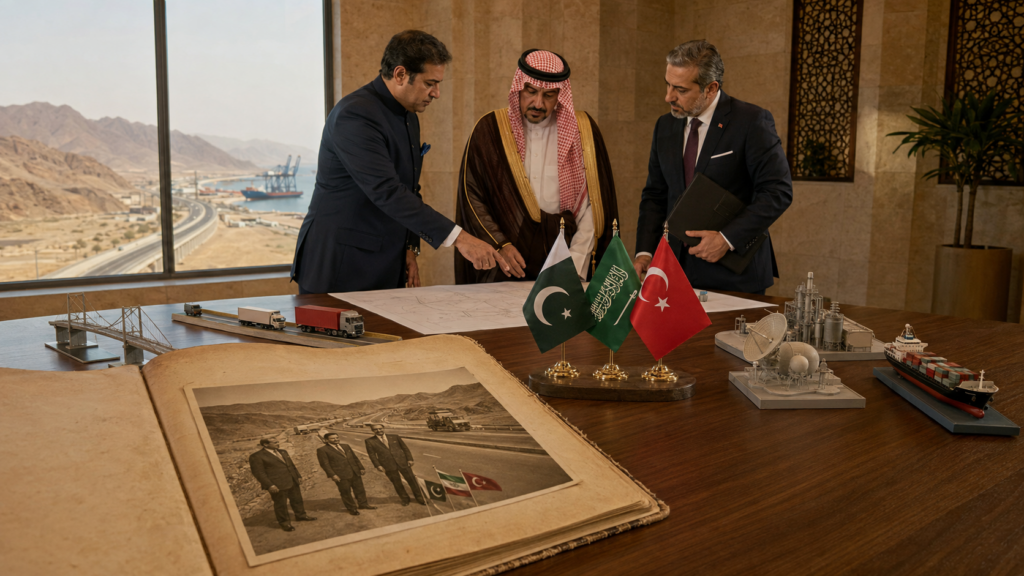


Comments