




War Without Victories: Why Modern Conflicts Refuse to End?
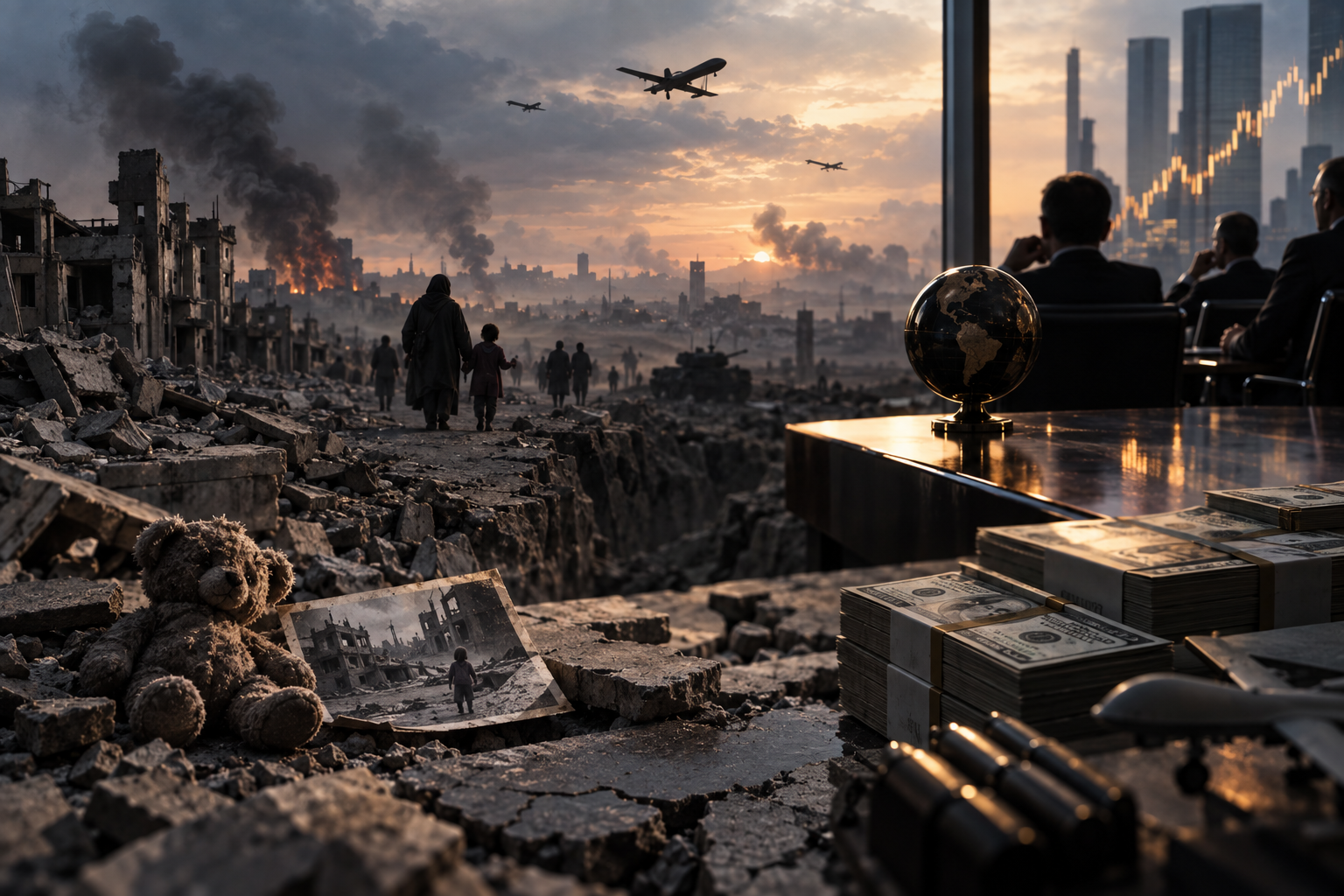
Modern warfare has shifted from seeking definitive victory to producing permanent, indecisive, and highly profitable cycles of violence. Tactical military superiority—whether through destruction of infrastructure or removal of leadership—fails to deliver political…
AI Analysis
For centuries, wars were anticipated to end with a winner and a loser; today they end with neither. Modern warfare is coming to be defined not by the ability of the competing actors to pursue decisive victory, but by their inability, or rather unwillingness, to achieve one.
Peace Research Institute Oslo published a report, “Conflict trends: A global overview, 1945-2025,” that highlights that 2025 was one of the deadliest years since the Cold War, with 65 active conflicts across 35 countries, killing more than 245,000 people. Whether it is a conflict in Palestine, Sudan, Mali, Niger, Yemen, Iran, or Ukraine, they all follow the same pattern: initial military operations achieve quick tactical gains, which then provoke resistance and escalation, forcing a ceasefire that is often temporary and eventually reigniting into a new conflict.
Historically, war strategy revolved around coalition warfare, strategic bombing, and economic and maritime blockades, with victory understood as a straightforward military defeat. The defeat that led to surrender, creating conditions for political settlement and, ultimately, peace. The destruction of the opponent’s army, capture of their territory, or toppling their government significantly determined the outcome of a conflict.
Military superiority and tactical success of military operations no longer guarantee political success.
Modern conflicts, however, have refused to follow this traditional pattern of war and victory. Military superiority and tactical success of military operations no longer guarantee political success. A state may defeat an opponent on a battlefield, destroy its strategic infrastructure, and eliminate its key command, all while leaving the underlying objectives of the conflict untouched. Nationalism, political grievances, demand for self-determination, social support, and external involvement allow the weaker opponent to resist despite significant military losses.
The fundamental example of this is both the Afghanistan and Iraq wars, where the United States demonstrated that military power can destroy regimes, win battles, and seize territory, but cannot create political order capable of surviving once the military power was removed. Similarly, the Russia-Ukraine War, despite the high-intensity warfare, Russia’s military superiority, and extensive external support to Ukraine, has evolved into a prolonged and adaptive confrontation shaped by shifting operational objectives and has yet to produce a decisive political outcome.
Moreover, the rise of non-state actors, insurgent groups, terrorist organisations, and militias has changed the nature of modern warfare. Unlike state military forces, they do not necessarily aim to defeat an opponent who holds a decisive technological advantage on the battlefield. For them, survival and remaining capable of resistance itself is the strategic success. In Yemen, the Houthi militia managed to retain its organisational and military potential despite the years of military intervention by a Saudi-led coalition with greater conventional capabilities. Their ability to survive the persistent armed campaign reflects how non-state actors can use conventional asymmetries to their advantage and prevent a stronger opponent from gaining a decisive political outcome.
Additionally, emerging technologies also play a major role in protracted conflicts. Modern armed forces have become increasingly advanced with sophisticated air power, precision-guided munitions, cyber capabilities, artificial intelligence, advanced surveillance, unmanned aerial vehicles, and drones. These technologies allow states to destroy targets with high speed and precision. However, technological superiority does not necessarily mean political success. The ongoing US-Israel and Iran conflict highlights this dilemma. At first glance, technological superiority appears to lie with the Western axis, but Iran’s ability to prolong the conflict despite suffering serious blows, to spread the cost of the war to international levels, and to exert geopolitical energy pressure highlights that the course of war goes beyond conventional militaries. Thus, the technology has made war more precise, but this precision is not the same as conflict resolution.
Even though wars and conflicts disrupt economies, for some defence contractors, energy companies, and military industrial complexes, enormous profits can be made if fighting continues. As the Russian tanks crossed the Ukrainian border in 2022, the stock prices in the global defence sector surged. Revenue of RTX, formerly known as Raytheon, which co-produces Tamir interceptors of Iron Dome with Israel’s Rafael, climbed from $64.3bn in 2021 to over $80bn by 2024. General Dynamics, a major American aerospace and defence company, posted a record of $47.7bn in revenue in 2024, an increase of nearly 25% from 2021. Lockheed Martin, whose PAC-3 (Patriot Advanced Capability-3) interceptors are deployed in Patriot air-defence systems across the Middle East, recorded a rise from $67bn to approx. $71bn in the same period.
Judging by their revenue surge, it might be assumed that these contractors are merely reacting to the wars and conflicts rather than capitalising on them. Yet their lobbying expenditure says otherwise. According to OpenSecrets, the top five US defence contractors spent over $60bn combined on lobbying Congress. While the defence sector is turning crisis into capital and creating war economies, the civilian infrastructure lies in ruins. The post-conflict reconstruction costs in Ukraine, Yemen, Iran, Sudan, and Gaza, to name a few, are expected to exceed hundreds of billions of dollars.
The tragedy of the protracted conflicts is not only the destruction it causes, but the way in which it is becoming the norm over time. As conflicts are dragging on with no decisive end, their intensity rising and falling, them slipping into ceasefires and then flaring up again, even accompanied by negotiations, the world is becoming inured to them.
The world has witnessed genocide unfold in real time, live-streamed bombings of innocent civilians, casualty figures reduced to a scrolling ticker, yet the public becomes increasingly inured to daily tolls on human life, their moral capacity dulled by repeated exposure. The greatest danger is that with this chronic exposure and protracted conflicts, society will eventually stop believing in political change and peace. Instead of asking how to end war quickly or decisively, the world is learning to live with it.
Article Authors

Atiqa Tariq
The writer is a Strategic Studies scholar at the National Defence University, Islamabad, with a research focus on deterrence, conventional-nuclear entanglement, and South Asian security dynamics.
View Profile


Comments