



Trump’s MAGA Politics Defeated in Midterm Elections
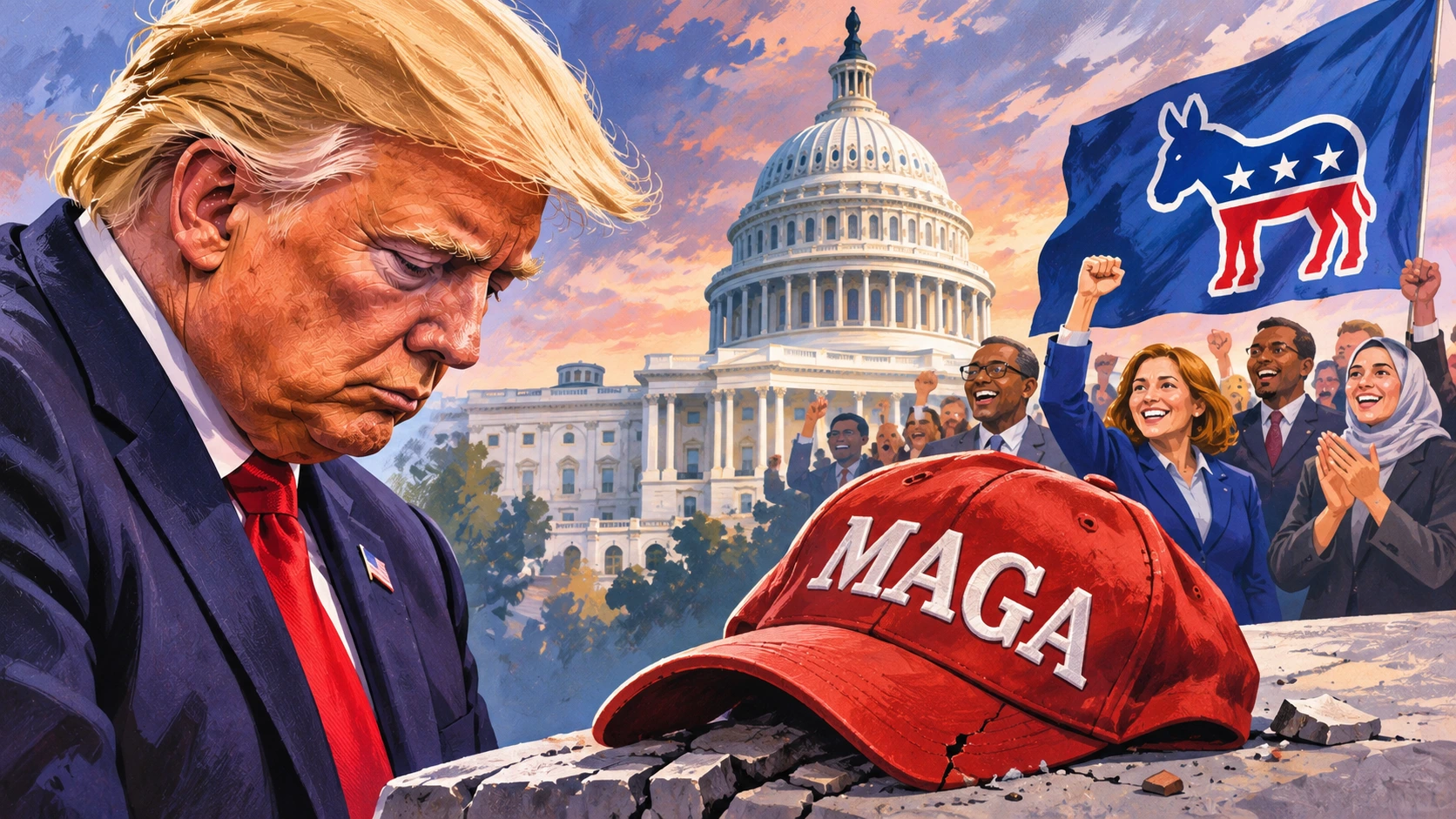
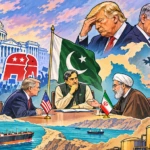
The November 3 midterm election defeat of Donald Trump and the Republicans was driven significantly by economic strain and public opposition to the war with Iran. The military action against Iran disrupted…
AI Analysis
American politics has witnessed a remarkable reversal. A president who returned to the White House promising to restore American greatness, challenge Washington’s political establishment and keep the United States out of unnecessary foreign wars has suffered a sweeping electoral setback. In the November 3 midterm elections, Democrats captured control of both chambers of Congress, delivering a powerful rebuke to Donald Trump and his Republican Party. The defeat extended beyond conventional political battlegrounds, reaching traditionally Republican territory and exposing weaknesses in the coalition that had brought Trump back to power.
The political significance of this result extends far beyond the loss of congressional seats. It reflects a growing disconnect between Trump’s political promises and the everyday economic realities of American households. Inflation, the rising cost of living, concerns about corruption, pressure on democratic institutions and the war with Iran combined to undermine the administration’s credibility. The Republican defeat, therefore, should be understood not simply as a victory for Democrats but as a warning about the limits of presidential power in a political system built around institutional checks and electoral accountability.
The Democrats have won an opportunity, not an unconditional public endorsement. Their responsibility is to translate electoral success into tangible improvements in ordinary Americans’ lives.
The most striking illustration came from Texas, where Democrat James Talarico defeated Trump-backed Republican Ken Paxton in a historic Senate victory. The broader results were equally consequential. Democrats regained control of both the Senate and House of Representatives, reversing the congressional advantage Republicans had enjoyed after the 2024 election. This leaves Trump with two years of his presidency in which the legislative branch will no longer operate as a reliable extension of his political agenda. The White House remains Republican, but Washington’s balance of power has changed. The roots of this reversal, however, lie in the economy.
In 2024, Trump successfully mobilised public frustration with the Biden administration’s economic record. Rising food prices, housing costs, healthcare expenses and the broader cost of living had created a sense of insecurity among millions of Americans. Trump presented himself as a businessman capable of restoring purchasing power and delivering immediate economic relief. His message resonated with working-class voters, younger men and sections of the Hispanic electorate that had traditionally leaned towards Democrats.
Two years later, that economic promise became a political liability. This exposes a fundamental weakness in the political language of economic success. Governments frequently point to stock market performance, corporate profits and national economic growth as evidence of prosperity. Yet these indicators do not necessarily reflect the experience of ordinary households. For millions of Americans, economic security is measured through rent payments, grocery bills, fuel prices, healthcare and the ability to save for the future. When these pressures persist, political promises lose their credibility regardless of how confidently they are presented. The Iran war intensified this contradiction.
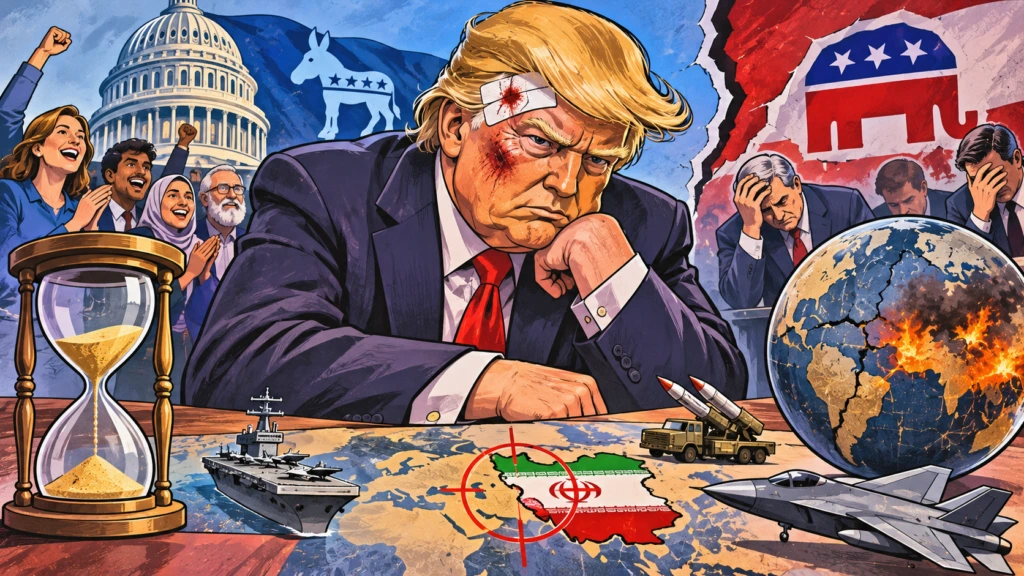
Trump built a significant part of his political identity around the promise of ending America’s involvement in costly foreign conflicts. His America First message appealed to voters who believed that Washington had spent too much money and political capital on overseas military interventions while neglecting domestic priorities. Yet military action against Iran placed his administration in direct tension with that promise.
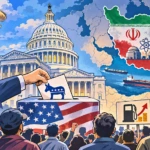
The consequences were not confined to the battlefield. The confrontation threatened energy supplies, disrupted confidence in regional stability and increased uncertainty surrounding the Strait of Hormuz, one of the world’s most strategically important oil transit routes. Any prolonged disruption in this corridor carries implications for international energy markets and global trade. For American consumers already struggling with high living costs, the prospect of higher fuel prices became another reminder that decisions made in Washington could have immediate consequences for household finances. The war was not the electorate’s dominant concern; the cost of living mattered more.
Iran thus became more than a foreign policy issue. It became a symbol of the distance between Trump’s electoral promises and governing choices. A president who had promised to prioritise domestic economic security was now associated with a military confrontation carrying financial and geopolitical risks. The war did not independently produce the Republican defeat, but it reinforced the perception that the administration had lost sight of the priorities that had originally brought it to power.
The Republican setback also reflects a wider debate about the concentration of executive power. Since returning to office, Trump has pursued an aggressive restructuring of federal institutions, removed government employees, challenged established administrative practices and exerted pressure on universities and major technology companies. Trump supporters regard these actions as an attempt to confront an entrenched bureaucracy. Critics, however, see them as part of a broader effort to weaken institutional independence and concentrate authority around the presidency.
The election results suggest that a substantial section of the electorate wants Congress to exercise stronger oversight. The Associated Press Voter Poll found that roughly seven in ten voters believed Congress was not doing enough to check presidential power. This is an important constitutional message. American democracy does not rest exclusively on presidential elections; it also depends on the distribution of authority between the executive, legislature and judiciary.
The return of Democratic control over Congress will consequently have practical implications. Congressional committees can investigate executive decisions, demand documents, summon officials and scrutinise government spending. The administration’s handling of the Iran war, military expenditure, federal dismissals and potential conflicts of interest could become subjects of intensified oversight. Democrats may also attempt to block legislation, challenge budget proposals and scrutinise presidential nominations.
Impeachment is another possibility, particularly if investigations produce substantial evidence of constitutional wrongdoing. However, control of the House alone cannot remove a president. Impeachment requires a majority vote in the House, while conviction and removal require a two-thirds majority in the Senate. Trump also retains presidential veto powers and his constitutional authority as commander-in-chief. The new Congress can constrain his political agenda, but it cannot automatically terminate his presidency or eliminate his military powers.
There is, however, a deeper economic question that the Democratic victory does not resolve: has corporate America lost its political influence?
This presents Democrats with a difficult challenge. Opposition to Trump may have united voters, but it is not a comprehensive economic programme. Their credibility will ultimately depend on whether they can address housing costs, healthcare, educational debt, employment insecurity and economic inequality. Otherwise, the political dissatisfaction that weakened Republicans could eventually turn against Democrats as well.
The defeat also opens a new chapter in Republican politics. Trump cannot constitutionally seek a third elected presidential term under the Twenty-Second Amendment. His presidency ends in 2029, and the struggle over who inherits his political movement is already becoming more consequential. Vice President JD Vance, Secretary of State Marco Rubio and other Republican figures will face a difficult balancing act: retaining the support of Trump’s MAGA constituency while demonstrating that they can build an electoral coalition beyond his personal leadership.
For America’s international partners, the consequences will be equally significant. Middle Eastern allies will have to consider the domestic political constraints facing Washington, while European governments will closely monitor the impact of congressional opposition on Trump’s policies towards NATO, Ukraine and trade. China, meanwhile, should not assume that Democratic control will fundamentally reverse American strategic competition with Beijing. Bipartisan concerns about China’s economic and geopolitical influence remain deeply embedded in Washington.
Ultimately, the 2026 midterms were not simply a referendum on Donald Trump. They exposed the contradictions of a political project that promised economic relief, national restraint and institutional renewal but increasingly became associated with expensive foreign conflict, persistent household pressures and the concentration of executive authority.
Trump remains president, and his political movement retains considerable influence. Yet his ability to govern without meaningful congressional resistance has ended. The Democrats have won an opportunity, not an unconditional public endorsement. Their responsibility is to translate electoral success into tangible improvements in ordinary Americans’ lives.
Iran may have helped sink Trump’s political fortunes, but the deeper lesson is about the relationship between power and public trust. No president, however wealthy, influential or politically dominant, can indefinitely substitute personal authority for economic performance and institutional accountability. America’s voters have reminded Washington that the presidency is powerful, but it is not absolute.
About the Author

Akmal Soomro
Akmal Soomro is identified here as an author. No further biographical information about his background or works has been provided.
Profile and all publicationsHow to Cite This Article
Soomro, Akmal. “Trump’s MAGA Politics Defeated in Midterm Elections.” Iqbal Forum, November 5, 2026. https://iqbalforum.org/en/?p=54182.



Comments